


I’m going to tell you a story. It’s not the most important story in the world. Nobody got hurt. No laws were broken. But it’s revealing—about how information moves, who gets credit, and what happens to small writers who do the work that big creator monetize.
On September 26, 2025, I published a piece called “This Is American Fascism!” about an extraordinary U.S. War Department training pamphlet from March 24, 1945—”Army Talk 64: FASCISM!” I walked through the whole thing. How it warned that a native fascist movement could rise here. How it laid out exactly what that would sound like, how it would take root, the tactics it would use. I held it up against today and said: this is us. Right now.
It did fine by small-writer standards. 48 likes. 32 restacks. I was proud of it. Life went on.
Then on January 8, 2026, historian Heather Cox Richardson did a live video about fascism. She was emphatic—”Recognizing this administration as fascist is now imperative.” I was genuinely excited. Here was someone with an enormous creator saying what needed to be said.
But then she pulled back. Twice. She told her audience she wouldn’t “go down that rabbit hole.” She said explicitly: “I’m not going to go any further into fascism.” No “stay tuned.” No “I have something coming on this.” Just—I’m not going there.
I’d already gone there. Four months earlier. Using that exact pamphlet.
So that night, I did something a little delusional. I sent her a DM. Pointed her directly to the source. Maybe it would help, probably it would disappear into a sea of messages—but what’s the harm in trying?
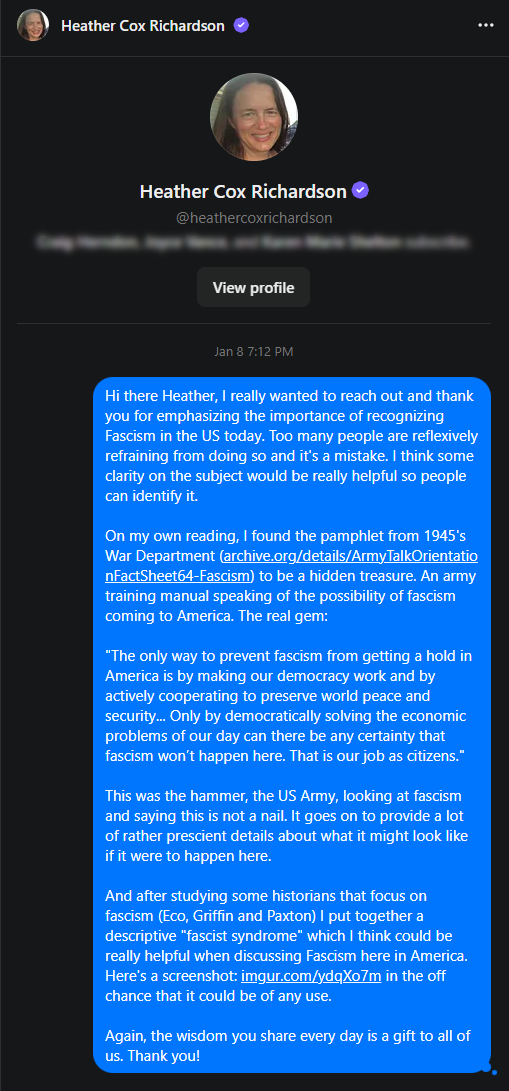
The next day—January 9, 2026—she published a Letter from an American built around that same pamphlet. 11,991 likes. 2,789 restacks. As of mid-February, it’s her #2 most-liked letter of 2026 and her #1 most-restacked—her strongest overall performer of the year by a wide margin.
I’ll be honest—it was bittersweet. The pamphlet was finally getting the audience it deserved, and that genuinely mattered. But watching something you surfaced explode under someone else’s name—with no mention of how it got there—stings. Anyone who’s ever done the work and watched someone else take the bow knows the feeling.
Ten days later, on January 19th, I followed up. Politely. Directly. I identified myself, linked my piece, and asked—if the DM had helped surface it or saved her time—whether she’d consider a brief hat-tip or mention.
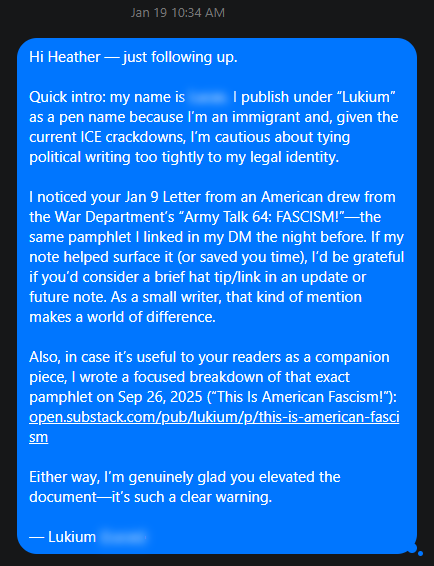
That was nearly a month ago. Nothing.
Now—could this be coincidence? Sure. It’s possible. Historians collect sources. Maybe she had the pamphlet queued up for months and my DM landed at the exact right moment by pure chance. I can’t see inside her research process, and I won’t pretend I can.
But I’m not arguing intent. I’m arguing outcome.
Here’s what I can see: On camera, hours before my DM, she told her audience—twice—that she was not going to go further into fascism. She gave no public indication that she had a deep dive on a 1945 War Department pamphlet ready to publish the next morning. Then I sent her that pamphlet. Then she published on that pamphlet. Then I asked for a mention. Then—silence.
Whether it’s coincidence or not, the mechanism is the same: the credit trail breaks.
Same primary source. Same warning. Same pamphlet. 48 likes versus 11,991. And the person who may have handed it to her? Invisible.
But this piece isn't really about Heather Cox Richardson. It's about the system—because this is how it usually works, even though it doesn't have to. Thom Hartmann's team has quoted directly from my work and credited me consistently (see examples here). So yes: it’s possible. Which is the point. Attribution isn’t hard. It’s optional. And most big creators treat it as optional.
The Megaphone Problem
Here’s the demoralizing truth about the internet: it’s not a meritocracy of ideas. It’s an ecosystem of distribution. And distribution follows the people who already have it.
You can do real research. You can locate a primary source, write it up carefully, build a framework that makes it land. And you’ll reach a few hundred people—maybe a few thousand if you’re lucky. Then someone with a massive platform picks up the same source, reframes it, and reaches millions. That’s not a moral failure. It’s just how attention moves.
But it creates a problem that nobody talks about: the people who do the early digging become invisible. The source becomes “something I read in [big writer’s newsletter],” not “something a chain of smaller writers surfaced, contextualized, and explained.” The trail goes cold. The small writer stays small. The big creator absorbs the credit like it absorbs everything else.
This isn’t unique to my story. It happens constantly. Every small creator has a version of this. The research, the framing, the original synthesis—that labor just disappears into the content supply chain.
Why This Matters Beyond Ego
I know what you might be thinking: this sounds like a writer complaining about not getting credit. And honestly? Partly. I’m human. It stings.
But there’s something bigger here. When big creators don’t link down the chain, they don’t just hurt individual creators—they starve the ecosystem that feeds them. Because here’s the thing: someone has to do the digging. Someone has to find the primary sources, read the 80-year-old pamphlets, build the frameworks that make them relevant today. That work often happens in the margins—small writers, independent researchers, people doing the unglamorous labor of synthesis.
If those people can’t build an audience—because the creators above them absorb their work without attribution—eventually they stop doing the work. And then there’s nothing left to absorb.
A single hat-tip or link can be the difference between a small writer staying stuck in place and a small writer gaining enough momentum to keep going. It costs the big writer nothing. It can mean everything to the small one.
What Would Fix This
Here’s the norm I wish existed:
Cite the primary source. Always. That’s baseline.
If someone surfaced it for you, mention them. A hat-tip. A “reader [name] pointed me to this.” It takes ten seconds.
If there’s a strong earlier explainer, link it. Give your readers the depth. They’ll thank you for it.
Here’s the plug-and-play version:
“A reader, [Name], pointed me to ‘Army Talk 64: FASCISM!’—here’s their breakdown, and here’s the primary source.”
This isn’t about entitlement. It’s about keeping the information ecosystem alive. The work of finding, contextualizing, and framing ideas is labor—and we’re going to need a lot more of it in the years ahead. If the people doing that labor remain invisible, they’ll stop doing it. Simple as that.
What You Can Do
If any of this resonates, here are things that actually matter—small actions that have outsized impact for independent writers:
Restack and share pieces you value. Algorithms reward engagement. Be the engagement.
When you share a big writer’s post, add a small-writer link alongside it. “Loved this from [big writer], and here’s a deeper dive from [small writer].” That’s how you build a chain.
Subscribe to writers who are still building. Not just the ones with millions of followers. The ones doing the work in the margins.
If you can afford it, paid subscriptions are research grants. That’s not hyperbole. For small writers, a paid subscriber is the difference between doing this work and having to stop.
That’s the unglamorous infrastructure of an informed public. Nobody’s going to build it for us.
Link down. Name your sources. If someone saved you time, say so.
The original breakdown I published in September is here: This Is American Fascism! — the one that started all of this.
This Is American Fascism!

There is a word the current administration does not want you to use. They have threatened those who say it out loud. That word is fascism.
To be honest, my goal isn't to create a rift between any of my readers and HCR. She is very knowledgeable and there is much that people can learn from her. I sincerely don't want folks to feel like they have to take sides in this situation. The really important thing is just for people to realize that stuff like this does happen, as unfortunate as it may be.
Surprising since HCR goes out of her way to credit reporter's names in her column Point well taken
Fascist Takeover: Taxation Without Representation
This is what independent journalism should look like https://bit.ly/4kCRkxy Yes there are daily news events that need to be covered but deep thought about what underlies our current national predicament is sorely required if WE the People are able to manage our way out of this historically created institutional hellscape that WE live in today
As intimated America is now engaged in a fascistic civil war created by the constitutional flaws of our institutions Judicial bandaids are not enough even though right now it is what is keeping the fascists from being completely successful But there needs to be some deep thinking by the DNC to make some major institutional demands to help restructure the country's guardrails and insist on taxation with representation This type of planning requires a long range strategy not just a 1y plan to win the next election but a 5, 10, and even a 20y plan as to how to rectify the current problems facing the country
The Solution: It's up to WE the People in the end as constitutionally mandated WE need to demand more of our elected federal officials because with slim majorities it leaves no conscious will to make radical changes WE are the ones to collectively demand the much needed structural changes cited But it appears the attempted fascist takeover has become the breaking point and possibly the beginning of the end ot taxation without representation
For light heartedness see https://bit.ly/4rNmJiW