


A word first: this part is optional, and it is not for everyone who read the series. The four essays made the whole case; if they persuaded you, you have lost nothing by stopping here. This appendix is for one particular reader — the one who reached Part One, watched me invoke Gödel and Tarski and Turing to talk about a constitution, and felt something tighten. The one with enough mathematics in them to know that Gödel's theorem is about arithmetic, and that people who wave it at politics are usually selling something. That suspicion is healthy, it is mostly right, and it deserves a real answer instead of a wave of the hand. Here is the answer.
So let me say at the outset exactly what I will and will not try to do, because the whole value is in how little it claims. I will not prove that constitutional law is arithmetic, or that the Constitution is a formal system, or that Gödel's theorem — unaltered — applies to the Fourteenth Amendment. None of that is true. What I will show is narrower, and far harder to wave off: that what was done to Section 3 is a genuine witness to the same diagonal structure Gödel belongs to — the one behind Cantor, Tarski, and Turing too. A witness to the structure, not an application of Gödel's theorem. That structure was never the private property of arithmetic in the first place. The theorem is mathematical. The wound it exposes is structural. Everything that follows is the slow walk from the one to the other.
If you skip it, you skip a proof, not a premise: the series stands without it. If you read it, you will have the formal floor under everything the four essays asked you to believe.
§1 · The same move in many costumes
In 1969 the mathematician F. William Lawvere proved something that should have traveled further than it did: that a whole shelf of the twentieth century's most famous impossibility results — Cantor's, Gödel's, Tarski's, Turing's — are not cousins but the same theorem wearing different clothes. Decades later Noson Yanofsky wrote the plain-language version, stripping the categorical machinery down to sets and functions.1 Pull any one of these results apart and the identical skeleton is lying underneath.
Here is that skeleton, in about as little notation as it can survive on. Take a collection of things a system can form — call it T — and a collection of answers it can hand back — call it Y. The system can evaluate one of its things against another:
eval : T × T → Y eval(t, x) = the answer that thing t returns about thing xA thing t names an evaluator g : T → Y when, fed any input x, it gives back g‘s answer — eval(t, x) = g(x). And call the evaluation universal when every evaluator g : T → Y is named by some thing already inside T: nothing about the system’s own answer-giving escapes being captured within it. (Lawvere’s exact term is point-surjective. I deliberately avoid the word complete here — it has a different, specific job in logic, and we will want it clean when Gödel’s incompleteness arrives later.)
Now add the single ingredient that turns this into a wall. Pick an operation on the answers that never sits still — a map α : Y → Y with no fixed point, no value it leaves unchanged. Negation is the usual one: not-true ≠ true, and not-false ≠ false.
Lawvere’s theorem, with the mirror that does all the work:
If eval is universal,  then every α : Y → Y has a fixed point.
So, in reverse:  if some α has NO fixed point,  then eval cannot be universal.
The proof is one line — the diagonal. Build the evaluator that turns each thing on itself and flips the answer:
d(t) = α( eval(t, t) )If the evaluation were universal, some thing t₀ would have to name d. But then, feeding t₀ to itself:
eval(t₀, t₀) = d(t₀) = α( eval(t₀, t₀) )— which says the answer eval(t₀, t₀) is one that α leaves unchanged. And α changes everything. Contradiction. So d is the one evaluator no thing inside the system can name. A system rich enough to evaluate itself, met with an answer-flip that has no fixed point, must always leave something it cannot place.
That single sentence is every result on the shelf — the same body, different costumes:
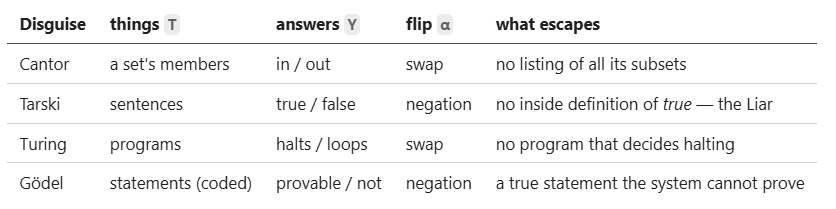
None of this is about numbers, or programs, or sets as such. It is about self-evaluation plus an answer the system cannot stabilize. The arithmetic in Gödel, the strings in Turing, the sets in Cantor — those are just the local material in which the one structure happened to get caught. That is the whole reason it can be lifted out of any single field: the limit was never in the material. It was in the shape.
One fold to pocket for much later. Tarski's flip lands a flat contradiction — so the truth-evaluator simply cannot exist inside the language at all.2 Gödel's is gentler, because his "provable" can be named in only one direction; instead of exploding, his diagonal sentence merely escapes — neither proved nor refuted.3 Same skeleton; two different ways for a system to fail to close — by blowing up, or by springing a leak. Which way a system fails will turn out to decide exactly what we are, and are not, allowed to say about law.
§2 · The shape behind the costumes
If those four results are one theorem in four costumes, then the costumes come off, and something is standing underneath wearing them. Let me take them off and describe what is left — because what is left is the only thing that decides whether anything outside mathematics can be made to wear the same clothes.
Stripped to the bone, the diagonal asks for exactly four things and refuses to run on fewer:
Objects. A supply of things the system can form — and, the part that matters, things that can stand in for the system’s own evaluators. Call them
E— §1’sT, relettered (along withVfor §1’sY, below) now that we are naming the general structure rather than its instances. This is the self-reference ingredient: not merely that the system has parts, but that a part can represent how the system evaluates.Answers. A collection of answers the system can hand back —
V.Self-evaluation. A way to turn one object on another and read off an answer:
eval : E × E → V. The dangerous case iseval(t, t)— an object turned on itself.A flip with nowhere to rest. An operation
α : V → Von the answers with no fixed point — some flat reversal the answer-space cannot absorb.
Notice what is not on the list. No numbers. No arithmetic. No proof-checker, no recursion, no mechanical procedure for deciding which moves are legal. The diagonal never asked for any of it. Those were the local materials Gödel needed to catch the structure inside arithmetic — the blackboard, not the proof. The structure itself wants only objects, answers, self-evaluation, and a flip. That is precisely why it was always going to be portable: there is nothing arithmetical inside it to leave behind.
Now the one ingredient that earns its own paragraph, because it is the easiest part of the whole structure to get backwards. Alongside the four, the diagonal carries a hypothesis — and it is tempting to read it as a capacity a system proudly possesses, a feature on the spec sheet. It is the opposite. The hypothesis is universality: the supposition that every evaluator the system has is named by some object inside E — that the system can, from within, fully represent how it evaluates. And the theorem's entire content is that this supposition fails. Given the other three ingredients, a fixed-point-free flip makes universality impossible. So the genus is defined by the very feature that dooms it: a self-internalizing system is one whose claim to contain all of its own evaluation cannot be made good.
Call that genus a self-internalizing system — anything that can turn its own evaluation back on itself, over an answer-space that admits a flat reversal. The theorem about the entire genus is a single sentence: no self-internalizing system can name all of its own evaluators from inside. It cannot be universal. For some question about itself, it must reach past its own edge.
The genus is narrower than it sounds, and the boundary is load-bearing — because in a moment we are going to try to enroll a new member, and the enrollment has to be earned, not waved through. Two conditions, and a system fails the genus if it misses either. It is out if its objects cannot stand for its own evaluators: a thermometer reads the room, never itself; a rulebook too thin to mention its own rules never reaches the diagonal. And it is out if its answers admit no fixed-point-free flip: if every operation on the answer-space has somewhere to rest, the diagonal turns up nothing that escapes. So the genus is emphatically not "anything self-referential." A mirror is self-referential and perfectly harmless. What arms self-reference is the flip — an answer the system can produce, aim back on itself, and then reverse, with nowhere left to stand.
There is the shape, stated without a single number in it: a system that can evaluate itself, over answers that admit a flat reversal, harbors a question about itself it cannot settle from within. Every wall in §1 is one instance. The only question left is whether there are instances that were never mathematics at all — and the first candidate, the one this whole series has been circling, is a constitutional order's defense of itself. Testing that enrollment is where the safe mathematics ends.
§3 · The corner where law judges itself
So we bring the candidate to the door and run §2’s test. Does a constitutional order — or some honest part of one — fit the genus? Map the four ingredients and see what answers back.
Objects,
E. The legal things: clauses, doctrines, judgments, certifications, votes, offices, the acts that make and unmake them. And — the ingredient the genus actually cares about — many of these objects stand for evaluators. A doctrine is not inert text; it is a rule for assigning a legal status to other legal objects. Only Congress may enforce this; this immunity shields that act; this clause does not reach that office — each is an object inEthat, applied to somex, returns an answer. The order is full of objects that are evaluations of the order.Answers,
V. In law the answers are validity statuses — valid or void, authorized or unauthorized, eligible or ineligible, binding or not. The operative pair is{valid, void}.Self-evaluation,
eval : E × E → V. A doctrine, an institution, a clause, applied to a legal object, returning its status. The dangerous case, exactly as in §2, is the diagonal one:eval(t, t)— a doctrine turned on the very order that authorizes it.The flip,
α. Strictly,αis not the institutional act of voiding but the status-reversal operator: it sendsvalid ↦ voidandvoid ↦ valid. Because it moves both values, it leaves none unchanged — it has no fixed point. (In the cases that will matter to us only the live half of that reversal ever shows its face — voiding, nonrecognition — because a usurpation claims validity and the counter-move denies it. But the operator itself is the two-way flip, and that two-wayness is exactly what makes it fixed-point-free.)
Two of these are not in dispute: law plainly forms objects, and it plainly hands down valid/void answers. What §2 made the genus turn on is the harder pair — whether the flip is genuinely fixed-point-free, and whether the objects stand for the order’s own evaluators. Run both in the open.
Does the answer-space admit a fixed-point-free flip? The status-reversal operator is one — it sends valid to void and void to valid, leaving nothing fixed. But here a careful reader plants a flag, and it is the sharpest objection in this section, so it earns a full answer and not an aside. Law is not two-valued at all, the objection runs. A ruling can be pending, stayed, appealable, binding-until-reversed, nonjusticiable; it can be procedurally final and substantively wrong at the same time. Where, in that fog, is the crisp valid/void the flip needs?
The answer is to separate two questions the objection has quietly fused. There is validity — what the constitutional order actually authorizes — and there is recognition — what some forum, at some moment, will say or enforce. Pending, stayed, nonjusticiable, binding-until-reversed are all states of recognition. They are the system managing the distance between when a thing is valid and when it is treated as such; they are not a third value wedged between valid and void. The mathematics has the identical texture, and we do not let it confuse us there: a proof still being checked is not "half-true," an operation applied outside its domain is not a refutation of two-valuedness, order-of-operations is process and not a third answer. So here: pending does not mean half-valid, binding-until-reversed does not mean constitutionally authorized, nonjusticiable does not mean valid — it means this forum will not say. Validity is one question; recognition is another. Hold the two apart and, for the authority-conferring status questions this appendix models — eligible or not, validly enacted or not, in office or not — the validity predicate underneath is two-valued: bivalent enough for the status-reversal to be fixed-point-free and for the diagonal to bite. We need no claim that all of law is two-valued; vague statutes, balancing tests, and standards of review are as graded as the objection says — they are simply not the flat constitutional status questions we modeled. Condition met — but mark it, because this is the single load-bearing premise of the whole appendix, the one place a determined skeptic can still step off the train. Everything downstream needs a fact of constitutional validity, two-valued, standing behind whatever a forum happens to recognize. The strict positivist denies exactly this: for him validity simply is recognition — if the last authoritative institution treats a thing as valid, then in law it is valid, with no further constitutional fact underneath. On that view he has not beaten the diagonal; he has starved it, dissolving the answer-space `V` before the flip can cross it. That is a coherent place to stand, and an honest reader should see it named.
It is also, on this project's terms, the jurisprudential form of surrender — and it fails for the same reason Part One's suicide-pact reading failed, one rung down. Run it out. If constitutional validity is nothing but final recognition, then no final institution can ever violate the Constitution in law; it can only redefine it. A captured court, once its answer is final, does not hand down an invalid result — it hands down law; its verdict is not wrong in the constitutional sense, only unpopular, or immoral, or resisted. Which means the Constitution no longer stands above the machinery it created: it becomes whatever that machinery last says it is. A Constitution that cannot bind its own final recognizers is not a higher law at all — it is an honorific name for the last successful act of power. That is not self-government; it is power wearing constitutional costume, and it is the one price this whole series was written to refuse. So we take the other premise, and say so plainly: recognition is not validity, finality is not closure, and a result can be final in fact while void in law.
(How that gap between validity and recognition eventually gets settled — by force, by acquiescence, by refusal — is a different and far deeper matter, and it is the whole of §5. Here we need only that the gap exists and that the verdict beneath it is two-valued. The settlement waits.)
Do the objects stand for the system’s own evaluators? Here a constitutional order is not an ordinary legal system but the unusual one — because it is the rare system that writes the rules for its own judging. It defines its own courts and what they may decide; its own amendment, and the price of amending; its own offices, and who may hold them; its own enforcement, and who must carry it out. The evaluators that assign constitutional validity are themselves constitutional objects. The clearest of these is judicial review — itself a derived power, the very authority Marbury claimed for the courts, yet turned to pronounce the order’s own acts valid or void.⁴ But it is one evaluator among several, never the only one: an immunity, a rule of jurisdiction or justiciability, a doctrine of finality — each is machinery the order derived that can turn back and judge the order. eval is the whole family; judicial review is only its plainest face. So eval(t, t) — a doctrine the order produced, turned back on the order that produced it — is not a category error here the way it is for a thermometer. It is the everyday traffic of constitutional law. Condition met — with one honest asterisk I will plant now and pay off next.
The asterisk: in arithmetic, “this object names that evaluator” is exact — Gödel built a mechanical code, a number for every formula, so that “talk about proof” became literal arithmetic. Law has no such code. A doctrine “stands for” an evaluator by what it does, read through interpretation, not by a numbering anyone could mechanically check. So the enrollment we are running yields a modeling claim, not a theorem. The diagonal is genuinely present in law — we will be holding the self-referential object in our hands in §6 — but we cannot claim the mechanical exactness that let Gödel turn the screw the last quarter-turn into proof. That ceiling is real, and naming it ourselves is the price of being allowed to make the argument at all. It is also the concession Part One already banked: property, not proof.
One last narrowing, because it matters and it cuts in our favor. We are not enrolling all of law. Most of it — torts, contracts, the ten thousand ordinary disputes — never turns on itself and never reaches the diagonal. The corner that does is the authority-conferring corner: officeholding, disqualification, amendment, certification, jurisdiction, enforcement — the places where law passes verdicts on the validity of law’s own machinery. And that corner is the most formal part of law there is. Section 3 is a flat status-bar with a numeric threshold — two-thirds of each House — about as close to an arithmetized condition as constitutional law ever comes. We are enrolling the Constitution exactly where it most resembles a formal system, not where it least does.
So the verdict, asterisk attached. In its authority-conferring corner, a constitutional order is best modeled as a self-internalizing validity system, now that V is {valid, void}. And on that model — if the enrollment holds — §2’s result applies: the system cannot be universal. It cannot, from inside, assign a settled validity to all of its own validity-questions — least of all to the sharpest one, whether its own doctrines have disabled its own defenses. That is “complete internal self-validation,” and on this model it is unavailable. Closure is forbidden — and now it is forbidden in law, not merely on a blackboard.
Which is precisely where a certain reader stops walking. A constitutional order is not a formal system at all — no recursion, no proof-checker, and it shrugs off contradictions that would detonate arithmetic on contact. So has the enrollment actually been earned, or only asserted? That objection is serious, it arrives in two distinct shapes, and answering both is the whole work of §4.
§4 · "But law is not a formal system"
There it is, said plainly — the objection a logician has been holding since §3 opened. Gödel's theorem is not a theorem about "systems." It is about formal systems meeting exact conditions: an effective axiomatization, enough arithmetic to encode themselves, consistency held against the threat of collapse. A constitutional order has none of these. No mechanical procedure decides what the law is; there is no numbering of statutes; and law tolerates flat contradiction every day without the sky falling. So whatever got enrolled in §3, it was not the kind of thing the theorem speaks to. That was a costume, not a membership.
It is the strongest objection in this appendix, and it is right about its facts. The reason it does not land is that it is two objections wearing one coat — and they fail for opposite reasons, which is why pulling them apart is the whole answer. Call them the machinery objection and the behavior objection.
The machinery objection says law lacks the apparatus the theorem runs on — the axiomatization, the arithmetic, the coding. Grant every fact of it. The apparatus it names belongs to Gödel's proof, not to the limit the proof found, and that is exactly what §1 and §2 were quietly building toward. Lawvere proved the diagonal with no arithmetic in it at all: no numbering, no recursion, no effective axiomatization, no demand that anything be "formal" in Gödel's sense. He needed only the bare structure §2 named — objects, answers, a self-evaluation that can be turned on itself, and a fixed-point-free flip. The arithmetic was never the engine. It was the bench Gödel happened to build the engine on, the one material rigorous enough to catch the structure red-handed in 1931. Take the bench away and the engine still turns. So the machinery objection attacks the preconditions of a proof we explicitly never use — property, not proof, exactly as Part One said.
One honest residue survives, and it is better said aloud than left for someone to find. Even stripped to Lawvere, the diagonal still needs one item off the machinery list: the naming relation — objects standing for the system's own evaluators. In arithmetic that naming is mechanical and exact; in law it is interpretive, read off what a doctrine does rather than computed from a code. That is the asterisk from §3, and it does not dissolve here — it is the ceiling. It is why ours is a modeling claim and not a theorem, and why we never pretend to turn the screw the last quarter-turn into proof. But look at what the objection has shrunk to: not "law is the wrong kind of thing," merely "law's naming is interpretive, not coded." That is a true and bounded concession — the one we volunteered first — and it leaves the enrollment standing. The diagonal needs naming; law has naming; the naming is soft. That is the whole of it.
The behavior objection is the deeper one, and it fails the other way — by being true in a manner that confirms the enrollment rather than breaking it. It runs: a formal system that ever produced a contradiction would explode — prove everything, mean nothing — so for it, consistency is life or death; law, by contrast, swallows contradiction and keeps walking. Therefore law cannot be the kind of system this limit binds.
Grant it completely — and then watch it turn over. A classical formal system meeting the diagonal has exactly two moves, and both are internal: blow up (inconsistency), or spring a leak (incompleteness — the question simply goes unanswered). Law has a third move neither of them has: it can produce an answer anyway. The barred man is seated, the case is closed, the country moves on. But ask the one question that flips the objection inside out — with what does law produce that answer, when its own validity logic could not? Not with a proof; there was none, the two-thirds was never paid. It produces the answer with force, with recognition, with compliance, with the brute institutional fact of a result nobody reverses. And not one of those belongs to the validity logic. Every one of them comes from outside it. So law's refusal to explode is not a sign the limit spares it. It is the sign that law pays the limit's price in a currency a formal system does not own — an external settlement, imported from beyond its own rules. The diagonal said a self-internalizing system must, for some question about itself, reach past its own edge. Watch law reach. The very behavior the objection points to is the reaching.
That is the answer in outline, and it is enough to leave the enrollment standing: the machinery objection collapses into the honest ceiling we already own, and the behavior objection collapses into the thesis itself. But the behavior answer has only been named here, not earned — because the instant you say "law settles from outside its own logic," three questions come due together. What exactly is the difference between settling a thing and validating it? Which of the two formal failures — the explosion or the leak — is law actually suffering? And who, in a self-governing order, is this "outside" that does the settling? Answering those three is §5 — where the word in this appendix's title finally has to mean something.
§5 · Finality is not closure
§4 ended on the claim that where its own logic runs out, law produces an answer from somewhere else. §5 makes that precise — and the precision is the whole of this appendix's title.
Validity, finality, and the gap between them. Law ordinarily settles by validity: the rules authorize a result, the result follows, and finality arrives with the validity, as its shadow. Nothing has to be supplied from outside, because the system has genuinely closed. Nearly all of legal life is this — which is exactly why the next distinction hides so well. Finality is not the same act as closure. To close is for the rules to license the result from inside; to be final is only for the contest to stop — the result accepted, enforced, left unreversed. While a result is valid the two coincide and the difference sleeps. The pathology begins the instant they come apart: when a result is final where validity is absent — settled in fact, forbidden in law. There the system has closed over nothing. It has merely been complied with, or refused, by hands standing outside the validity logic. That divergence — final but not valid — is the gap this appendix was built to name, and everything structural happens inside it.
The certifier that cannot exist. Here is that gap stated at full precision — the diagonal of §1, now run on law’s own validity. Suppose the order contained, inside itself, a universal validity-certifier: a doctrine Val that returns, for every legal act x, the true constitutional validity of x — valid or void. That is §2’s universality hypothesis in legal form: the Constitution can settle every one of its own validity-questions from within. Now form the diagonal act — the constitutional Liar:
A ≡ the act that is valid ⟺ Val(A) = voidIts validity is defined as the flip of the certifier’s verdict on it — d(t) = α( eval(t, t) ) wearing a robe. Put it to the certifier. If Val is faithful, then Val(A) simply is the true validity of A, so A valid ⟺ Val(A) = void ⟺ A void: the act is valid if and only if it is void. α has no fixed point; the equation has no solution. No faithful universal certifier can live inside the order.
And the way out that law seems to offer only moves the wound. Let the order shrug — A has no settled validity; it is nonjusticiable, pending, unripe. Then Val is simply undefined at A: not the universal certifier we supposed, but a partial one, holed exactly where the order turns on itself. Determinate, and the certifier collapses into contradiction; indeterminate, and it springs a leak. Both are the one verdict §2 forced — no complete internal self-validation. Law’s interpretive give chooses which failure it suffers; it cannot purchase closure. That — not a metaphor, not an analogy — is the formal floor. The rest of §5 only says what it means to live on it.
Fix where the people stand, because their position is double and the doubleness is the point. In the deep, constitutive sense they are the metalanguage always: the Constitution derives from them, so even a flawlessly valid result is, far upstream, theirs — validity is their authorship running on rails. But that role stays latent while the rails hold. They become the operative evaluator — the live settler — only in the gap, only when validity has gone missing and finality must come from somewhere or the system stalls. Ordinary closure keeps them upstream and invisible. Nonclosure pulls them down into the machine.
What the gap is, and what it can become. §1 left two ways a self-internalizing system can fail under the diagonal — by exploding, or by springing a leak — and said the choice would decide what we may claim about law. Law's case turns out to be subtler than either, and getting it exactly right is the hinge. The wound first appears as a leak — nonclosure — though not the kind where the answer is simply unknown. On the self-defense question — did our own doctrine disable our own defense? — the order's own machinery can produce two outputs. A faithful evaluator reaches the genuine verdict: void, by the parent-and-child principle, exactly as an honest court would on the evidence. A captured evaluator can decline that verdict and, wielding doctrines the order itself supplies, manufacture the opposite — letting the barred result through. The leak is not that the true answer cannot be found; a faithful evaluator finds it and says it aloud. The leak is that the order has no internal way to certify which of its own evaluators spoke faithfully and which turned the order against itself — for that certification is the self-referential question all over again, an evaluator set in judgment over the evaluators, and §2 forbids any internal one from rendering it without judging its own cause. So the order cannot, from inside, guarantee the genuine verdict prevails over the counterfeit. That is incompleteness — no internal certification of the order's own validators — and it is pointedly not inconsistency: the Constitution holds exactly one true answer here, void; it does not assert both. The counterfeit is a captured evaluator's handiwork, never the document at war with itself.
But nonclosure does not sit still — it is a doorway, and something is waiting in it. Let the constitutional community mistake finality for validity — obey the counterfeit as if the rules had licensed it — and the leak mutates into the second failure after all. Call it constitutional explosion. Not the logician's ex falso, where a single contradiction proves every proposition, but its legal cousin: the moment an invalid result is allowed to masquerade as valid, the parent-and-child hierarchy that orders the entire system gives way. A derived doctrine has overcome a parent clause and kept the winnings; a bare majority has done what the text priced at two-thirds; a refusal to enforce has been made to function as a lawful grant. And once that move is licensed once, it is available always — an order that can output a single result its own rules forbid can reach any of them by the same road. The hierarchy was the one thing making "derived" mean subordinate; let finality overwrite validity and the word goes hollow.
So the honest answer to incompleteness or explosion? is both, in order. Incompleteness is the wound — the order cannot certify, from within, which answer to the self-defense question is the faithful one. Explosion is what the wound becomes if invalid finality is obeyed as valid. The slogan survives — incompleteness, not inconsistency — but read it precisely: it names the Constitution's nature (nonclosing, not self-contradictory), while explosion names the danger that nature is exposed to. The Constitution does not detonate on its own. It detonates only when it is complied with in the wrong place.
Which of the two — and who decides. Whether the wound stays a contained leak or tips into collapse, the order cannot settle for itself. We have just seen why: from inside it cannot tell its own valid verdict from the counterfeit, so it has no non-circular authority to rule the counterfeit out. The decision has to come from the one place the order does not contain — and the only available outside is the one already named. Not another court, which sits inside the order as one more derived evaluator; not any organ the order constitutes; the people, the order's metalanguage. And in their hands the two outcomes are not the symmetric pair they first seem. Compliance lets the counterfeit pass — finality in validity's coat — and tips the leak into collapse. Refusal prises the two apart — this is final in fact and void in law, and we will not treat the one as the other — and holds the wound where it was, the hierarchy intact. The people are the source of validity either way; but here, this once, the gap forces into the open the question the order cannot answer about itself: is what we are being asked to obey the genuine verdict, or a counterfeit in its coat? The structure can carry them to that question. It cannot answer it for them.
§6 · The witness, and the hand it needs
The predicament we ended on — an order that cannot, from inside, tell its own verdict from a counterfeit, and a people who must settle which it is — is not a new one. It is Tarski’s, exactly: the member of the family we began with whose whole subject is a system trying, and failing, to fix its own truth from within. What was done to Section 3 is the moment the constitutional “this sentence is false” breaks the surface. Keep the two roles apart, because the precision is the point. The evaluator at work here is judicial review — for this instance, the order’s self-evaluation eval, the derived power Marbury claimed for the courts, by which the Constitution pronounces its own acts valid or void. But be precise about what plays the Liar’s part, because §5 has just sharpened it. The constitutional Liar is not the Anderson maneuver itself; it is the object §5 built — the diagonal act valid iff the order’s own certifier voids it, the self-negation no internal Val can consistently place. That is the pure diagonal, d(t) = α( eval(t, t) ) in legal dress, and — granting bivalence — it is airtight. What Anderson supplies is the thing arithmetic never has to hunt for and law does: a witness. In arithmetic the diagonal lemma guarantees, for free, that the self-turning object is formable — Tarski needs no specimen, only the construction. Law has no such lemma, so an escape hatch stays open: perhaps the order simply never turns on itself, and a universal certifier is safe after all. Anderson slams it shut. It is the order’s own machinery — a doctrine drawing its entire authority from the constitutional order — turned back to pass a validity-verdict on that order’s own self-defense, Section 3, and producing the very split the diagonal predicts: a faithful reading, void, and a captured one, valid, with no internal certifier to rule between them.⁵ The child presupposed the parent in the act of killing it, and the order reached, in open court, exactly the wall §5 said it must. So hold the discipline the series has kept throughout, and sharpen it: witness, not wound — and witness, not construction. Anderson is not the incompleteness, and it is not the Liar; it is the standing proof that the Liar’s family lives in the law and gets exploited — the empirical specimen that stands in for the lemma law does not have. Precisely as Tarski’s Liar was never the undefinability theorem, only the sentence that forces it into view. Same role. And the same exit: the Liar dissolves the instant you accept that truth lives in a metalanguage standing above the sentence, and the constitutional Liar dissolves the instant a people accepts that final validity lives with them, standing above the order. That is why this appendix ends where the series ended. The mathematics was the long way around to a thing Part Four already knew.
Be exact, then, about the ledger — because it is smaller, and harder, than the usual hedge. What is airtight: the certifier-diagonal itself. Grant one premise — that constitutional validity is a two-valued fact, not merely what some forum recognizes, the premise §3 planted and flagged as load-bearing — and it follows with no softness at all that the order can hold no complete internal validity-certifier. That is not a metaphor and not an analogy; it is the Lawvere diagonal run on {valid, void}, the same move that closes Cantor, Tarski, Turing, and Gödel, in constitutional dress. What everything rests on: that one premise. Deny bivalence — hold, with the strict positivist, that validity simply is recognition with no fact beneath it — and the answer-space V collapses and the flip has nothing to cross; the construction is not refuted but starved. So the honest fault line was never math versus law. It is realism about validity, and we stand on it in the open, because the alternative surrenders the whole series before it starts. And the one genuine residue, narrower than the old worry and worth stating precisely: the abstract Liar — valid iff the certifier voids it — is a clean self-negation, but any real object we point to as its witness may wear a milder self-reference — a self-affirming finality clause (a Truth-teller, which merely goes indeterminate) or a derived doctrine sawing its own branch (a pragmatic self-refutation that rhymes with the diagonal without being one). Each of those still delivers the incompleteness; not each delivers the exact self-negating form. That seam — between the airtight abstract diagonal and the interpretive fit of any single real witness — is the whole of what we cannot mechanize away. And it is, fittingly, an instance of this appendix’s own claim: a structure certain beyond doubt, whose every particular instancing the order cannot certify from within. Property, not proof — but now we can name exactly which property, and exactly where the proof stops.⁶ A logician who throws the analogy out entirely can still grant the one premise, walk every legal step, and arrive exactly here.
So return, one last time, to the cold morning this all began — December 5, 1947, the road to Trenton, a logician who had found, he said, a way the republic could be turned lawfully into its own opposite, and who carried the flaw to his grave without ever writing it down.4 We said at the outset we would never know what he saw, and we still don't; we have not spent one step of this borrowing his authority for our candidate, and we will not start now. Method, not mind. But permit a single observation that costs nothing and ought to weigh something. The man who looked at the Constitution and found a built-in, self-destroying flaw was no tourist. He was the mind of the century on self-reference — the one person then alive most exactly tuned to notice the precise kind of crack this appendix has spent itself describing. A structural engineer walks into a building and sees the load path a thousand others stroll past. That Gödel, of all people, found this kind of flaw in this kind of system proves nothing — but it is the opposite of nothing, and the skeptic tempted to wave off any link between incompleteness and constitutional law has to reckon with the inconvenient fact that the author of incompleteness drew the link himself, by finding the flaw. And the one clue we do have only sharpens it: the standard scholarly guess at what he saw is Article V — the amendment power amending the rules for its own amendment, a self-reference eating its own tail.5 The single piece of evidence on the record already points straight at our family.
And here, at the very end, is the half no proof could ever supply. Everything this appendix built leads to a structure that cannot move itself. The diagonal can show you the gap; it cannot close it. It can prove the order has no non-circular way to tell its own valid verdict from a counterfeit; it cannot tell you, from inside, which one you are holding. That last step was never going to be mechanical — because a self-enforcing cure would be the very closure these theorems forbid, and the cure cannot be the thing it proves impossible. So the cure is not a clause, and not a proof. It is a recognition and a refusal, and they belong to you. The counterfeit that wears validity's coat needs exactly one thing to harden into law: your compliance. Withhold it — see the coat for what it is, and decline to treat the void as valid — and the masquerade ends, because the only thing that ever held it up was everyone agreeing to be fooled. The metalanguage a Constitution reaches for when its own machinery turns against it is not a court, and not a chamber. It is the people. It is you.
Finality is not closure. Recognition is not validity. A robe is not a proof. A silence is not an amnesty. And a Constitution written for self-government cannot be read to require its own surrender.
That is the formal floor, laid as solidly as I know how to lay it. But a floor is only worth the weight you put on it — and the weight, this whole series has argued, is you: the people the cure cannot work without. We did not write four essays and an appendix only to prove where the wound is. We wrote them to put the tools of repair in your hands.
We built this publication to equip you with the tools to fight back—the frameworks, the messaging, the strategies that actually work. See the links below. But we can only keep doing this with your help. If this matters to you, please consider becoming a paid subscriber. You keep the fight alive.
Fighting Fascism: How We Charge Ahead and Win — The strategic playbook for reclaiming power
The Trump Regime Messaging Guide — How to talk to people who've been captured by the machine
The Freedom Illusion — How we got here, and the counter-ideology that gets us out
Article Sources:
F. William Lawvere, "Diagonal Arguments and Cartesian Closed Categories", 1969 (reprinted in Reprints in Theory and Applications of Categories, no. 15, 2006); and Noson S. Yanofsky, "A Universal Approach to Self-Referential Paradoxes, Incompleteness and Fixed Points", Bulletin of Symbolic Logic, 2003.
Together these are the formal backbone of the appendix's central claim — that Gödel, Tarski, Turing, Cantor, and Russell are not a loose family of analogies but instances of a single diagonal/fixed-point structure. Lawvere's 1969 paper proves the abstract fixed-point theorem, in cartesian closed categories, from which the whole family follows; Yanofsky's 2003 paper restates it in elementary set-and-function terms and works the unification explicitly across logic, computability, and formal-language theory. The appendix borrows Yanofsky's de-categorified presentation — the evaluation map, the universality hypothesis, the fixed-point-free flip, and the diagonal d(t) = α( eval(t, t) ) — more or less wholesale; the entire structural result, that no self-internalizing system can name all of its own evaluators from inside, is theirs, not ours. We rely on it to make "property, not proof" precise: the limit lives in the diagonal architecture, which needs no arithmetic, rather than in Gödel's particular arithmetization.
Wilfrid Hodges, "Tarski's Truth Definitions", Stanford Encyclopedia of Philosophy.
Tarski's undefinability theorem is the appendix's exact analogue for the legal case, so it carries unusual weight here. The entry sets out the result — that a sufficiently expressive language cannot contain its own truth predicate, and that defining truth for a language requires a richer metalanguage standing above it — together with the Liar sentence as the constructed object that forces it. That is the structure the appendix maps onto law: a captured court's attempt to make the order validate its own self-defense from within is the Tarski-forbidden internalization, and the exit — truth, here validity, living in a metalanguage that is the people — is the move §5 and §6 turn on. It is also why "Section 3 / Anderson is the witness, not the wound": the Liar is never the theorem, only the sentence that demonstrates it.
Panu Raatikainen, "Gödel's Incompleteness Theorems", Stanford Encyclopedia of Philosophy.
The appendix leans on the precise content of the first incompleteness theorem — the diagonalization (fixed-point) lemma, the provability predicate, and the construction of a sentence that is true but unprovable — and this entry supplies the authoritative statement. Two details do real work. First, the theorem's conditions (effective axiomatization, enough arithmetic to encode itself, consistency) belong to Gödel's proof, which is exactly why the appendix never claims the theorem applies to law. Second, the contrast between Gödel's "leak" (incompleteness, where the diagonal sentence escapes unproven) and Tarski's "explosion" (contradiction, where the predicate cannot exist at all) is the fork §5 uses to distinguish law's nonclosure from formal inconsistency, while explaining why Tarski supplies the closest analogue for the legal problem of internal self-validation. Both moves rest on the entry's account.
Oskar Morgenstern, "History of the Naturalization of Kurt Gödel", memorandum, September 13, 1971.
The appendix's closing returns to the December 1947 citizenship hearing, and this memorandum — set down by Morgenstern from memory more than two decades after the fact — is the sole contemporaneous record of the scene. It documents Gödel's conviction that he had found a lawful route by which the United States could become a dictatorship, his two witnesses (Einstein and Morgenstern), and the fact that he never wrote the flaw down. The appendix uses it for exactly what it supports and nothing more: that the discoverer of incompleteness, reading the Constitution, found a built-in self-destroying flaw — the "consider the source" observation — while scrupulously declining to claim any knowledge of what the flaw actually was. It is the same source that anchors the Trenton scene in Part One.
F. E. Guerra-Pujol, "Gödel's Loophole", Capital University Law Review 41 (2013): 637; see also F. E. Guerra-Pujol, "Gödel's Loophole: A Prequel", Southwestern Journal of International Law 30 (2024).
The appendix notes that the standard scholarly conjecture about what Gödel saw points at Article V, and these two articles are its canonical statement. In the 2013 piece Guerra-Pujol argues that the flaw lies in the amendment clause itself: because Article V supplies the procedure for amending the Constitution, it can be turned on itself — used to loosen or strip away the very limits that constrain amendment, opening a lawful path to entrenchment. Notably, Guerra-Pujol frames the flaw, as this appendix does, through self-reference — he makes self-reference the dividing line of a "Gödelian" constitutional defect, and illustrates it with the very sentence the appendix borrows for Section 3: "this sentence is false." The 2024 "Prequel" sharpens what makes that vulnerability self-referential — the recurring pattern, traced through the interwar European self-coups Gödel lived among, in which the same actor bound by a set of rules also holds the power to change those very rules. The appendix invokes the conjecture for one narrow purpose in its closing: the single piece of evidence on record about Gödel's flaw is itself a closure-type vulnerability — a rule for changing rules, turned against itself — exactly the family the appendix describes. It is offered as corroboration of the diagnosis, not as proof of what Gödel actually found.
This went straight to the hubs for his amusement. However, I thought you might like to know that I finally got "ReleaseTheTrumpsteinFiles" trending on Twitter! :)
A finite system including mathematics can never define infinity