


Oil hit $115 a barrel on March 9th.
Not because of a natural disaster. Not because of a supply chain accident. Because the United States government chose to go to war in the Middle East, and the Strait of Hormuz — the narrow chokepoint through which roughly 20% of the world's seaborne oil flows — effectively closed.1
The price has since pulled back to the low $80s as Trump said the war would end "very soon," and the International Energy Agency announced the largest strategic oil reserve release in its 52-year history — 400 million barrels, more than double the 182 million barrels released after Russia invaded Ukraine.2 The headlines moved on.
Don’t move on. Since then, oil prices have been climbing steadily, sitting around $90–95 as of the time of writing.
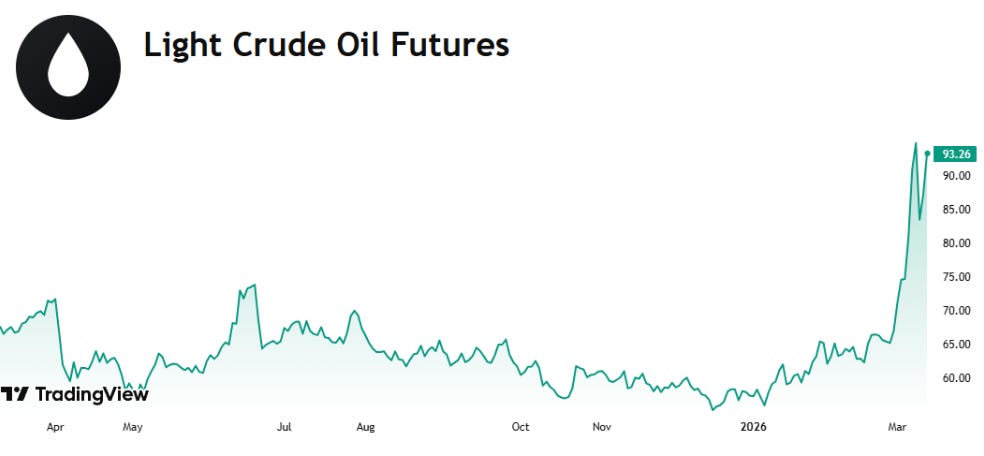
The oil spike is one of four simultaneous economic shocks hitting the American economy right now. Any one of them, in isolation, would be manageable with competent policy. None of them are being managed. All four are happening at once. And when you add them up, you get something that economists already have a name for — something the United States hasn't experienced since the 1970s.
We're going to walk through all four. Then we're going to do the math.
The War Tax
Let's call the Iran war what it is for American consumers: a tax. Every time you fill your tank, you're paying it. US fuel prices jumped 25 cents in a week, then another 25 cents over the weekend, averaging $3.44 a gallon by March 9th.3 That's before the war fully settles into global supply chains. Goldman Sachs estimated that three months of Strait of Hormuz disruption could send Brent crude to $185 a barrel.² The Royal Bank of Canada calculated that sustained $100 oil would push US inflation to 3.7%.³
Warren Hogan, economic adviser at Judo Bank, didn't mince words: "There's a good chance that we're seeing one of the most sudden increases in the cost of oil to the global economy ever."³
And Trump's response? "They had risen 'probably less than I thought they'd go up.'"¹
That is the policy response. A shrug. A brag. Nothing else.
The Deportation Fraud
Here's the promise: deport the immigrants, free up the jobs. American workers step in. Wages rise. Americans first.
Here's what actually happened.
The premise was always built on a broken model of how economies work. Labor isn't a fixed pool of slots where removing one person opens a vacancy for another. It's an interconnected system where labor input generates labor demand downstream. Destroy enough input nodes, and you don't redistribute work — you destroy the conditions for work to exist at all.
Take construction. You deport construction workers — but you also terrify the ones who remain. Fear is its own labor shock; you don't have to remove everyone to make people afraid to show up. So now you have less construction being done than the deportation numbers alone suggest. Contractors lose projects, some shut down. The native project manager at that contractor? His job just ceased to exist. The building materials supplier sees demand drop — layoffs in distribution. Less freight moving means less work for native truck drivers. Less truck traffic means less business for fuel stops and repair shops. And all of those newly unemployed native workers stop spending — which destroys demand somewhere else entirely.
None of those downstream native job losses show up in any model that asks: did a native worker fill the deported immigrant's specific job? The measurement frame is too narrow to capture the damage. And none of it accounts for the demand destruction on the other side — every deported worker was also a renter, a customer, a consumer. Remove them, and you shrink the market that native-owned businesses depended on to stay open.
The BLS data makes the verdict plain. As the foreign-born labor force shrank by 530,000 — and the foreign-born civilian population fell by 741,000, the deportation numbers hiding in plain sight — native-born labor force participation dropped. From 61.4% in February 2025 to 61.0% in February 2026.4 Native unemployment rose. Two million more native-born workers dropped out of the labor force entirely.
A January 2026 Brookings Institution analysis — authored by economists from both Brookings and the American Enterprise Institute — found that net migration turned negative in 2025 for the first time in at least half a century.5 "We estimate the sustainable pace of monthly job growth to be between 20,000 and 50,000 in late 2025," they wrote, "and believe it could be negative in 2026."⁵
It's now 2026. The February report shows -92,000.
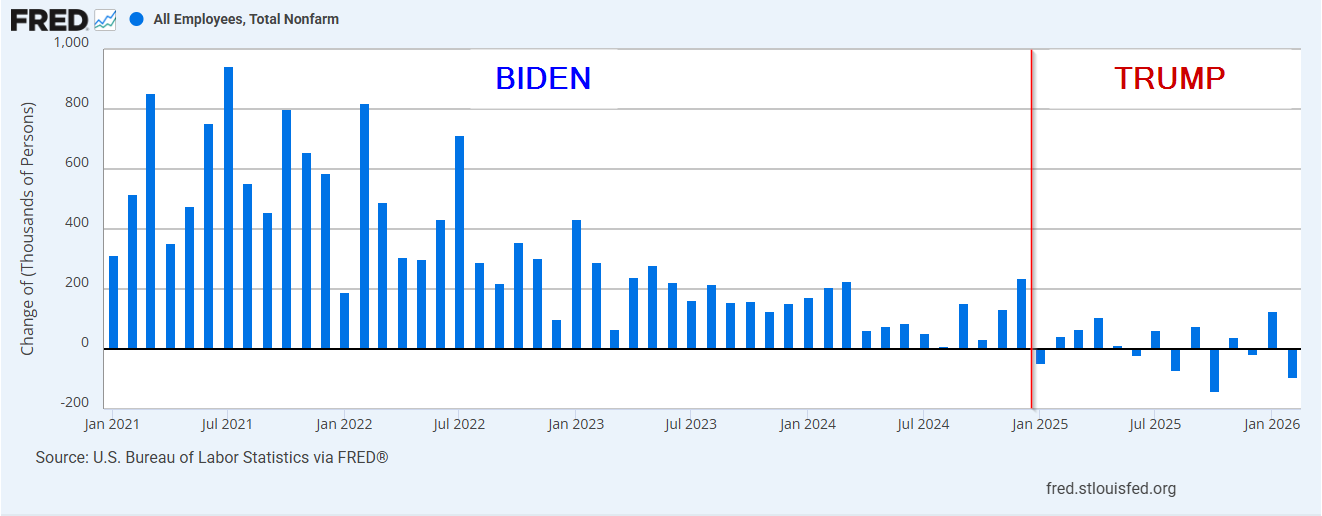
Economists had forecast a gain of 60,000. The miss: 152,000 jobs. And that's before the revisions — December was quietly revised down by 65,000, January by another 4,000. In total, 69,000 more jobs vanished from the record than we knew about. The federal workforce is down 330,000 jobs — an 11% drop — since October 2024. Manufacturing lost 12,000. Leisure and hospitality lost 27,000. Construction lost 11,000.6
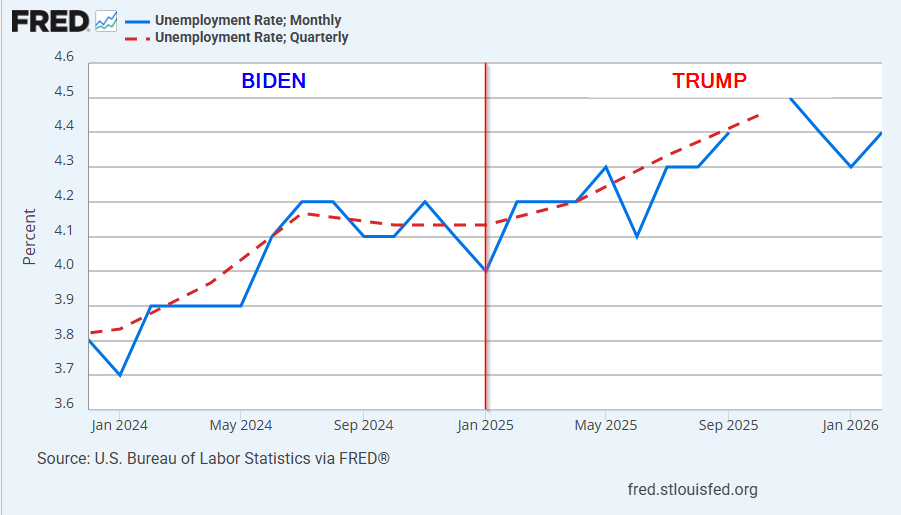
The deportation promise wasn't just wrong. It was a fraud built on a model that was never true. And this is what that fraud looks like in practice: an administration that terrorized the workforce that kept American industries running, gutted federal employment, disrupted global trade — and called it a boom. The February report isn't a blip. It's a verdict.
The Tariff Tax
You are paying the tariffs. Not China. Not Mexico. Not the foreign governments Trump insists are funding his trade war.
You.
The Federal Reserve Bank of New York studied the data.7 Their finding: nearly 90% of the economic burden of Trump's tariffs fell on US firms and consumers. The average US tariff rate jumped from under 3% to 13% in 2025. The Treasury Department collected $287 billion — up 192% from the prior year. Every dollar of that came out of American wallets.
The tariff isn't a negotiating lever. It isn't making American manufacturing competitive. It's a consumption tax on the American working class, imposed by a president who told them foreigners would pay it. They believed him. They're paying it anyway.
The Automation Extraction
The fourth shock is different. It doesn't have a villain you can easily name. The technology itself isn't the problem — in a system designed for human flourishing rather than extraction, AI could be liberation. Costs fall because machines do the work? Pass those savings to consumers. Workers displaced by automation? A share of the productivity gains funds the floor they land on. The math isn't complicated. The mechanism isn't mysterious. None of this is beyond us.
We've been here before. When manufacturing went overseas, the gains were real — cheaper goods, soaring corporate profits, record shareholder returns. The workers who built those companies got nothing. No dividend. No retraining that actually worked. No share of the windfall their displacement created. And we were told it was inevitable. It wasn't. It was a choice — made by people in rooms that workers weren't in, ratified by politicians whose priorities workers didn't shape, enforced by a system designed to ensure the gains flow up and the costs flow down.
The political consequence of that betrayal is sitting in the White House right now. Communities hollowed out by globalization didn't get a seat at the table. They got a demagogue who acknowledged their rage and had no intention of addressing its cause.
Now we're doing it again. In the first months of 2026, more than 9,200 tech jobs — roughly 20% of all tech layoffs — were explicitly attributed to AI automation.8 Block cut 4,000 jobs. eBay cut 800. Pinterest cut 15% of its workforce. These are not struggling companies. These are profitable companies replacing humans with machines and pocketing the difference.
And too much of the left's response is to protest the technology. To argue about whether AI should exist. To fight the container ship instead of demanding a seat at the table of the people who own it. That's the same mistake made with globalization — and it leads to the same place. The decisions get made without you. The gains get captured without you. And the people left behind eventually vote for whoever is loudest about their pain, regardless of whether he intends to do anything about it.
The problem was never the robots. It's the system that ensures the people who own the robots keep everything. And the political failure — across both parties, but especially from a left that should know better — to put people in power who would change that calculus.
The Math
Here's what's happening at the same time, right now:
Oil prices up → energy costs spike across every sector of the economy
Labor supply destroyed → deportations didn't free up jobs, they collapsed the production chains that created them
Tariffs → input costs up across manufacturing, retail, construction — passed directly to consumers
AI extraction → workers replaced by machines, productivity gains pocketed by shareholders, no floor for the displaced
Policy response → zero
Add it up. Rising prices across energy, goods, and services. Stagnating or contracting employment. No meaningful intervention from the government that caused it.
Economists already have a word for this. David Bassanese, chief economist at BetaShares, used it directly in the context of the Iran war: "If oil does stay above $100 a barrel and this disruption continues, then we may face a stagflationary moment in the first half of the year: weak growth, but central banks unable to do much about it because of the high level of inflation."³
The word is stagflation.
We've Seen This Before
In 1973, OPEC imposed an oil embargo on the United States. Oil prices quadrupled. Supply shocks rippled through an economy with few buffers and a government caught flat-footed. By 1974, inflation hit 12%. By 1975, unemployment peaked at 9%. GDP contracted 3.2% in the 1973–75 recession. By 1980, inflation peaked at 13.5% — and the Federal Reserve was forced to raise interest rates so aggressively that it triggered another recession to kill it.
That's the 1970s stagflation trap: the moment when the Fed faces a choice between fighting inflation and protecting jobs — and discovers it cannot do both. Raise rates, and you crush employment. Hold them, and prices spiral. There is no clean exit.
The parallel to 2026 is not rhetorical. It is structural. Then: an external oil shock the government didn't cause. Now: four simultaneous supply shocks the government did cause — through deliberate policy choices made in service of ideology, donor interests, and base mobilization, with no coherent plan for what came next.
The difference between 1973 and 2026 isn't the outcome. It's the culpability.
Where Is the Opposition?
We will name the primary driver plainly: the Trump administration built this. The war, the deportations, the tariffs, the gutting of any policy infrastructure that might buffer the AI transition — these are Trump's choices, Trump's ideology, Trump's donors' interests.
But let's be honest about the rest of it.
The Democratic Party is not sounding the alarm. Not about the individual shocks. Certainly not about the convergence. There is no coordinated messaging. No sustained floor strategy. No one holding daily press conferences naming these four forces and connecting them. If Mitch McConnell were in the minority facing a Democratic administration producing -92,000 jobs, $115 oil, and a 90% tariff pass-through to consumers, he would have turned Congress into a daily indictment. He would have made it impossible to change the channel.
Instead: silence. Or worse, carefully worded statements that treat each crisis as isolated, manageable, not quite worth the political risk of sustained fury.
That's not opposition. That's managed surrender.
The American people deserve better from both sides. They are not getting it from either. And we — the people — are the ones who will pay.
The Verdict
In the 1970s, Americans didn't know the trap was being sprung until they were already in it. Economists named it in retrospect.
We're naming it now, in real time, while there is still a window to understand what's happening and demand accountability for it.
Four forces. One destination. Zero response.
This is what stagflation looks like before it fully lands. This is what it looks like when a government makes itself the cause of the crisis and then shrugs at the consequences. This is what it looks like when the opposition goes quiet.
The question isn't whether the convergence is happening. The data says it is.
The question is what you do with that knowledge. Picket signs and protests didn't save workers from globalization. They won't save anyone from AI, or from stagflation, or from any of this. The only thing that changes the calculus is power — and power means people in office who answer to the people instead of shareholders.
Look around you for those willing to run. Support them. Elect them. And if you see nobody willing to step up, stop waiting for someone to rise. Become that person. Others will follow.
We built this publication to equip you with the tools to fight back—the frameworks, the messaging, the strategies that actually work. See the links below. But we can only keep doing this with your help. If this matters to you, please consider becoming a paid subscriber. You keep the fight alive.
Fighting Fascism: How We Charge Ahead and Win — The strategic playbook for reclaiming power
The Trump Regime Messaging Guide — How to talk to people who've been captured by the machine
The Freedom Illusion — How we got here, and the counter-ideology that gets us out
Article Sources:
Callum Jones and Alex Daniel, "Oil prices fall and stocks rebound after Trump says Iran war could end 'very soon'", The Guardian, March 10, 2026.
Covers the oil price spike to $119.50/barrel on March 9, 2026 — the highest since Russia's invasion of Ukraine — and the subsequent partial pullback after Trump described the Iran war as "very complete, pretty much." Documents Trump's dismissal of the spike ("probably less than I thought they'd go up"), Iran's threat to block all regional oil exports, and the broader market turmoil including sharp drops in Asian equity markets. Establishes both the severity of the spike and the administration's cavalier non-response, directly supporting the article's argument that this is a self-inflicted supply shock with no meaningful policy answer.
IEA (International Energy Agency), "IEA Member Countries to Carry Out Largest Ever Oil Stock Release Amid Market Disruptions From Middle East Conflict", IEA, March 11, 2026.
Official IEA announcement of the 400 million barrel emergency release — the largest collective action in the agency's 52-year history, more than double the 182 million barrels released after Russia's Ukraine invasion. IEA Executive Director Fatih Birol stated the challenges were "unprecedented in scale." Documents that the Strait of Hormuz disruption reduced export volumes to less than 10% of pre-conflict levels, with the strait normally carrying approximately 20 million barrels per day (25% of world seaborne oil trade). The unprecedented scale of the response underscores the severity of the crisis the Iran war created.
Luca Ittimani, "Why has the Iran war sparked fears of stagflation for the global economy?", The Guardian, March 9, 2026.
Comprehensive analysis drawing the explicit stagflation parallel, with data from the IMF, Royal Bank of Canada, Goldman Sachs, RSM, and Oxford Economics. Documents the consumer price impact (US fuel up 25 cents/week), projects US inflation at 3.7% if oil holds at $100/barrel, and includes direct quotes from economists invoking the 1970s comparison. David Bassanese of BetaShares states the situation resembles "those seen in the 1970s, when conflict in the Middle East resulted in surging prices and dragged advanced economies into persistent slumps" — a comparison that forms the historical frame of this article.
U.S. Bureau of Labor Statistics, "Table A-7. Employment status of the civilian population by nativity and sex, not seasonally adjusted", BLS Employment Situation Summary, March 6, 2026.
The official BLS monthly employment report broken down by nativity. Data for February 2026 versus February 2025 shows the foreign-born civilian labor force shrank by 530,000 and the foreign-born civilian population fell by 741,000 — the direct statistical signature of deportations. Simultaneously, native-born labor force participation fell from 61.4% to 61.0%, native unemployment rose from 4.4% to 4.7%, and 2 million more native-born workers dropped out of the labor force entirely. The data demolishes the premise that deporting immigrant workers frees up jobs for Americans — the opposite occurred.
Wendy Edelberg, Tara Watson, and Stan Veuger, "Macroeconomic Implications of Immigration Flows in 2025 and 2026: January 2026 Update", Brookings Institution, January 13, 2026.
Rigorously documents that net migration turned negative (-295,000 to -10,000) in 2025 for the first time in at least 50 years, with mass deportations reaching 310,000–315,000 removals. Critically, native-born labor force participation did not increase as deportations accelerated — the authors establish that "nearly all growth in the labor force has stemmed from immigration flows" in recent years. The sustainable pace of monthly job growth collapsed to 20,000–50,000 and could turn negative in 2026, with GDP reduced by 0.2–0.3 percentage points. This Brookings/AEI co-authored analysis — representing both center-left and center-right economic institutions — is the definitive data source for the article's argument that deportations destroyed the labor supply without creating replacement workers.
U.S. Bureau of Labor Statistics, "The Employment Situation — February 2026", Bureau of Labor Statistics, March 6, 2026.
Official BLS report showing nonfarm payrolls fell by 92,000 in February — the first net job loss since the pandemic — while unemployment rose to 4.4%. The report missed economist expectations of +60,000 by 152,000 jobs. Downward revisions to December (-65,000) and January (-4,000) add 69,000 more losses to the record. Federal government employment is down 330,000 (11%) since October 2024. Broad-based weakness across manufacturing, construction, leisure/hospitality, and the information sector documents the systemic nature of the employment collapse, directly supporting the article's argument about a failing economy under the current administration.
Megan Cerullo, "Nearly 90% of Trump's tariffs are being paid by U.S. businesses and consumers, Fed analysis finds", CBS News, February 18, 2026.
Reports on a Federal Reserve Bank of New York analysis showing that U.S. importers and consumers bore 86–94% of Trump's tariff costs throughout 2025, directly contradicting the administration's claim that foreign governments pay the tariffs. The average US tariff rate jumped from under 3% to 13%, and the Treasury collected $287 billion — up 192% from the prior year. Establishes the tariff as a regressive consumption tax on American households, supporting the article's framing of tariffs as a self-inflicted supply shock that raises prices without any compensating economic benefit.
TechNode Global Staff, "2026 Tech Layoffs Reach 45,000 in March — More Than 9,200 Due to AI and Automation", TechNode, March 9, 2026.
Documents 9,238 AI-attributed tech layoffs in 2026 through early March, representing 20% of all tech sector cuts. Includes explicit statements from major companies: Block CEO Jack Dorsey directly attributed 4,000 layoffs (40% of the company) to AI capability rather than financial pressure; eBay cited AI automation of core workflows; Pinterest announced an "AI-forward strategy" while cutting 15% of staff. RationalFX analyst Alan Cohen: "Even as companies post record revenues in 2026, the tech sector continues to be fundamentally reshaped by AI." Provides the named-company evidence that AI displacement is not theoretical — it is happening now, at scale, in profitable companies with explicit executive acknowledgment.
"It was a choice — made by people in rooms that workers weren't in, ratified by politicians workers didn't elect..." Do you perhaps mean politicians they DID elect, but captured by the extraction machine?
Billionaire Cheeto: Let Them Eat Cake
Nazi Republicans of the CNPP(Christian Nationalist Ped Party) have their party affiliations these days because they aren’t what one would call “conservatives” but a very wealthy group of people who want to preserve power over the American electorate
If a billionaire sees higher gas and grocery prices he simply gives more money to his kid’s nanny or people around him who take care of his daily needs If his chef faces more expenses at the store no big deal With oodles of cash why should he or his family be concerned?
But for a president of a country who should feel some responsibility to those who voted him into office and looks out for the welfare of his people Even if he’s a billionaire, it becomes a problem if he turns on the people he should be helping and says, “get over the high costs, no big deal” Today former slumlord Cheeto reportedly told Speaker Mike Johnson that “no one gives a shit about housing.” Such callousness and disregard for the poorest of his people is cruel and shows no respect for the people he promised when elected “no more wars” and “lower prices on day 1” all to stay out of jail
And yet this is where the American people find themselves with the Orange Cheeto WE the People deserve an end to lies and disrespect WE deserve better than this and WE’ll let him know in November