


Everyone in economics loves talking about the pie. Grow the pie. Stop fighting over slices. Create more wealth, and everyone can have more.
And whenever politicians, economists, and news coverage tell us whether that pie is growing, they reach for the same scoreboard: gross domestic product, or GDP.
GDP is useful. It measures the value of the goods and services produced inside the country, and its familiar expenditure formula adds consumption, investment, government purchases, and exports while subtracting imports.1 But GDP cannot tell us what that production leaves behind. It measures the activity of the current cycle—not the condition of the people and systems expected to produce the next one.
Imagine two societies with roughly the same GDP. In the first, workers borrow for college and healthcare. Rent, transportation, childcare, insurance, and debt payments consume nearly everything they earn. Their spending still becomes revenue for landlords, lenders, retailers, insurers, hospitals, and technology platforms, so the economy remains busy. But households leave the cycle with less freedom, less security, and more of their future income already committed.
In the second society, education and healthcare are broadly accessible without crushing debt. Reliable transportation, broadband, energy systems, and public research lower the cost of participation. Families retain enough time and money to retrain, move, start businesses, buy durable goods, or survive a failed experiment. Private companies still earn profits—but they sell to customers who can express preferences, not merely emergencies.
The two societies may report the same present. They do not possess the same future.
This is not a philosophical objection to measurement. The World Bank now tracks “comprehensive wealth” precisely because GDP alone cannot show whether current growth is accumulating or depleting the assets that make future growth possible. Those assets include roads, machinery, intellectual property, natural resources, and—most importantly—human capability. Human capital accounted for an estimated 60 percent of global wealth in 2020.2
That is the economic pie we should be thinking about: not only what a society produced this year, but its usable capacity to meet needs, create new value, withstand disruption, and expand what will be possible next year.
GDP is the receipt. It is not the kitchen.
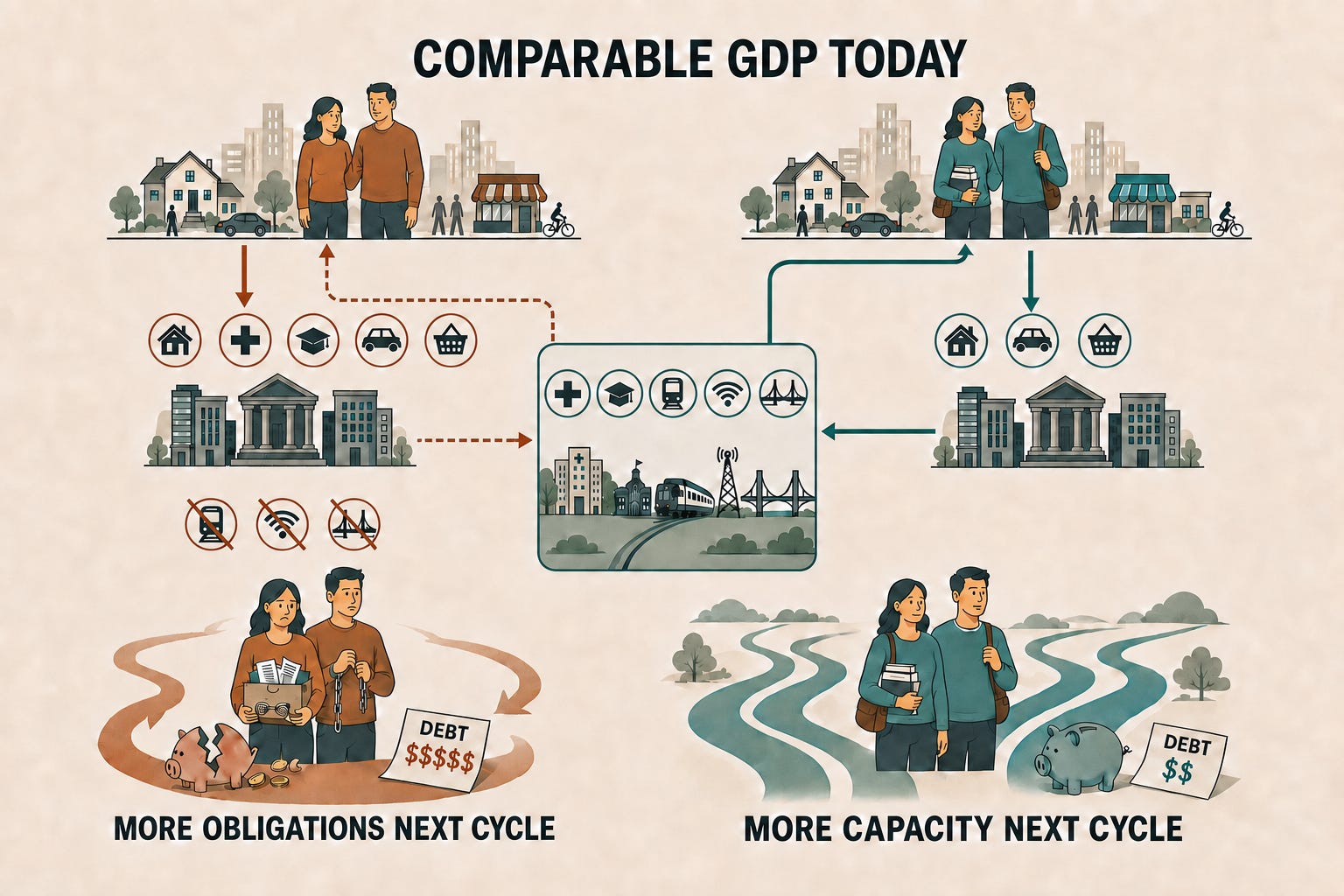
Two societies can produce the same amount today while leaving their people radically different capacities to create tomorrow.
The Flywheel and the Ratchet
Once we define the pie as productive capacity, the American economy becomes easier to understand. Beneath the thousands of policies, prices, institutions, and transactions, there are two basic patterns. One compounds capability. The other compounds control.
The first is a flywheel. People become healthier, better educated, better connected, and more secure. That capability produces useful work, new ideas, stronger businesses, and better systems. The people who organize, finance, invent, manage, and perform that work receive differentiated rewards—but enough of the gains circulate back into wages, demand, infrastructure, and opportunity to make the next round of creation possible. Each cycle begins with more people able to contribute than the cycle before it.
The second is a ratchet. People must obtain housing, medicine, transportation, education, communication, and credit whether the markets providing them work well or not. Whoever controls access can collect a toll. Those tolls concentrate income and ownership; concentrated ownership buys more gates, more bargaining power, and more influence over the rules; the next cycle begins with households weaker and gatekeepers stronger.
This reveals two fundamentally different ways to become rich.
The builder becomes rich by making the pie larger. She creates a better product, discovers a new process, coordinates people effectively, accepts genuine risk, or supplies capital that turns possibility into production. Her reward can be enormous without making everyone else poorer, because the value available to society has increased.
The gatekeeper becomes rich by gaining control over something people already need and charging more for access. He may purchase competitors, corner land, exploit switching costs, impose junk fees, raise rents faster than he improves housing, or use market power to capture gains created elsewhere. The ledger records income in both cases. Only one reliably expands the productive base.
Profit is not the problem. The question is whether profit is evidence that new value was created—or merely proof that someone owned the gate.
Real economies contain both patterns at once. A pharmaceutical company can develop a lifesaving drug and later exploit monopoly power over it. A landlord can build and maintain housing or simply acquire scarce homes and raise the toll. A financial firm can direct savings toward productive investment or manufacture fees around transactions that would have happened anyway. The purpose of the distinction is not to sort every person or company into moral boxes; it is to see which behavior the rules reward.
When the flywheel dominates, success produces more potential creators, customers, and competitors. When the ratchet dominates, success purchases the power to narrow entry and extract more from everyone below. The flywheel grows the pie. The ratchet first transfers slices—and then begins dismantling the kitchen.
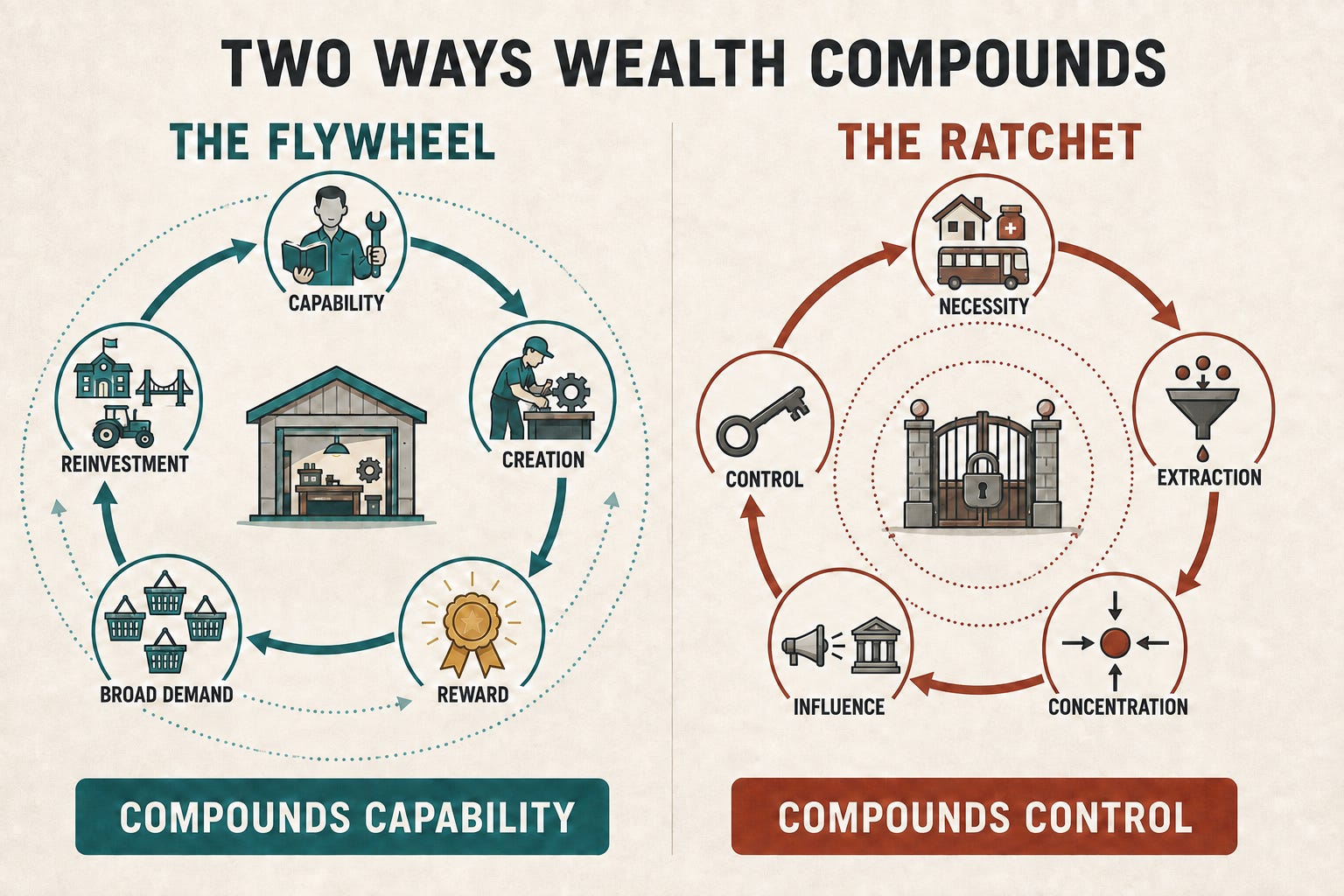
The flywheel compounds capability. The ratchet compounds control.
Raising the Floor Is How We Grow the Pie
This is where the usual language of “distribution” and “redistribution” begins to mislead us.
In ordinary political speech, the story goes like this: the economy first creates wealth through a neutral market; that wealth naturally arrives in the hands of those who produced it; government then takes some away and redistributes it to people who did not. The makers create. The takers receive. Public policy enters only after the real economic work is finished.
But there is no economy before distribution. Every rule governing wages, ownership, contracts, bankruptcy, patents, zoning, taxation, bargaining, inheritance, and corporate power helps determine where income, risk, and control go during production. A paycheck is distribution. A dividend is distribution. Rent, interest, capital gains, stock options, and monopoly profit are distribution. The question is never whether the economy distributes value. The question is what its rules reward—and what condition people are left in when the cycle begins again.
The moral story attached to “redistribution” has also been politically loaded. Martin Gilens found that Black Americans were dramatically overrepresented in national news images of poverty during the period he studied, and that public overestimates of the share of poor Americans who were Black were associated with greater tendency to blame welfare recipients for their circumstances.3 That history matters because the stereotype did more than stigmatize assistance. It trained people to see the economic floor as a gift to an undeserving outsider rather than infrastructure on which nearly everyone depends at some point in life.
There is a simpler way to think about it.
A safety net catches someone before catastrophe. It prevents hunger, untreated illness, homelessness, or total financial collapse. That is real value. Destruction avoided does not become worthless merely because it is difficult to see on a quarterly earnings report.
But a net is not the same as a floor. A floor gives people enough stability to stand, plan, and make choices. And a floor is not yet a foundation. A foundation supplies the health, education, infrastructure, time, security, and access required to build something that lasts.
The distinction matters because an economy can maintain a minimal safety net while continuing to consume its own base. If assistance is only enough for a family to remain barely housed, barely fed, barely treated, and perpetually indebted, the immediate benefit may pass straight through that household to the same concentrated landlords, retailers, healthcare providers, and lenders collecting the tolls. The family survives. The ratchet remains intact.
Survival is necessary. It is not the same as compounding capability.
Research on the long-run effects of childhood Medicaid provides one concrete example. Andrew Goodman-Bacon found that expanded childhood eligibility reduced later mortality and disability and generated measurable long-term returns to government.4 The claim is not that every program automatically pays for itself. It is that preventing damage to a child is not merely consumption in the present; it preserves the adult capacity on which future households, businesses, and public finances will depend.
The same logic applies to physical infrastructure. Research across advanced economies has found that well-designed public investment can raise output in the short term and productive capacity over time, especially when projects are selected and executed efficiently.5 A reliable bridge is not charity for commuters. Broadband is not a handout to rural businesses. Clean water, functional transit, basic research, and a healthy population are parts of the platform on which private creation occurs.
Raising the floor also makes markets work better. People with no margin cannot reward quality, experiment with unfamiliar products, leave an abusive employer, wait for a better price, or absorb the risk of starting a company. They buy what is cheapest today, even when it costs more over time. They tolerate bad service because switching requires money. They remain in the job because missing one paycheck means missing rent.
Markets are supposed to translate human preferences into signals. But when most people can afford to express only their emergencies, the signal becomes distorted. Cheap, immediate, and unavoidable beats durable, better, and innovative—not necessarily because consumers prefer it, but because scarcity has stripped them of meaningful choice.
Distribution also affects the strength of demand. Federal Reserve researchers estimate that consumer spending responds far less to changes in wealth held by the top 20 percent than to changes in wealth held by the bottom 80 percent. Their finding concerns spending out of wealth—not every dollar of wages or benefits—but the mechanism is intuitive: a household whose needs are already met can save most of an additional gain, while a household with deferred repairs, medical care, clothing, or transportation is more likely to spend it.6 That spending becomes revenue for businesses, which gives businesses a reason to hire, invest, and produce.
This is not an argument for equal outcomes. It is an argument for maintaining the machinery that makes unequal achievement, innovation, and reward possible without allowing yesterday’s winners to destroy tomorrow’s field of entrants.
Raising the floor is not what we do after growing the economy. Raising the floor is one of the ways we grow it.
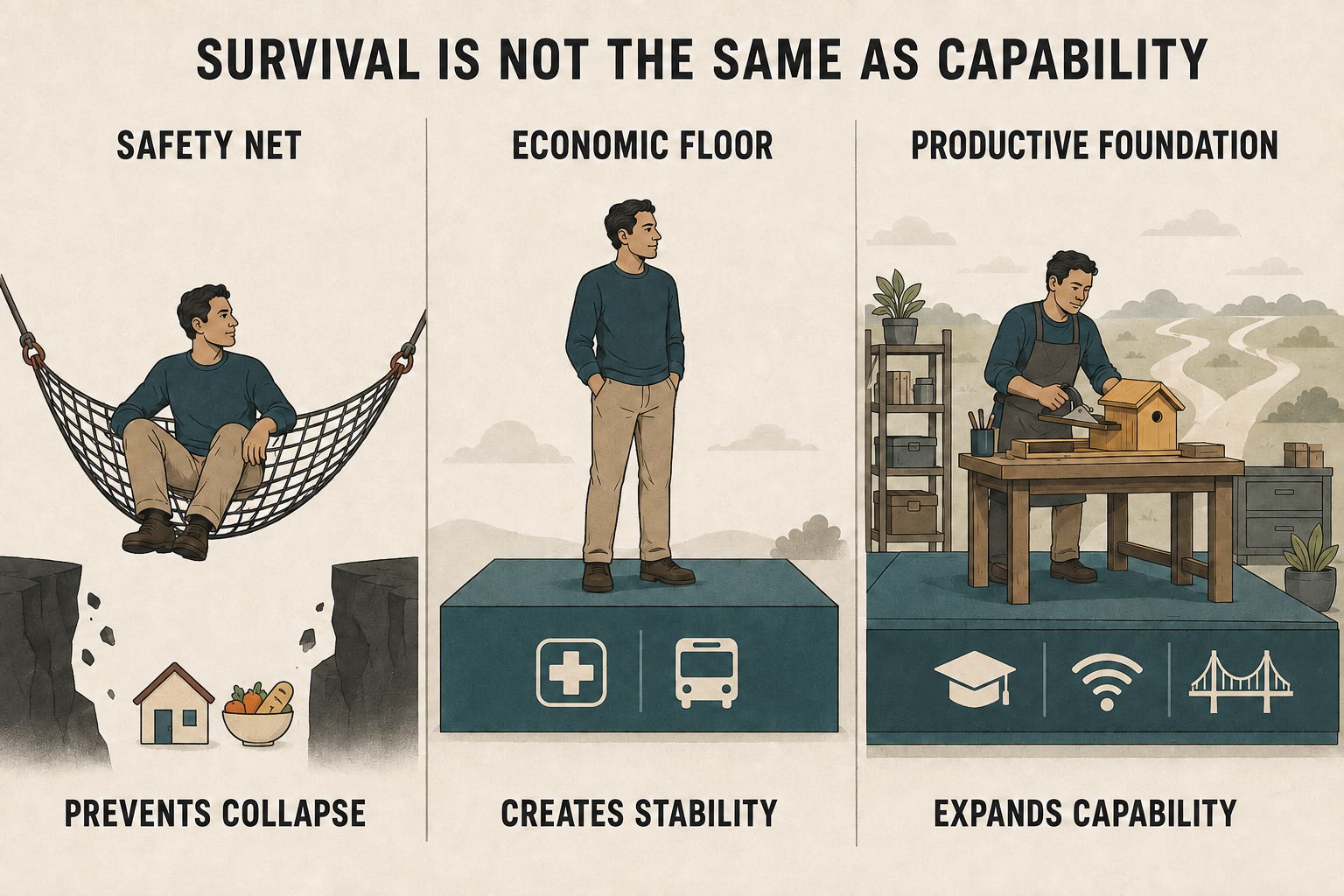
A safety net prevents destruction. A floor creates stability. A foundation allows people to build.
How America Changed the Loop
The American middle class did not emerge because the market naturally settled into a fair balance. It was built through a particular arrangement of power and investment.
During the New Deal and postwar eras, collective bargaining, Social Security, unemployment insurance, labor standards, mass education, housing finance, infrastructure, research, and industrial expansion reinforced one another. Workers became more productive. Unions and labor law helped them claim a larger share of what they produced. Broad purchasing power created customers. Customers justified more production and investment. Public systems lowered the cost of participating in the economy.
The scale of the labor shift alone was extraordinary. The Treasury Department reports that union membership rose from roughly 11 percent of the nonagricultural labor force in 1934 to 28 percent by 1939, and approached one-third of workers by the mid-1950s. Its review estimates that unions raise member wages by roughly 10 to 15 percent, improve benefits, and can create spillover gains for nonunion workers as employers compete for labor.7 Bargaining power helped convert productivity into mass purchasing power rather than allowing every gain to concentrate at the top.
This prosperity was never universal. Black Americans, women, agricultural workers, domestic workers, and many others faced exclusion from jobs, neighborhoods, credit, education, unions, and public benefits. The postwar system demonstrated the power of the flywheel while denying full access to millions of people. That is not a footnote to the model; it proves that productive institutions can expand a pie while political power still determines who is allowed into the kitchen.
Nor did one law or one president single-handedly create the middle class. War production, America’s unusual postwar industrial position, technological change, population growth, cheap energy, and many other forces mattered. The relevant point is narrower: for several decades, major institutions pushed productivity, wages, public capacity, and mass demand in a mutually reinforcing direction.
Then the loop changed.
The oil shocks, inflation, global competition, automation, and industrial restructuring of the 1970s created genuine pressure. But the response was not mechanically dictated by those events. Over the following decades, policy and corporate governance shifted power away from labor and toward owners: union density fell, the real minimum wage eroded, finance expanded, industries consolidated, tax burdens moved, production moved across borders, and shareholder returns became a more dominant test of managerial success.
Globalization and technology could have increased the pie while the gains financed adaptation, stronger public systems, and new paths into productive work. Instead, the institutions that once transmitted rising productivity into broadly rising compensation weakened. The Bureau of Labor Statistics finds that productivity and compensation, which moved together for much of the postwar period, diverged beginning in the 1970s. The precise size of that gap depends on which workers, sectors, compensation measures, and inflation measures are compared—but the broad divergence remains visible even under careful, matched comparisons.8
That is the systemic break. America did not stop creating value. It stopped reliably turning each round of value creation into a stronger base for the next one.
As compensation lagged behind what workers produced, the gains had to go somewhere. More flowed to profits, high earners, and asset owners. Those gains purchased more assets. Ownership generated more income and political leverage. Greater leverage helped preserve the rules producing the concentration. The flywheel of broad capability was increasingly joined—and in many sectors overpowered—by a ratchet of ownership and control.
The machine kept producing wealth. It stopped reliably producing a middle class.
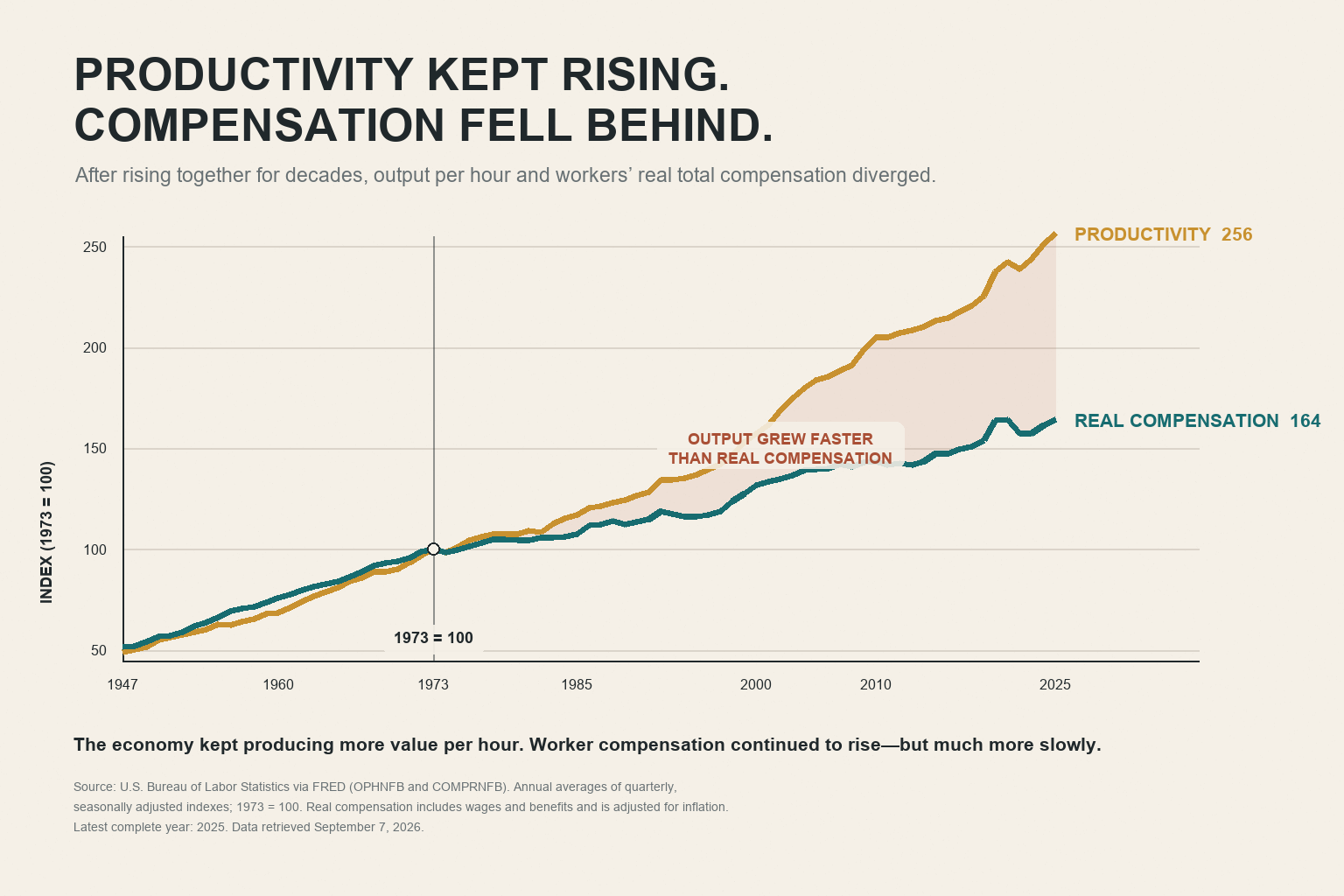
Productivity continued to rise. The institutions that once transmitted those gains broadly became weaker.
Debt Lets Extraction Impersonate Prosperity
When wages, security, and the cost of essential participation move apart, households do not simply stop needing homes, cars, education, healthcare, food, and electricity. They find another way to pay.
Increasingly, that way is credit.
The Federal Reserve’s 2025 household survey describes credit as a tool people use for everyday purchases and periods of uneven income. It also shows that recent credit-card balance growth was concentrated among people under financial strain: respondents who said they were “just getting by” or “finding it difficult to get by” accounted for 65 percent of balance growth in the linked survey data, and average balances among those finding it difficult rose 37 percent over two years, compared with 1 percent among those living comfortably.9
This does not prove that debt universally replaced stagnant wages. It does not need to. It shows something more specific and more important to the mechanism: households with the least margin are committing more future income to sustain ordinary life in the present.
That transaction can look healthy from above. The purchase is made. The retailer books revenue. The lender books interest. Consumption supports GDP. But the household enters the next cycle with a payment attached to income it has not yet earned.
GDP records the activity. The household balance sheet records what it cost.
The historical comparison should not be exaggerated. New York Federal Reserve data show that total nominal household debt grew far faster during the run-up to the 2008 crisis than it has in the most recent period. Credit-card debt is the important exception: author calculations from the same series show it rising more quickly in the recent period than during the earlier one.10 This is not simply 2008 happening again. The debt ratchet did not disappear; it changed instruments.
Debt itself is not inherently extractive. A mortgage can help a family acquire an asset. A business loan can finance machinery that produces more than the loan costs. Student debt can support valuable education. Borrowing builds the future when it creates an asset, income stream, or capability strong enough to repay the obligation while leaving the borrower better equipped than before.
The pattern becomes destructive when debt finances the price of admission to ordinary life without building a corresponding asset. Groceries purchased at 25 percent interest are not an investment. A medical bill that prevents bankruptcy only by consuming years of future income does not make the patient more capable. An auto loan made necessary by the absence of usable transportation may enable employment, but abusive terms can convert access to work into a permanent toll on work.
Debt also changes power. A worker with savings can reject an unsafe job, endure a strike, move to a better opportunity, or take time to retrain. A worker whose rent, car, medical, and credit-card payments arrive every month has less room to say no. Future income has already been promised, so current employment must be protected at almost any cost.
This creates another loop: low margin produces borrowing; borrowing preserves current consumption; current consumption sustains corporate revenue; debt service claims future income; and claimed future income leaves even less margin. First the system stops sharing the gains. Then it lends workers the money required to keep buying them.
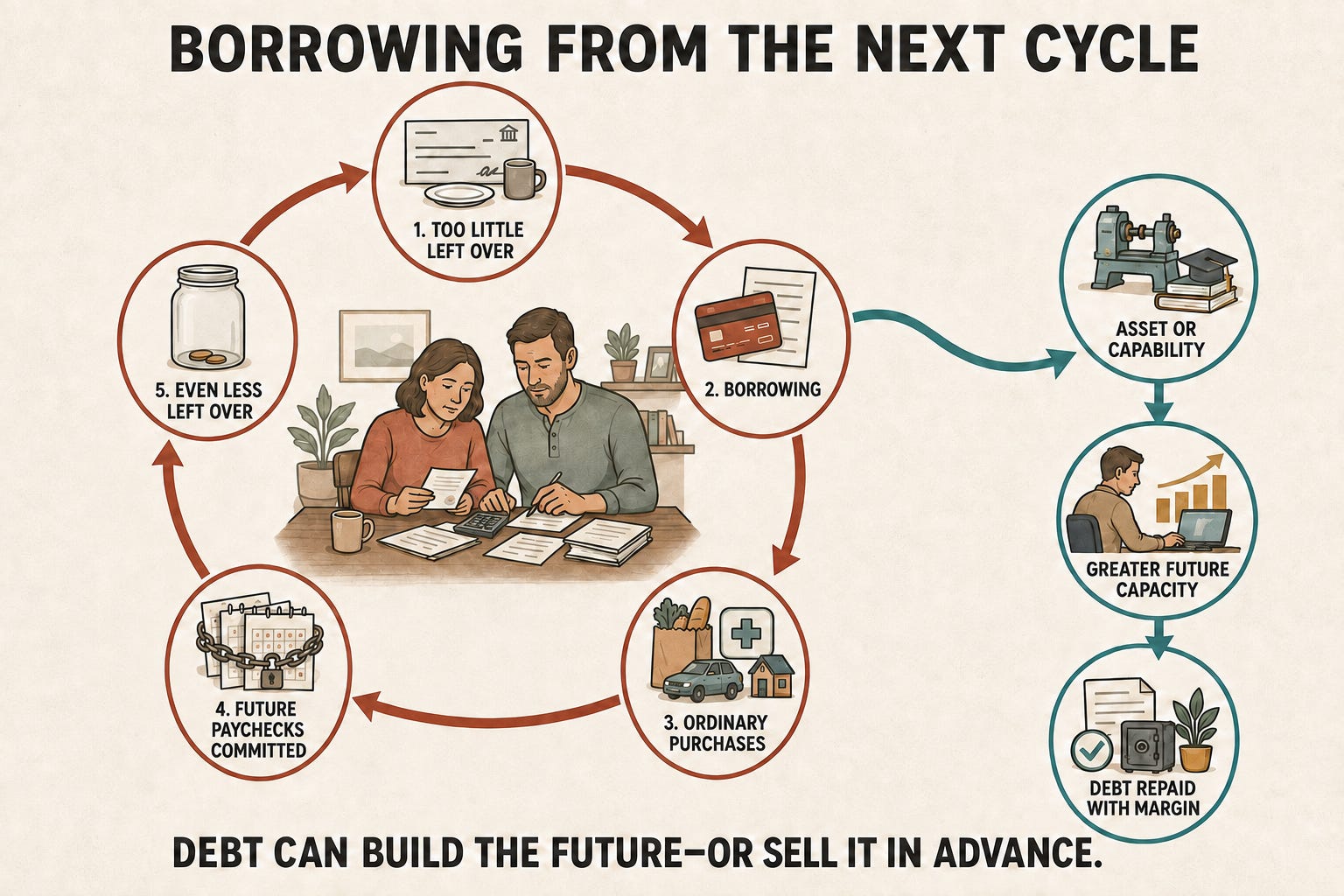
Debt can build the future—or sell it in advance.
Why Trickle-Down Cannot Repair the Machine
The strongest version of the trickle-down argument sounds plausible. Lower taxes and fewer constraints leave owners and companies with more resources. They invest those resources in new plants, equipment, research, products, and workers. Higher productivity eventually creates higher wages and greater prosperity for everyone.
Sometimes supply really is the constraint. A shortage of factories, energy, housing, skilled labor, or technological capacity can limit output, and well-designed investment can relieve it. An economic model that ignores supply is no better than one that ignores demand.
But giving more money to people who already own capital does not determine what they do with it. They can build productive capacity. They can also purchase existing assets, acquire competitors, buy back shares, reduce debt, move production abroad, increase executive compensation, or simply save. If a company already has the cash and productive capacity to make more widgets but lacks customers able to buy them, another tax cut does not create the missing order.
This is the missing link in trickle-down economics: private enrichment is treated as if it were identical to productive investment.
The long-run evidence does not support that assumption. David Hope and Julian Limberg examined major tax cuts for the rich across 18 advanced economies from 1965 through 2015. They found that the cuts increased the income share of the top 1 percent but produced no statistically significant improvement in economic growth or unemployment.11 That does not establish that every tax cut is harmful or that incentives never matter. It does show that making the rich richer is not, by itself, a reliable growth mechanism.
The flywheel begins at the actual bottleneck. Sometimes that is productive capital. Sometimes it is infrastructure, workforce health, education, competition, research, or household demand. The intervention works when it expands the capacity the system is missing—not when it rewards whoever already holds the strongest claim on existing output.
Broad purchasing power supplies a direct signal. Households buy what they need and value. Their purchases become business revenue. Revenue reveals demand. Businesses that expect continued demand hire, invest, and compete to satisfy it. The lower spending response to wealth gains at the top helps explain why concentrating additional wealth can weaken this transmission.⁶
Money does not trickle down. Demand travels up.
This is not a choice between supply and demand, capital and labor, or markets and government. Healthy economies connect them. Workers become capable producers and solvent customers. Businesses receive both the infrastructure required to produce and the demand required to sell. Investors earn returns by enabling expansion. Public institutions preserve the platform and prevent accumulated success from becoming permanent control over entry.
Trickle-down begins by reinforcing ownership and hoping capability follows. A functional flywheel identifies what prevents capability from expanding and repairs that link directly.
Build More Bakers
The goal is not to divide a fixed pie into identical slices. It is not to punish people who create extraordinary value. It is not to pretend that every public program is productive or every private profit extractive.
The goal is to distinguish wealth earned by expanding society’s capacity from wealth extracted by controlling access to what society already needs.
Reward inventors, builders, organizers, workers, and productive investors. Reward them well. But keep entry open, preserve competition, prevent reward from hardening into unaccountable control, and return enough of each expansion to the human and physical base that made the next expansion possible.
When evaluating an economic policy, ask four questions:
Does it expand usable human or material capacity?
Does it raise the floor from which people can build?
Does it reward creation—or merely strengthen control over a gate?
Does the next cycle begin with more capable people and more open paths, or with greater dependence and concentration?
A functioning economy does more than keep people alive long enough to work and consume. It leaves them healthier, smarter, freer, more secure, and more capable than they were during the previous cycle. It turns today’s abundance into tomorrow’s possibility.
The American middle class grew when the country expanded the number of people able to participate in that process, even as it unjustly excluded millions. It began to fracture when we confused the enrichment of owners with the expansion of society, weakened the institutions that connected productivity to ordinary life, and used debt to bridge the widening gap.
GDP can tell us how much the economy produced. It cannot tell us whether we are building more bakers—or burning the kitchen for fuel.
The real measure of prosperity is not how much value the system can extract from its people. It is how much value its people become capable of creating.
Understanding the machine is only the first step. Once we can see the loops, we can change what they reward.
We built this publication to equip you with the tools to fight back—the frameworks, the messaging, the strategies that actually work. See the links below. But we can only keep doing this with your help. If this matters to you, please consider becoming a paid subscriber. You keep the fight alive.
Fighting Fascism: How We Charge Ahead and Win — The strategic playbook for reclaiming power
The Trump Regime Messaging Guide — How to talk to people who've been captured by the machine
The Freedom Illusion — How we got here, and the counter-ideology that gets us out
Article Sources:
U.S. Bureau of Economic Analysis, “The Expenditures Approach to Measuring GDP”, Bureau of Economic Analysis, June 3, 2025.
The Bureau of Economic Analysis defines GDP as the value of goods and services produced within the United States minus the inputs used in production. Its explanation of the expenditure approach—consumption, investment, government purchases, and exports minus imports—grounds the article’s treatment of GDP as a valid measure of present production. It also clarifies why the article criticizes what GDP cannot show rather than mischaracterizing what GDP measures.
World Bank, “The Changing Wealth of Nations 2024”, World Bank, 2024.
The World Bank explains why GDP must be complemented by measures of the assets that support future production. Its comprehensive-wealth framework includes produced capital, human capital, natural capital, and net foreign assets, and it explicitly distinguishes growth that accumulates those assets from growth that depletes them. The report estimates that human capital constituted 60 percent of global wealth in 2020, providing strong support for the article’s central claim that people’s capabilities are productive infrastructure, not an afterthought.
Martin Gilens, “Race and Poverty in America: Public Misperceptions and the American News Media”, Public Opinion Quarterly, Winter 1996.
Gilens compared the racial composition of poverty in the United States with the people depicted in national news coverage. He found substantial overrepresentation of Black Americans in poverty imagery and linked public misperception of poverty’s racial composition to harsher judgments of welfare recipients. The study does not prove that media imagery alone created those attitudes, but it documents the racialized information environment in which the “undeserving recipient” frame became politically powerful.
Andrew Goodman-Bacon, “The Long-Run Effects of Childhood Insurance Coverage: Medicaid Implementation, Adult Health, and Labor Market Outcomes”, National Bureau of Economic Research, December 2016.
Goodman-Bacon studies the original implementation of childhood Medicaid and traces effects into adulthood. He finds that greater childhood eligibility reduced later mortality and disability and generated measurable long-run returns to government. The article uses this evidence as a concrete example of capability preservation: preventing childhood health damage can affect what a person is able to do decades later. It is not presented as proof that every social program pays for itself.
Abdul Abiad, Davide Furceri, and Petia Topalova, “The Macroeconomic Effects of Public Investment: Evidence from Advanced Economies”, International Monetary Fund, May 2015.
Using evidence from advanced economies, the authors find that increased public investment can raise output in both the short and long run. The effects are stronger under certain economic conditions and where investment efficiency is high, an important limitation preserved in the article. The study supports the distinction between spending that merely records activity and investment that expands the infrastructure available for future private and public production.
Samara Beach, William Gamber, and Patrick Moran, “Wealth Heterogeneity and Consumer Spending”, Board of Governors of the Federal Reserve System, August 5, 2025.
The authors find that consumer spending is less responsive to fluctuations in wealth held by high-income households than to wealth held by the bottom 80 percent. They argue that increasing wealth concentration reduced the economy’s average propensity to consume out of wealth and helps explain weak spending after the Great Recession. This is specifically evidence about changes in wealth—not a universal estimate for every kind of income or government payment—and the article uses it within that boundary.
U.S. Department of the Treasury, Office of Economic Policy, “Labor Unions and the Middle Class”, U.S. Department of the Treasury, August 2023.
The Treasury report documents the rapid rise in union membership after the National Labor Relations Act, the scale of union wage and benefit effects, and spillovers to nonunion workers. It also discusses unequal access to the gains of the midcentury economy and the relationship between unions, inequality, and economic opportunity. The source supports the article’s compressed historical account of how bargaining institutions helped transmit productivity into broad purchasing power without implying that unions alone created postwar prosperity.
Michael Brill, Corey Holman, Chris Morris, Ronjoy Raichoudhary, and Noah Yosif, “Understanding the Labor Productivity and Compensation Gap”, U.S. Bureau of Labor Statistics, June 2017.
The authors examine the divergence between labor productivity and worker compensation and explain how the apparent size of the gap changes with sector coverage, worker population, compensation definitions, and price measures. Even after accounting for those measurement choices, their industry analysis finds productivity outpacing inflation-adjusted compensation across most industries studied. This source grounds both the historical claim and the requirement that the eventual chart use matched measures rather than the most dramatic available comparison.
Board of Governors of the Federal Reserve System, “Economic Well-Being of U.S. Households in 2025—Credit”, Board of Governors of the Federal Reserve System, May 2026.
The Federal Reserve’s report combines household survey responses with credit-bureau data to examine how Americans use and experience credit. It finds that recent credit-card balance growth was concentrated among respondents who reported that they were just getting by or finding it difficult to get by. This directly supports the article’s limited debt claim: households under strain are increasingly using future income to support present purchases. It does not establish that debt replaced wages for every household or that all forms of household debt are at unprecedented levels.
Federal Reserve Bank of New York, Center for Microeconomic Data, “Quarterly Report on Household Debt and Credit, 2026 Q2”, Federal Reserve Bank of New York, August 11, 2026.
The New York Fed’s Consumer Credit Panel provides a consistent quarterly series for mortgages, home-equity credit, auto loans, credit cards, student loans, and other household balances. Calculations from the series show that total nominal debt increased much faster before the 2008 financial crisis than in the recent period, while credit-card balances have recently grown faster. The comparison prevents the article from treating the present as a replay of 2008 while showing how the composition of the debt mechanism has changed.
David Hope and Julian Limberg, “The Economic Consequences of Major Tax Cuts for the Rich”, Socio-Economic Review, April 2022.
Hope and Limberg analyze major tax reductions for high earners across 18 advanced economies from 1965 through 2015. They find that these reforms increased the income share of the top 1 percent without producing statistically significant gains in economic growth or reductions in unemployment. The study tests the broad trickle-down promise over a long period and across many countries. The article uses it to reject automatic claims about enrichment at the top, not to argue that every tax change or investment incentive has the same effect.
TY for your cogent explanation. Economics is like voodoo to most of us.
Great stuff, Lukium. I've been reading a lot about economic history lately, especially of the Nordic Model. Do you have any thoughts on the economic limitations and benefits of the Scandinavian economies vs the New Deal (or New Deal 2.0 as you would design it within the USOS architecture?). Some resources in case they're useful to you:
** On the failures of neoliberalism in the US: https://rooseveltinstitute.org/wp-content/uploads/2020/07/RI_The-Empirical-Failures-of-Neoliberalism_brief-202001.pdf
** On the Swedish welfare state and why it's not socialist: https://realitiesofsocialism.org/sites/default/files/2023-08/mirage-of-swedish-socialism-economic-history-of-welfare-state_0.pdf
** On the Danish experience: https://realitiesofsocialism.org/sites/default/files/2023-10/free-enterprise-welfare-state-history-of-denmarks-unique-economic-model.pdf
The Realities of Socialism website is associated with the Frasier Institute and other center-right or centrist think tanks, so their analysis is from a classical liberal/fiscal conservative viewpoint (I doubt they would agree with the analysis from the Roosevelt Institute, though they are at pains to point out why social democracy isn't socialism). Take that for whatever it's worth or isn't worth, though in broad terms, I think you'd find much to agree with in their papers. I found the Sweden one highly informative (I'm still working through the Denmark one) but it leads me onto further question for you, such as: the budget-balance issues and deficit crisis faced by Sweden in the 1980s and 90s and their fiscal conservative reforms to try to bring things under control; their use of private competition to cater to welfare services (such as their school vouchers that can be used by parents to select private schools, and similar schemes in health care), as well as high tax rates across the board but with a lower top marginal tax rate bracket than in the US (in other words, the middle class pays for most of the welfare services since the top income tax rate kicks in at around $US62K; in Denmark it's at around $US91K, still well below that in the US, which kicks in at $500K or so if I understand it correctly), their uniform 25% VAT, etc. Do you see these things as "fair"? Are they part of a coherent overall framework (and maybe one configuration for achieving what you would want to see) or are they a rickety and unstable pastiche? What's the relevance and lessons for the US?