


This is Part Two of a three-part series. Part One laid out the case across nine domains — guns, speech, states' rights, law and order, life, money, merit, religion, and identity — and proved that the American right's stated values were never principles. They were instruments. Tools picked up when useful and discarded the moment they weren't. One project, running for 165 years, with the same real objective every time: power and protection for the in-group.
If you haven't read Part One, start there. What follows builds on it — and it gets worse.
On Identity Politics
Nine domains. Nine stated values. Nine reveals. Every single one resolved the same way: the stated principle was a weapon, the real principle was power, and the moment the weapon was no longer useful it was discarded without a second thought.
But there's one objection still standing — and it's the one you'll hear first if you share this piece with the wrong dinner party. It sounds like this: "Sure, the right is bad. But the left does identity politics too. Both sides divide people into groups. Both sides play the identity game."
It sounds reasonable. It sounds balanced. It even comes from the left — Columbia humanities professor Mark Lilla wrote a bestselling book arguing that "American liberalism has slipped into a kind of moral panic about racial, gender and sexual identity" and that progressive identity politics was "Reaganism for lefties."1 The New York Times published his argument the week after Trump won in 2016, and it became the paper's most-read political op-ed that year.¹ Centrist Democrats nodded along. Liberal pundits cited it approvingly. The "both sides do identity politics" framing hardened into bipartisan conventional wisdom — the kind of critique that sounds so sophisticated it immunizes itself against examination.
So let's examine it.
In the opening of this piece, I made a promise: every single left-wing policy attacked as "identity politics" traces directly back to defending people from a documented, specific, right-wing attack. I said we'd prove it exhaustively. Here's the proof. Try the challenge yourself: name one that doesn't trace back. You won't find it.
Affirmative Action
Affirmative action didn't spring from ideology. It was the remedy after decades of anti-discrimination law failed to produce any change at all.2
In 1963 — a full century after the Emancipation Proclamation — a federal court enjoined the state of Alabama from discriminating against Black applicants in the hiring of state troopers. The court's finding: "In the thirty-seven year history of the patrol there has never been a black trooper."² Eighteen months after the court order, still operating under anti-discrimination statutes alone, not a single Black person had been hired — as a trooper or into any civilian position.² The court had to impose numerical goals to make the law mean anything at all.
That wasn't an outlier. It was the pattern. At Kaiser Aluminum's Gramercy, Louisiana plant, 5 of 273 skilled craft workers were Black — because the craft unions had excluded Black workers for generations, and Kaiser only hired people with prior craft experience, creating a self-perpetuating loop of exclusion.² In San Francisco, women represented 4 percent of entry-level police officers in 1979.² After a consent decree imposed numerical targets, Black officers rose from 7 to 31, Hispanic officers from 12 to 55, Asian officers from 0 to 10 — and women were admitted as firefighters for the first time.²
President Kennedy introduced the term "affirmative action" in Executive Order 10925 in 1961.² President Johnson expanded it in 1965. And here's the detail that should stop the "identity politics" accusation in its tracks: the Nixon administration — Nixon — defended goals and timetables as "necessary and right."² Both Republican and Democratic administrations turned to race- and gender-conscious remedies, the Clinton White House review noted, because "periods of experimentation had shown that other means too often failed to correct the problems."²
Thirty-seven years. Zero Black troopers. That's not ideology. That's a wound, and affirmative action was the bandage.
DEI
The modern diversity, equity, and inclusion movement traces its origins to a specific act of violence against a specific person.3
In 1946, Sergeant Isaac Woodard Jr. — a Black World War II veteran, still in uniform, hours after receiving his honorable discharge — was dragged off a Greyhound bus by the police chief of Batesburg, South Carolina, and beaten so severely with a blackjack that both of his eyes were destroyed.³ He was blinded for life. He was 27 years old.
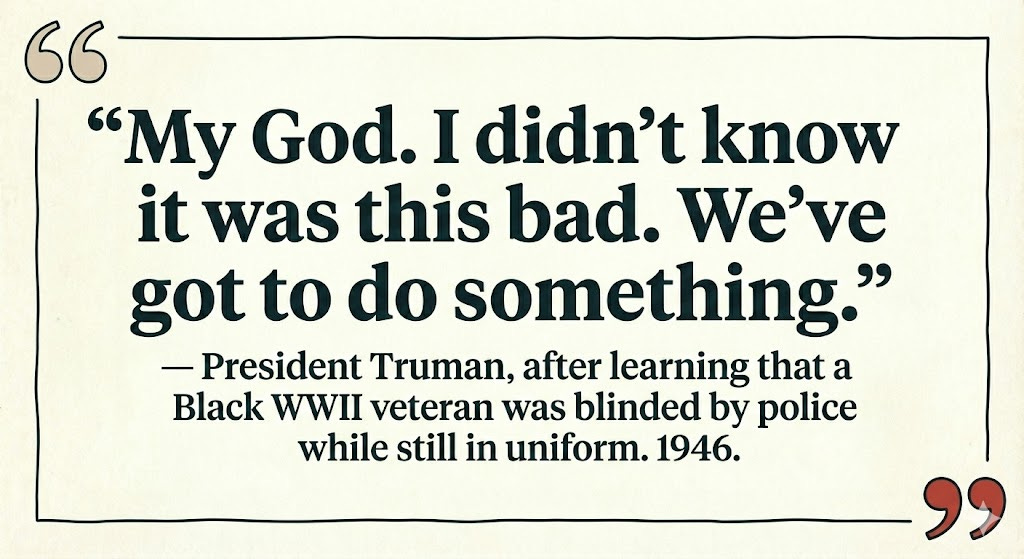
When NAACP Executive Secretary Walter White brought Woodard's case to President Truman, the president's response was immediate: "My God. I didn't know it was this bad. We've got to do something."³ White House aides later said the Woodard incident was what finally pushed Truman to act. He issued Executive Orders 9980 and 9981 in 1948 — desegregating the federal workforce and the armed forces.³ That is the direct origin of everything we now call DEI: a blind veteran, a horrified president, and the first federal attempt to make American institutions reflect the country they claimed to serve.
Every subsequent wave followed the same pattern. The Civil Rights Act of 1964 — responding to a century of Jim Crow. The post-Ferguson reforms — responding to a Washington Post project that revealed police kill roughly 1,000 people a year, disproportionately Black and young.³ The post-George Floyd corporate DEI initiatives — responding to a man murdered on camera by a police officer who knelt on his neck for nine minutes while he called for his dead mother.³ Every wave of DEI expansion corresponds to a documented wave of violence. As Thurgood Marshall put it in 1987: the Constitution itself was "defective from the start" — and DEI programs are the ongoing repair.³
Ron DeSantis in 2023 said DEI "is better viewed as standing for discrimination, exclusion, and indoctrination."³ He was describing a program born from a blinded veteran and built to remedy centuries of documented exclusion — and he called it the discrimination.
Sanctuary Cities
Sanctuary cities were not created to "protect illegal immigrants." They were created because the people who actually enforce the law — police chiefs — said that federal immigration enforcement was making their communities less safe.4
The International Association of Chiefs of Police warned that state and local enforcement of federal immigration law creates a "chilling effect" on crime reporting — because undocumented residents stop calling 911 when they witness crimes, stop cooperating with investigations, stop testifying.⁴ The Major Cities Chiefs Association reached the same conclusion: commingling local policing with immigration enforcement "would result in increased crime against immigrants and in the broader community, create a class of silent victims and eliminate the potential for assistance from immigrants in solving crimes or preventing future terroristic acts."⁴
The data confirmed what the police chiefs predicted. A UC San Diego study using ICE's own data — 608 sanctuary counties analyzed against comparable non-sanctuary counties — found that sanctuary counties have 35.5 fewer crimes per 10,000 people.⁴ Median household income is $4,353 higher. Poverty is 2.3 percent lower. Unemployment is 1.1 percent lower.⁴ Sanctuary policies aren't soft on crime. They reduce crime — because they keep communities functional instead of terrorized into silence.
Trans Protections
This was not a cultural reaction to trans "overreach." It was an organized political campaign, and its origins are traceable to a specific date. ACLU Transgender Justice Director Chase Strangio identified the trigger directly: "It's part of a continued backlash from marriage equality. So when the Supreme Court struck down bans on marriage for same-sex couples in 2015, you immediately saw a backlash in the form of legislative attacks on trans people and trans youth in particular."5 The wave escalated after the 2020 Supreme Court ruling that LGBTQ people are covered under federal civil rights law. It intensified again after Biden's election.⁵ The attackers needed a new target after losing on marriage. Trans people — the smallest, most vulnerable group in the LGBTQ coalition — became it.
The scale is staggering. In 2023 alone, state legislatures introduced 615 anti-trans bills. Eighty-seven were signed into law across 24 states.6 The bills targeted healthcare, sports, bathrooms, schools, legal recognition — every dimension of trans people's existence in public life.
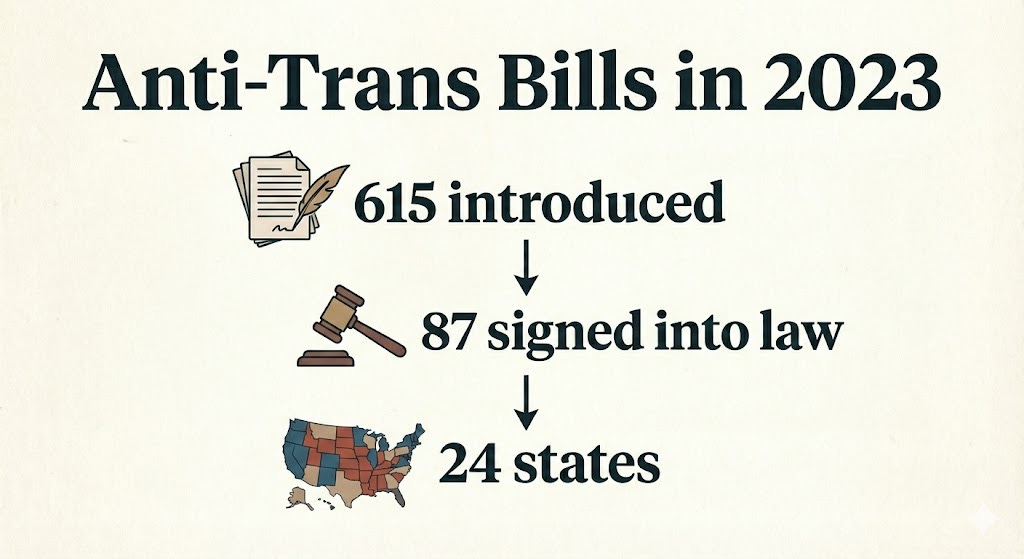
The legislative tracker maintained by the ACLU documents it year after year: hundreds of individual bills, each one targeting a specific aspect of trans people's lives — who they can see for medical care, which bathroom they can use, what sports team they can join, what name appears on their driver's license.⁶ The protections that followed — from executive orders to corporate policies to state-level equality acts — were responses to that campaign. The attackers moved first. Every single time.
The Undeniable Fact
Here is the challenge, stated one final time: name a single left-wing "identity politics" policy that does not trace directly back to defending people from a documented right-wing attack.
Affirmative action: the response to 37 years of zero Black state troopers. DEI: the response to a blinded veteran, a century of Jim Crow, and police killings documented by newspaper databases. Sanctuary cities: the response to federal raids that made communities less safe, built on the recommendation of the nation's police chiefs, validated by ICE's own data. Trans protections: the response to 615 bills in a single year targeting people for existing.
You can't find one that doesn't trace back. Not one.
And here's the honest concession that makes the argument stronger, not weaker: these policies are not the real solutions. Affirmative action is a bandage, not a cure. DEI training is not a substitute for the kind of structural investment in education, infrastructure, housing, and healthcare that would actually deliver equity. Sanctuary cities wouldn't need to exist if immigration policy were rational and humane. Every one of these policies is harm reduction — a tourniquet applied to a wound that requires surgery.
But ask yourself who keeps defunding the surgery. As we documented in Section V, the "fiscal responsibility" party has blown multi-trillion-dollar holes in the federal budget — every single time — through tax cuts that overwhelmingly benefit the wealthy, while telling hungry children and sick mothers there's no money left. The real investments that would make affirmative action unnecessary — world-class public schools in every zip code, universal healthcare, a living wage, affordable housing — require exactly the kind of public spending that the right has spent fifty years ensuring will never happen. And Democrats have often played along. Clinton's 1996 welfare reform gutted the safety net for millions. His crime bill fueled mass incarceration. Obama's response to the 2008 financial crisis — "foam the runway" for the banks, as his own Treasury official put it — rescued Wall Street and left millions of families to lose their homes. The bipartisan consensus that public investment is wasteful and markets will provide has been, for decades, a bipartisan agreement to leave the wound open.
So yes — affirmative action, DEI, sanctuary cities, and trans protections are band-aids. But in a country where one party actively blocks the surgery and the other party often can't bring itself to schedule it, the choice is between harm reduction and letting people bleed. The left chose to stop the bleeding. And the right calls that "identity politics."
The right doesn't oppose "identity politics." It opposes the defense. The attack — segregation, discrimination, raids, bathroom bills, the Muslim ban — is their project. The accusation of "identity politics" is the accusation the bully makes after you raise your arms: stop hitting yourself. And the most devastating irony is that the accusation itself is the single most successful act of identity politics in American history: a white, "Christian," corporatist political movement — running the most identity-driven project this country has ever seen — accusing the people it's attacking of "playing identity."
And we don't have to infer that. They confessed.
The Confession
In 1981, Lee Atwater — the Republican strategist who would go on to run George H.W. Bush's presidential campaign and chair the Republican National Committee — sat for an interview with political scientist Alexander Lamis. The full 42-minute audio, unearthed by researcher James Carter IV and published by The Nation in 2012, contains the most explicit description of the Republican identity-politics project ever recorded by one of its architects:7
You start out in 1954 by saying, "Nigger, nigger, nigger." By 1968 you can't say "nigger" — that hurts you, backfires. So you say stuff like, uh, forced busing, states' rights, and all that stuff, and you're getting so abstract. Now, you're talking about cutting taxes, and all these things you're talking about are totally economic things and a byproduct of them is, blacks get hurt worse than whites.… "We want to cut this," is much more abstract than even the busing thing, uh, and a hell of a lot more abstract than "Nigger, nigger."
Read it again. The man who ran the Republican Party described — on tape, in his own words — a deliberate, decades-long project to encode racial hostility into policy language so abstract that it couldn't be called racist. "States' rights." "Cutting taxes." "Forced busing." Not principles. Codes. The same codes this article has been decoding for 10,000 words.
That wasn't a rogue confession. Two Republican National Committee chairmen have since acknowledged the strategy on the record.
In 2005, RNC Chairman Ken Mehlman stood before the NAACP's national convention in Milwaukee and said: "Some Republicans gave up on winning the African American vote, looking the other way or trying to benefit politically from racial polarization. I am here today as the Republican chairman to tell you we were wrong."8
In 2010, Michael Steele — the first Black RNC chairman — went further: "For the last 40-plus years we had a 'Southern Strategy' that alienated many minority voters by focusing on the white male vote in the South."9 Steele acknowledged that the party had "lost sight of the historic, integral link between the party and African Americans" and had "mistreated that relationship."⁹
The architect described the strategy. Two party chairmen apologized for it. And the party kept doing it — because the apologies were not confessions of guilt. They were bids for a new market. Mehlman didn't dismantle the Southern Strategy. He rebranded it. Steele didn't reverse course. He narrated the damage while the machine kept running. The strategy that Atwater described in 1981 — encode the racial appeal, make it abstract, deny it's racial — is the same strategy operating today under the label "anti-identity politics." The code words changed. The project didn't.
Ta-Nehisi Coates saw it clearly. Responding to Lilla's framing, Coates wrote that it "effectively excuses white identity politics" while condemning the identity politics of everyone else — ennobling "what appeals to the white working class" while damning "what appeals to black workers, and all others outside the tribe."¹ Critics noted that Lilla's history conveniently omitted the Southern Strategy — the fifty-year experiment in explicit white identity politics that two of the party's own chairmen have publicly acknowledged.¹ The accusation erased the attacker and blamed the defense. That's not analysis. That's cover fire.
What this shows: this is the inversion at the center of the whole project: the movement running the most aggressive identity politics in modern American life accuses its targets of "identity politics" for defending themselves. The attack comes first. The defense is then recoded as the offense. That is not hypocrisy; it is narrative control as strategy.
The War
Every example so far — guns, speech, states' rights, law and order, life, money, merit, religion, identity — resolved the same way. The stated value was never the actual value. The actual value was always power and protection for the in-group. That's the analytical conclusion. We've been proving the negative — these aren't their real principles. Now here's the positive. Here's what the project actually looks like when the people waging a war stop pretending they're engaged in a debate about principles.
Immigration is where you see it most clearly — not because it's the only front, but because immigrants are the group with the least power to resist. No vote. No lobby. No leverage. When the machinery of state turns on people who can't fight back, you see it operate without restraint or camouflage. You see what they've built, what the courts tried to stop, what the world watched them do, and what they said about it in their own words.
What They Built
In February 2023 — two full years before the first American deportation flight — El Salvador's Justice Minister Gustavo Villatoro stood before cameras and said that prisoners sent to CECOT, the country's mega-prison, "will only leave in a coffin."10 The U.S. State Department's own 2023 human rights report described El Salvador's prison conditions as "harsh and life-threatening."¹⁰ The human rights organization Cristosal documented 419 prison deaths under El Salvador's state of emergency before a single American deportee arrived.¹⁰ The guards wore hoods and went by nicknames — Satán, Pantera, El Tigre — designed so no one could be identified.¹⁰ There were no yards, no recreational areas, no natural light. Lights stayed on around the clock. Bunks had no mattresses. Human Rights Watch and Cristosal later titled their joint investigative report with a quote from a deportee describing his arrival: "You Have Arrived in Hell."¹⁰
They knew all of this. They sent people there anyway.
On March 15, 2025, three flights carried 238 Venezuelan men to El Salvador.11 Upon landing, they were marched off the planes by heavily armed Salvadoran soldiers, had their heads shaved, and were transferred into CECOT.¹¹ Their families found out from Salvadoran government social media posts — the U.S. government told no one.¹¹ No release dates. No specified sentences. No access to lawyers or family communication. The administration called them "the worst of the worst."
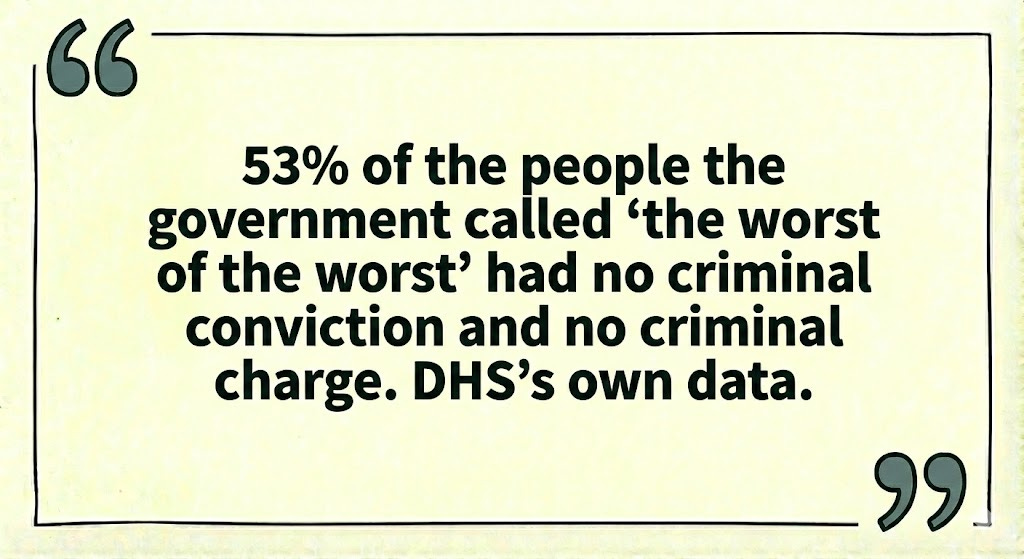
They weren't. DHS's own data — obtained through a Freedom of Information Act request — showed that 53 percent of the Venezuelans sent to CECOT had no criminal conviction and no criminal charge of any kind.12 Only 4 percent had a violent crime conviction. The primary tool used to identify them as gang members was a points-based checklist that flagged tattoos — including roses, clocks, a Real Madrid soccer logo, a Call of Duty video game reference, and song lyrics from a Puerto Rican reggaeton artist.¹² The government's own Tren de Aragua expert testified under oath that the tattoo method was unreliable and reflected "an incorrect conflation of gang practices in Central America and Venezuela."¹² Over 50 of the deportees had entered the United States legally.¹² And in a detail that should end any debate: DHS later created its own "Worst of the Worst" database of criminal immigrants. It included none of the CECOT deportees.¹²
DHS Secretary Kristi Noem visited CECOT after the flights and posted a video thanking El Salvador for "incarcerating" the deportees and imposing "consequences for the violence they have perpetuated." She captioned it: "President Trump and I have a clear message to criminal illegal aliens: LEAVE NOW. If you do not leave, we will hunt you down, arrest you, and you could end up in this El Salvadorian prison."13 UCLA law professor Ahilan Arulanantham — who actually represented CECOT deportees in court — noted that Noem's own words legally transform the deportation from civil immigration enforcement into criminal punishment, which triggers the full weight of the Fifth and Sixth Amendments.¹³ The government said "convicted criminals only" get CECOT. The government sent 238 people who had never been convicted of anything.
Then there was Kilmar Abrego Garcia — the case that made the machinery visible. Abrego Garcia was a 29-year-old Salvadoran national living in Maryland with his American wife and U.S. citizen child. He was a sheet metal worker pursuing his journeyman license. In 2019, a federal immigration judge had granted him "withholding of removal" — a court order explicitly barring his deportation to El Salvador because he faced likely gang persecution there.14 He had a DHS-issued work permit. He had never been charged with or convicted of any crime.
In March 2025, ICE seized him and put him on a plane to El Salvador. He was thrown into CECOT. The administration called it a "clerical error."¹⁴
Three courts — district, circuit, and the Supreme Court — ordered his return. The administration defied them all. Judge Paula Xinis called the government's responses a "willful and bad faith refusal to comply."¹⁴ The DOJ attorney who conceded in court that the deportation was wrong — that it was, in Xinis's words, "wholly lawless" — was removed from the case and placed on administrative leave.¹⁴ When the administration finally brought Abrego Garcia back to the United States, it was not to correct the error. It was to charge him with federal crimes — retroactively constructing justification for what they had done.¹⁴ Attorney General Pam Bondi made public accusations — murder, soliciting images from a minor — that do not appear anywhere in the actual indictment.¹⁴ His attorney: "There's no way a jury is going to see the evidence and agree that this sheet metal worker is the leader of an international MS-13 smuggling conspiracy."¹⁴
And CECOT was only one destination. The administration sent people to countries they had no connection to — and countries where the United States itself had documented that people would be harmed. Eight men were deported to South Sudan — a country on the verge of civil war — and only one was actually South Sudanese.15 The others came from Cuba, Mexico, Laos, Myanmar, and Vietnam. One Burmese man was told he was being sent to Libya, then South Africa, then South Sudan — all within hours.¹⁵ His immigration attorney, a 20-year veteran: "This is a death penalty case with traffic court-level procedure."¹⁵ The administration planned military-operated deportation flights to Libya — a country the State Department rates "Do Not Travel" (its highest danger designation), where open slave markets have been documented since the collapse of the government in 2011.16 Two hundred people, including 81 children, were expelled to Costa Rica from 16 countries — Afghanistan, Armenia, Iran, Russia, Vietnam, Yemen — dumped in a country where they didn't speak the language and had no connection, after Costa Rica's president was coerced by threats of trade-zone tariffs.17 One deportee's statement gave Human Rights Watch its report title: "The strategy is to break us so we will give up."¹⁷ The average cost: $133,000 per person.18
Back on American soil, the apparatus was expanding. In the Florida Everglades, a detention facility was built in eight days in an alligator-infested swamp.19 It was named "Alligator Alcatraz" — after a prison famous for brutality — and they were proud of it. The Florida Republican Party sold branded T-shirts and beer koozies. The ACLU filed a federal lawsuit documenting that detainees were held "off the grid," invisible to families and lawyers, without charges, in conditions they called "atrocious and dangerous."¹⁹ DACA recipients — people brought to this country as children, with legal status — were detained; ICE agents told them their status "doesn't matter anymore."¹⁹
And then DHS revealed its plans for the next phase: 24 warehouse mega-centers across the country — 16 regional processing facilities holding 1,000-1,500 people each, and 8 large-scale detention centers holding 7,000-10,000 people each.20 Total cost: $38.3 billion. Target: 135,000 detention beds by 2029.²⁰ This is not a processing system. It is a permanent deportation pipeline — built to scale, funded by the "One Big Beautiful Bill Act," designed to hold more people in immigration detention than the federal prison system holds convicted criminals.
In 2025, 32 people died in ICE custody — the deadliest year in more than two decades.²⁰ Nearly 75 percent of those detained had no criminal convictions. December alone: seven deaths. Among the dead: DACA recipients brought to the United States as children. An imam who filed an emergency medical motion three days before he died. A man stopped on a grocery run with his wife — they were separated, detained, and he died of kidney and liver failure after repeated symptoms went untreated.²⁰
What the Courts Saw
The judiciary's response tells you how far outside the bounds of normal governance this has gone — because judges don't write the way they've been writing unless they believe something foundational is breaking.
When Judge James Boasberg ordered the Venezuelan deportation flights halted, the planes flew anyway. El Salvador's President Bukele posted on social media: "Oopsie… Too late."21 White House officials amplified the post.
Judge Paula Xinis, on the Abrego Garcia deportation, called it "wholly lawless" and said the government's responses reflected a "willful and bad faith refusal to comply with discovery obligations."¹⁴
Then Judge J. Harvie Wilkinson III wrote what may be the most consequential appellate opinion of the era — and he is a Reagan appointee. Writing for a unanimous Fourth Circuit panel, Wilkinson said: "The government is asserting a right to stash away residents of this country in foreign prisons without the semblance of due process that is the foundation of our constitutional order." He continued: "Further, it claims in essence that because it has rid itself of custody that there is nothing that can be done. This should be shocking not only to judges, but to the intuitive sense of liberty that Americans far removed from courthouses still hold dear."22 And then the warning: "If today the Executive claims the right to deport without due process and in disregard of court orders, what assurance will there be tomorrow that it will not deport American citizens… and train its broad discretionary powers upon its political enemies?"²²
A Reagan-appointed judge, asking on the record whether the government will next come for its political enemies. Even the National Review — the flagship conservative publication — covered the ruling as a "resounding" rejection of the DOJ.²²
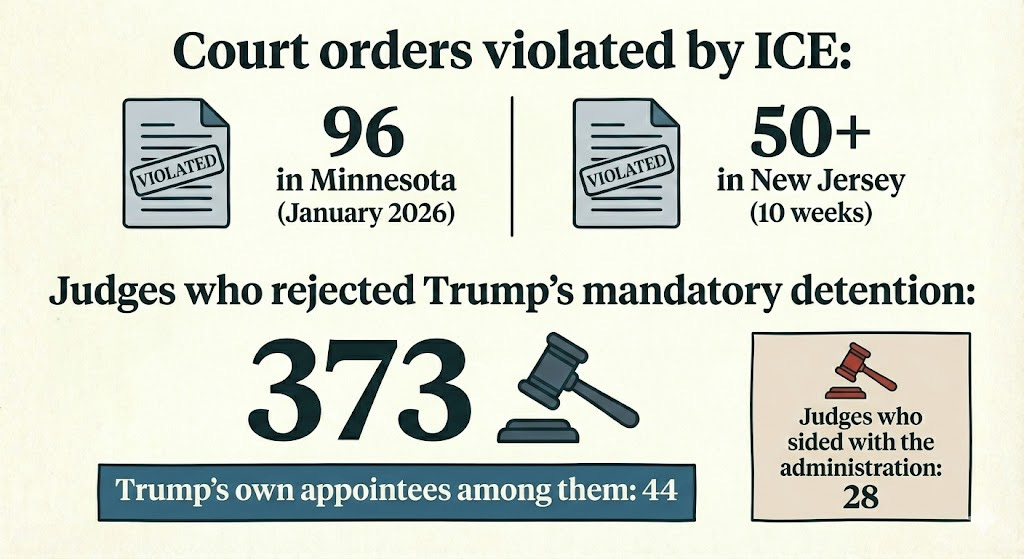
In Minnesota, the scale of defiance overwhelmed the courts. ICE violated 96 court orders in January 2026 alone.23 Chief Judge Schiltz: "ICE has likely violated more court orders in January 2026 than some federal agencies have violated in their entire existence."24 DOJ attorney Julie Le — a Homeland Security lawyer handling more than 80 cases from Operation Metro Surge — told a federal judge in open court: "The system sucks, this job sucks. I wish you would just hold me in contempt so I can get 24 hours of sleep."25 She said ICE had "no guidance or direction" on how to comply with court orders.²⁵ She was later removed from her detail.
Army lawyer Matthew Isihara — pulled from the JAG corps to plug the gap left by mass DOJ resignations — was held in contempt of court and fined $500 per day after ICE defied a specific order to release a man in Minnesota with his identification documents.²⁴ Judge Laura Provinzino, in a nine-page order, wrote: "The Government has offered that excuse to this Court again, and again, and again (and to other judges in this district again, and again, and again, and again, and again, and again)." She called the consequences of non-compliance "real consequences on real human beings."²⁴
In New Jersey, the DOJ admitted in a court filing to violating court orders more than 50 times in 10 weeks, covering 547 immigration cases — including an illegal deportation to Peru in defiance of a judicial injunction.26
And then the language escalated beyond anything in modern judicial memory. Judge Mustafa Kasubhai, in Oregon, did something courts almost never do: he stripped the Department of Justice of its "presumption of good faith" — the foundational trust that courts extend to the federal government.27 "The presumption of regularity that has been previously extended to Plaintiff that it could be taken at its word — with little doubt about its intentions and stated purposes — no longer holds."²⁷ The DOJ can no longer be trusted to tell the truth.
Judge Sunshine Sykes, in California, used the word "terror": "Beyond its terror against noncitizens, the executive branch has extended its violence on its own citizens, killing two American citizens — Renée Good and Alex Pretti — in Minnesota."28
Judge Fred Biery, in Texas, ordered the release of 5-year-old Liam Conejo Ramos from ICE detention, writing: "The perfidious lust for unbridled power and the imposition of cruelty in its quest know no bounds and are bereft of human decency. And the rule of law be damned."29 He affixed a photo of the detained child to his order. Then two Bible verses. Matthew 19:14: "Let the little children come to me, and do not hinder them." John 11:35: "Jesus wept."²⁹
Judge Richard Leon — a George W. Bush appointee — blocked Defense Secretary Hegseth's attempt to demote Senator Mark Kelly for appearing in a video reminding troops of their duty to refuse illegal orders. Leon's response to the government's procedural arguments: "Horsefeathers!"30 He used exclamation points more than a dozen times in the opinion. He told Hegseth to "be grateful" for retired military voices rather than trying to "shrink" their First Amendment rights.³⁰
And Judge William Young — a Reagan appointee — found that Cabinet secretaries Marco Rubio and Kristi Noem had engaged in an "unconstitutional conspiracy" to violate the First Amendment, targeting academics and activists for their political speech on Palestine.31 Young compared their conduct to enforcement of the Fugitive Slave Act. He said the president "has a fearful view of freedom."³¹
Three hundred and seventy-three federal judges have rejected the administration's mandatory detention policy. Forty-four of them were Trump's own appointees. Only twenty-eight sided with the administration.²⁸ Tom Homan, the border czar, went on Fox News and said: "We're not stopping. I don't care what the judges think."²¹
As the New Republic observed: "This is not how federal judges write opinions in normal circumstances."32 When judges start affixing photos of detained children to their orders, citing Bible verses, writing "Horsefeathers!" with exclamation points, using the word "terror," stripping the government of its good-faith presumption, comparing Cabinet secretaries to fugitive slave catchers, and warning about "incipient crisis" — the judiciary is sounding the loudest alarm it can while staying within its institutional role. Judges cannot take to the streets. They can only write opinions. And they are writing the most extreme opinions in living memory.
And the Supreme Court is overruling them.
Since January 20, 2025, the Brennan Center for Justice has tracked 25 decisions on the Supreme Court's shadow docket — the fast-track emergency procedure that bypasses full briefing, oral argument, and written reasoning. Of those 25, the Court ruled for the administration at least partially in 20. Seven came with no written explanation at all.33 In the first 20 weeks of the second Trump administration, the government filed 19 shadow docket applications — the same number the Biden administration filed in four years. The Obama and Bush administrations combined filed 8 in sixteen years.³³
The pattern is consistent. Lower courts block administration actions as likely illegal. The administration appeals to SCOTUS on the shadow docket. The Court overrules — often without explaining why. Racial profiling in immigration sweeps: overruled, no explanation. Mass revocation of parole for half a million people: overruled, no explanation. Firing transgender service members: overruled, no explanation. Terminating members of the FTC without cause: overruled, no explanation.³³ Each time, a lower court found the government was probably breaking the law. Each time, the Supreme Court let it proceed anyway.
The dissenting justices are no longer writing in legalese. Justice Sotomayor, in McMahon v. New York, after the Court allowed the Department of Education to fire its employees despite a lower court order: "When the Executive publicly announces its intent to break the law, and then executes on that promise, it is the Judiciary's duty to check that lawlessness, not expedite it. The majority is either willfully blind to the implications of its ruling or naive, but either way the threat to our Constitution's separation of powers is grave."³³
Justice Kagan, after the Court let the president fire FTC commissioners without cause — overturning a century of precedent on the independence of federal agencies: "Our emergency docket should never be used, as it has been this year, to permit what our own precedent bars. Still more, it should not be used, as it also has been, to transfer government authority from Congress to the President, and thus to reshape the Nation's separation of powers."³³
And Justice Jackson, who has emerged as the most urgent voice on the Court, writing dissent after dissent as the majority clears the path: "The Court allows the Government to do what it wants to do regardless, rendering constraints of law irrelevant and unleashing devastation in the process."³³ And: "Once again, this Court dons its emergency-responder gear, rushes to the scene, and uses its equitable power to fan the flames rather than extinguish them."³³ And, in a line that could serve as the epitaph for the shadow docket era: "By needlessly granting the Government's emergency application, the Court has cleared a path for the Executive to choose law-free action at this perilous moment for our Constitution — right when the Judiciary should be hunkering down to do all it can to preserve the law's constraints."³³
So here is the complete picture: Lower courts — including Reagan, Bush, Clinton, Obama, and Trump appointees — are issuing the most extreme judicial opinions in living memory, stripping the government of its good-faith presumption, comparing Cabinet secretaries to slave catchers, and warning of constitutional crisis. And the Supreme Court is using an emergency back door to overrule them 80 percent of the time, often without bothering to say why. The lower courts are sounding the alarm. The highest court is cutting the wires.
The International Front
The war isn't only domestic. And the rest of the world knows it.
We covered the events briefly in "America First" — the invasion of Venezuela, the Greenland threats, the seizure of the U.S. Institute of Peace, the tariff defiance.34 35 36 37 38 What matters here isn't a second recitation of those facts. What matters is what two people said about them — one from inside the machine, one watching it from the outside — because together they tell you exactly what this project is.
Three days after U.S. special forces captured Nicolás Maduro in a midnight raid on his own capital, White House Deputy Chief of Staff Stephen Miller went on CNN and explained the new world order. Jake Tapper asked him what it meant that the United States was "running Venezuela." Miller didn't hedge: "The United States of America is running Venezuela. By definition. That's true." And then he said this: "We live in a world — in the real world, Jake — that is governed by strength, that is governed by force, that is governed by power. These are the iron laws of the world."39
Read that again. Not "governed by law." Not "governed by treaties." Not "governed by the consent of nations." Governed by strength, force, and power. The iron laws. He wasn't embarrassed. He wasn't caught off guard. He was explaining the thesis — on camera, to a national audience, three days after the United States invaded a sovereign country without congressional authorization and captured its head of state.
Miller kept going. When Tapper asked about Greenland — whether the administration could rule out military force against a NATO ally — Miller refused. When Tapper asked about elections in Venezuela, Miller dismissed the question as a "neoliberal frame." The real frame, Miller said, was simpler: "The United States is using its military to secure our interests unapologetically in our hemisphere. We're a superpower, and under President Trump, we are going to conduct ourselves as a superpower."³⁹ No rules. No allies. No constraints. Just power, applied wherever the president points it.
That was January 6, 2026.
Fourteen days later, Canadian Prime Minister Mark Carney stood at the podium in Davos and gave the world's answer. He did not name the United States. He didn't have to.
"Let me be direct," Carney said. "We are in the midst of a rupture, not a transition."40 The rules-based international order — the system of open sea lanes, collective security, multilateral dispute resolution — was over. Not fading. Over. "The old order is not coming back. We shouldn't mourn it. Nostalgia is not a strategy."⁴⁰
Then Carney did something remarkable. He invoked Václav Havel's 1978 essay The Power of the Powerless — the one about a greengrocer in communist Czechoslovakia who places a sign in his window every morning: "Workers of the world unite." He doesn't believe it. Nobody does. But he places it anyway, to signal compliance, to avoid trouble. And because every shopkeeper on every street does the same, the system persists — "not through violence alone, but through the participation of ordinary people in rituals they privately know to be false."⁴⁰
Havel called this "living within a lie." Carney said the international community had been doing the same thing for decades — placing signs in the window of the rules-based order, performing compliance with a system everyone knew the strongest would exempt themselves from whenever it suited them. "You cannot live within the lie of mutual benefit through integration," Carney said, "when integration becomes the source of your subordination."⁴⁰
And then the line that landed: "When we only negotiate bilaterally with a hegemon, we negotiate from weakness. We accept what's offered. We compete with each other to be the most accommodating. This is not sovereignty. It's the performance of sovereignty while accepting subordination."⁴⁰
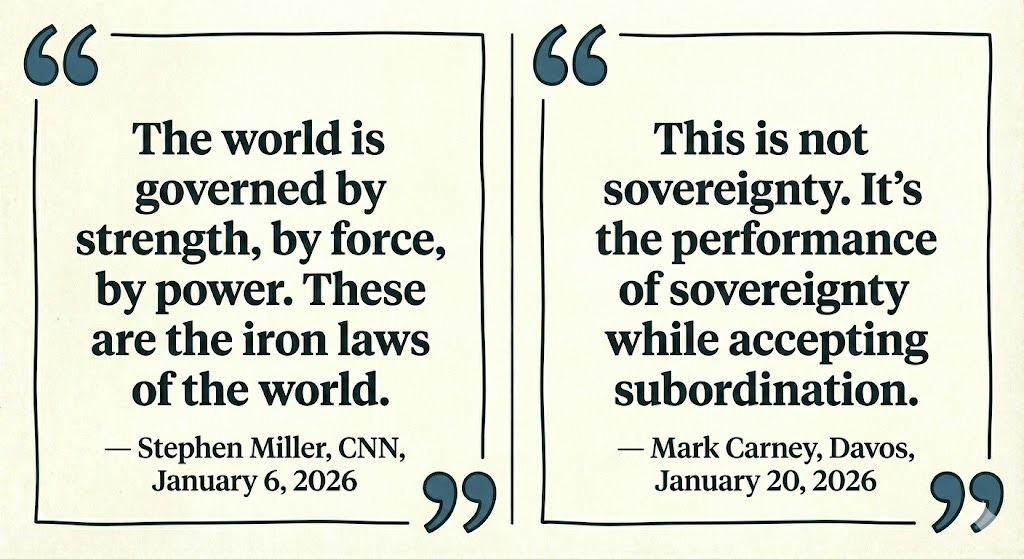
There it is. The architect and the witness. Miller announced that the world is governed by force and the United States would wield it without apology. Carney announced that the lie had been exposed and the sign was coming down. Two weeks apart. One said the quiet part out loud; the other said the world had finally stopped pretending not to hear it.
This is what "America First" always meant. Not isolationism — the opposite. The freedom to project force without constraint, to treat allies as subordinates, to dismiss international law as a "neoliberal frame," to invade sovereign nations and call it "securing our interests." Miller didn't describe a foreign policy. He described the thesis of this entire essay — stated values as instruments, power as the only objective — applied to the planet.
What They Said
The camps are built. The courts have been defied. The international order has been attacked. Now listen to what they say about it — because they will tell you exactly what this is, if you let them.
Steve Bannon, White House Chief Strategist, at CPAC, February 2017 — weeks into the administration: "If you think they're going to give you your country back without a fight, you are sadly mistaken."41 And privately, to journalist Ronald Radosh: "Lenin wanted to destroy the state and that's my goal too. I want to bring everything crashing down and destroy all of today's establishment."⁴¹
Michael Flynn, Trump's former National Security Advisor, at the Reawaken America Tour, November 2021: "If we are going to have one nation under God, which we must, we have to have one religion."42 One religion. Not pluralism. Not liberty. One.
Donald Trump, Veterans Day 2023, Claremont, New Hampshire: "We will root out the communists, Marxists, fascists and the radical left thugs that live like vermin within the confines of our country."43 Historians immediately noted the language. "Vermin." Hitler used it. Mussolini used it. It is the vocabulary of extermination — the word you use about people before you make them disappear.
Donald Trump, Fox News, October 2024, when asked about potential "chaos" on Election Day: "I think the bigger problem are the people from within. We have some very bad people. We have some sick people. It should be very easily handled by, if necessary, by the National Guard, or if really necessary, by the military."44 He named Adam Schiff by name. He said these internal enemies were more dangerous than China and Russia.⁴⁴
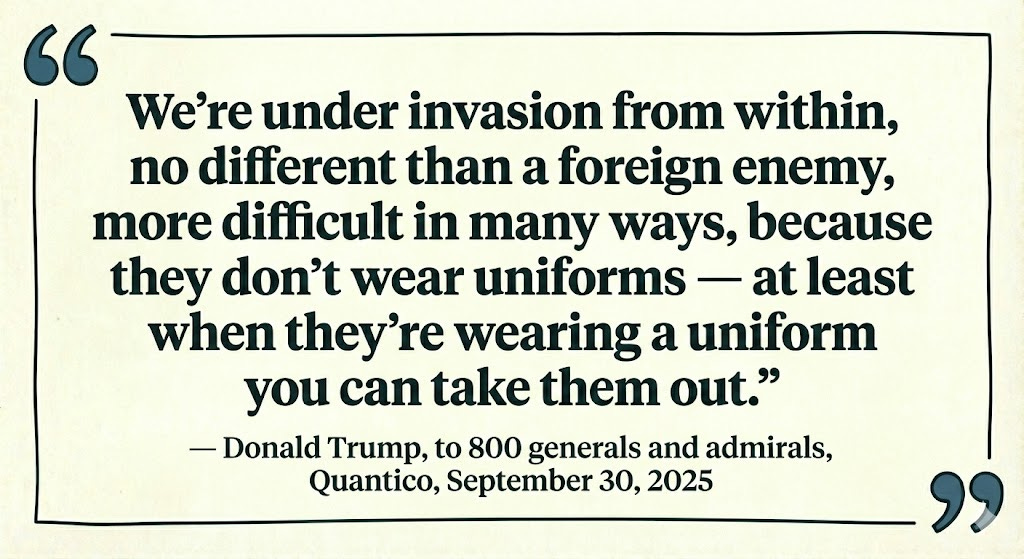
And then, on September 30, 2025, standing before approximately 800 generals and admirals at Marine Corps Base Quantico — the entire senior military leadership of the United States, summoned by Defense Secretary Pete Hegseth — Donald Trump said this: "This is a war too. It's a war from within."45 He called critics "vicious people that we have to fight."⁴⁵ He singled out cities "run by the radical left Democrats — San Francisco, Chicago, New York, Los Angeles" and said: "I told Pete, we should use some of these dangerous cities as training grounds for our military."⁴⁵ And then: "We're under invasion from within, no different than a foreign enemy, but more difficult in many ways, because they don't wear uniforms — at least when they're wearing a uniform you can take them out."⁴⁵
Read that last line again. The commander-in-chief, standing before 800 generals, describing his political opponents and their cities as a war front, and noting that unlike uniformed enemies, "you can take them out" — but these people don't wear uniforms.
Ruth Ben-Ghiat, NYU Professor of History and one of the foremost academic experts on fascism, heard the rhetoric and gave the clinical diagnosis: "Speaking of Americans as an enemy within — this is all straight from fascism. The core of fascism in Italy and Germany were combatants who followed their leader to bring the war home and turned their force against their own people."46
And then Kevin Roberts — president of the Heritage Foundation, the organization that authored Project 2025, the blueprint for everything you've just read — went on national television and said this: "We are in the process of the second American Revolution, which will remain bloodless if the left allows it to be."47
Read the conditional. Not "if we succeed." Not "if we're right." If the left allows it to be. The revolution is not in question. It's underway. The only variable is the blood — and that choice, Roberts says, belongs to the people being crushed by it.
That's the verdict: You don't name a prison after alligators and brag about it if you're enforcing immigration law. You don't build mega-centers for 10,000 people each if you're processing visa violations. You don't ship a court-protected man to a foreign torture prison over a "clerical error" if you see him as a human being. You don't deport people to countries with open slave markets if you care whether they live. You don't send 81 children to a country they've never been to and call it "enforcement." You don't kill a nurse holding his phone and call him an assassin if you see him as a citizen. You don't tell 800 generals that your political opponents are "the enemy" and their cities are "training grounds" if you're running a democracy.
This is what it looks like when there is no hypocrisy — when the stated values have been fully discarded, the real project is fully visible, and the people running it are telling you exactly what it is, in their own words, on camera, on the record.
This is what war looks like when the people waging it stop pretending they're engaged in a debate about principles.
What this establishes: by the time we reach the camps, the court defiance, the international posture, and their own rhetoric, the mask is gone. The project is no longer hiding behind principle-language because it no longer needs to. They are describing it openly now — force, hierarchy, enemies, war. The only mistake left is continuing to answer it like a debate.
The Verdict
Every time we call it hypocrisy, we give them cover. We reduce a war to a debate flaw. We treat detention camps as a "gotcha" moment and rendition flights as a contradiction to be catalogued. We act like if we just point out the double standard loudly enough — if we just catch them one more time — they'll be embarrassed into stopping. That the system will self-correct. That the referees will intervene. That someone, somewhere, will finally say enough.
They won't. Because there is no double standard. There is no contradiction. There never was. Every single "inconsistency" in this essay — every gun law they blocked while arming the state, every book they banned while screaming about free speech, every deficit they exploded while preaching fiscal discipline, every court order they defied while chanting "law and order" — points in the same direction. The stated values were never the project. They were the camouflage. And we have spent decades analyzing the camouflage while the project advanced unobstructed.
They are not — and never were — hypocrites. They are fascist insurgents waging a war against the republic, and they are willing to do anything to win it: lie about their principles, rendition innocent people into foreign torture prisons where nobody leaves alive, or kill American citizens on their own doorstep. You cannot avoid a war brought upon you by denial any more than you can win one without accepting you're in it.
But we didn't write 15,000 words just to tell you the house is on fire. We wrote them so you could see the architecture — who built it, how it works, and where the load-bearing walls are. Because you can't fight what you can't name, and you can't dismantle what you don't understand. This was the case. The next piece is the strategy.
We built this publication to equip you with the tools to fight back — the frameworks, the messaging, the strategies that actually work. See the links below. But we can only keep doing this with your help. If this matters to you, please consider becoming a paid subscriber. You keep the fight alive.
Fighting Fascism: How We Charge Ahead and Win — The strategic playbook for reclaiming power
The Trump Regime Messaging Guide — How to talk to people who've been captured by the machine
The Freedom Illusion — How we got here, and the counter-ideology that gets us out
Article Sources:
J. Oliver Conroy, "Mark Lilla and the Crisis of Liberalism", The Guardian, December 21, 2017.
Profile of Columbia humanities professor Mark Lilla, whose November 2016 New York Times op-ed "The End of Identity Liberalism" became the paper's most-read political op-ed that year and whose subsequent book The Once and Future Liberal described identity politics as "Reaganism for lefties." The piece captures the essential counter-arguments: Ta-Nehisi Coates argued Lilla's framing "effectively excuses white identity politics" — ennobling what appeals to the white working class while damning "what appeals to black workers, and all others outside the tribe." Thomas Chatterton Williams noted the book's telling omission of the Southern Strategy — the Republican Party's own half-century experiment in explicit racial identity politics. Columbia colleague Katherine Franke argued Lilla's critique made "white supremacy respectable" by blaming marginalized groups for Trump's election. Documents the "identity politics" accusation as a rhetorical weapon that erases the attacker and blames the defense.
Office of the President (Clinton Administration), "Affirmative Action: History and Rationale", Clinton White House / National Archives, 1995.
The Clinton White House's formal 1995 review of affirmative action — the single most authoritative government source documenting that affirmative action was created entirely as a response to documented, systemic discrimination. Case after case where anti-discrimination statutes alone failed: Alabama State Police had zero Black troopers after 37 years; even after a court injunction, 18 months passed with no hires until numerical goals were imposed. Kaiser Aluminum: 5 of 273 skilled craft workers were Black because of union exclusion. San Francisco PD: 4% women in 1979. After consent decrees with numerical targets, Black officers rose from 7 to 31, Hispanic from 12 to 55, Asian from 0 to 10, and women were admitted as firefighters for the first time. Even the Nixon administration defended goals and timetables as "necessary and right." Affirmative action was not ideological preference — it was remedial necessity after experimentation showed "other means too often failed to correct the problems."
DeNeen Brown, "Diversity, Equity, and Inclusion Programs", Encyclopædia Britannica, February 19, 2026.
Comprehensive entry tracing DEI's origins directly to documented racist state violence — beginning with Sgt. Isaac Woodard Jr., a Black World War II veteran blinded by police in 1946 while still in uniform, hours after receiving his honorable discharge. NAACP Executive Secretary Walter White brought the case to Truman, who responded: "My God. I didn't know it was this bad. We've got to do something." White House aides confirmed the Woodard incident pushed Truman to issue Executive Orders 9980 and 9981 (1948), desegregating the federal workforce and armed forces. Every subsequent wave of DEI expansion corresponds to documented violence: the Civil Rights Act responding to Jim Crow, post-Ferguson reforms responding to police killings (Washington Post: ~1,000 per year, disproportionately Black), post-George Floyd corporate initiatives responding to a murder on camera. Thurgood Marshall's 1987 speech: the Constitution was "defective from the start." Ron DeSantis in 2023 claimed DEI "is better viewed as standing for discrimination, exclusion, and indoctrination" — renaming the repair as the disease.
Tom K. Wong, "The Effects of Sanctuary Policies on Crime and the Economy", Center for American Progress, January 26, 2017.
Peer-reviewed statistical analysis by a UC San Diego political scientist using ICE's own FOIA data across 608 sanctuary counties. Findings: sanctuary counties have 35.5 fewer crimes per 10,000 people, $4,353 higher median household income, 2.3% lower poverty, and 1.1% lower unemployment than comparable non-sanctuary counties. The study documents why sanctuary policies were created: the International Association of Chiefs of Police warned that state and local enforcement of federal immigration law creates a "chilling effect" on crime reporting. The Major Cities Chiefs Association concluded that commingling local policing with immigration enforcement "would result in increased crime against immigrants and in the broader community" and "create a class of silent victims." Sanctuary policies are not identity politics — they are public safety policies designed by law enforcement leaders to keep communities safe.
Ivette Feliciano, "2021 Sets Record in Anti-Trans Bills in America", PBS NewsHour Weekend, June 6, 2021.
PBS NewsHour interview with ACLU Transgender Justice Director Chase Strangio documenting the origins of the anti-trans legislative wave as organized political backlash — not spontaneous cultural concern. Strangio identifies the causal chain: "It's part of a continued backlash from marriage equality. So when the Supreme Court struck down bans on marriage for same-sex couples in 2015, you immediately saw a backlash in the form of legislative attacks on trans people and trans youth in particular." The wave escalated after the 2020 SCOTUS ruling extending civil rights protections to LGBTQ people and intensified after Biden's election. More than 250 anti-LGBTQ bills were introduced in state legislatures in 2021 alone. Florida signed an anti-trans sports ban on the first day of Pride Month. The attackers moved first; the protections followed.
American Civil Liberties Union, "In 2023, the ACLU Tracked 510 Anti-LGBTQ Bills in the U.S.", ACLU, December 21, 2023.
The definitive legislative tracker documenting the scale of the anti-trans campaign: 615 anti-trans bills introduced in 2023, 87 signed into law across 24 states — the fourth consecutive record-breaking year. Bills target healthcare bans, sports exclusions, bathroom restrictions, school curriculum censorship, ID document restrictions, and religious exemptions allowing discrimination. States with the most bills: Texas (40+ in 2021 alone), Tennessee, Arkansas, Florida, Alabama. The tracker documents bills in both directions — attacks and protections — making clear which side initiated the fight. Gillian Branstetter, ACLU: "The end goal of anti-trans legislation is denying transgender people the words to describe our experience, the means to express it safely, and the community and support we all deserve." The existence of this tracker is itself evidence: there would be no need to track "attacks on LGBTQ rights" if those attacks were not coming overwhelmingly from one direction.
Rick Perlstein, "Exclusive: Lee Atwater's Infamous 1981 Interview on the Southern Strategy", The Nation, November 13, 2012.
Publishes for the first time the full 42-minute audio recording of Lee Atwater's 1981 interview with political scientist Alexander Lamis of Case Western Reserve University, in which Atwater — then working in the Reagan White House, later George H.W. Bush's campaign manager and RNC chairman — describes the deliberate evolution of Republican racial strategy: "You start out in 1954 by saying, 'Nigger, nigger, nigger.' By 1968 you can't say 'nigger' — that hurts you, backfires. So you say stuff like, uh, forced busing, states' rights, and all that stuff, and you're getting so abstract. Now, you're talking about cutting taxes, and all these things you're talking about are totally economic things and a byproduct of them is, blacks get hurt worse than whites." The audio was unearthed by James Carter IV, who also obtained the Mitt Romney "47 percent" tape. Lamis had published the interview anonymously in his 1984 book The Two-Party South and with Atwater's name in a 1999 edition, eight years after Atwater's death. His widow released the audio to validate her husband's scholarship after conservatives claimed he fabricated it. The architect of the Republican Party's modern electoral strategy, on tape, describing a half-century project to encode racial hostility into policy language abstract enough to deny.
Ken Mehlman, "Ken Mehlman Remarks at NAACP", KenMehlman.com, July 14, 2005.
The sitting chairman of the Republican National Committee, standing before the NAACP's national convention, formally apologized for the Southern Strategy: "Some Republicans gave up on winning the African American vote, looking the other way or trying to benefit politically from racial polarization. I am here today as the Republican chairman to tell you we were wrong." Mehlman acknowledged that after the Civil Rights Act of 1964 — when Democrats championed civil rights legislation — "some Republicans" chose to exploit the resulting racial backlash among white voters rather than compete for Black votes. The apology was widely covered by the Washington Post, Los Angeles Times, and national press. President George W. Bush's approval rating among African Americans fell to 2% after the speech — suggesting the audience recognized a gesture without a commitment. The party chairman confessed to a strategy of deliberate racial polarization. The party did not subsequently abandon that strategy.
Tommy Christopher, "RNC Chair Michael Steele Confesses to Race-Based Southern Strategy", Mediaite, April 23, 2010.
The first African American chairman of the Republican National Committee acknowledged that "For the last 40-plus years we had a 'Southern Strategy' that alienated many minority voters by focusing on the white male vote in the South." Steele said the party had "lost sight of the historic, integral link between the party and African Americans" and had "mistreated that relationship" — despite the Republican Party's historical role in co-founding the NAACP and its origins as the party of Lincoln. Two RNC chairmen, five years apart — one white, one Black — both publicly acknowledged that the Republican Party ran a deliberate, decades-long strategy of racial polarization to win white votes in the South. The confession was bipartisan within the party. The strategy continued regardless.
Human Rights Watch and Cristosal, "You Have Arrived in Hell: Torture and Other Abuses Against Venezuelans in El Salvador", Human Rights Watch, November 12, 2025.
Definitive 81-page joint investigative report by Human Rights Watch and Cristosal documenting the torture and abuse of Venezuelan deportees inside CECOT, based on interviews with 40 former detainees and 150 people with firsthand knowledge. Critically, the report also establishes what was known before the deportations: El Salvador's Justice Minister said in February 2023 that CECOT prisoners "will only leave in a coffin"; the U.S. State Department's own 2023 report called El Salvador's prisons "harsh and life-threatening"; Cristosal had documented 419 prison deaths under the state of emergency before the March 2025 flights. Guards wore hoods and went by nicknames (Satán, Pantera, El Tigre). No yards, no natural light, no mattresses, lights always on. The report explicitly states: "The United States sent the 252 Venezuelans to CECOT despite credible prior reports that torture and other abuses were taking place." They knew.
Camilo Montoya-Galvez and Annabelle Hanflig, "Names of All 238 Venezuelan Deportees Published", CBS News, March 20, 2025.
CBS News obtained and published the full internal government list of all 238 Venezuelan men deported to El Salvador on three flights on March 15, 2025 — documentation the government never intended to release. The article establishes the full scope: 137 removed under the Alien Enemies Act of 1798, 101 under regular immigration law. Families learned their loved ones had been deported from Salvadoran government social media posts — the U.S. government told no one. No release dates, no specified sentences, no access to lawyers or family communication. The U.S. paid El Salvador approximately $4.76 million. Total Venezuelans sent to CECOT across March-April 2025: 252.
David J. Bier, "DHS Doesn't List CECOT Prison Deportees in Its Worst of the Worst Data", Cato Institute, December 23, 2025.
Cato Institute analysis using DHS's own FOIA-released data that demolishes the "worst of the worst" framing. Fifty-three percent of CECOT deportees had no criminal conviction and no criminal charge of any kind. Only 4 percent had a violent crime conviction. The primary identification tool was a points-based checklist flagging tattoos — including roses, clocks, a Real Madrid soccer logo, and a Call of Duty video game reference. The government's own Tren de Aragua expert testified under oath that the method was unreliable. Over 50 deportees had entered the U.S. legally. DHS later created its own "Worst of the Worst" database and included none of the CECOT deportees in it. The government called them the worst criminals in America, then quietly refused to put them in its own worst-criminals list.
Ahilan Arulanantham, "Deportation to CECOT: The Constitutional Prohibition on Punishment Without Charge or Trial", Just Security (NYU School of Law), April 23, 2025.
Legal analysis by a UCLA law professor who actually represented CECOT deportees in habeas litigation. Arulanantham's argument: deportation to CECOT constitutes punishment under the Fifth and Sixth Amendments, which requires a trial. DHS Secretary Noem's own words on video — calling CECOT a "consequence" and threatening "we will hunt you down" — legally transform the deportation from civil enforcement into criminal punishment, triggering full constitutional protections. Both Rubio and Bukele described the arrangement as being for "convicted criminals" — but the deportees were never convicted. The government's own statements constitute the legal confession that this was punishment without trial.
Mark Sherman, "Trump Administration Asks Supreme Court to Block Order Returning Man Deported to El Salvador Because of Error", PBS NewsHour / Associated Press, April 7, 2025. ; Melissa Quinn, Jacob Rosen, and Nicole Valdes, "Kilmar Abrego Garcia, wrongly deported to El Salvador, brought back to U.S. to face human smuggling charges", CBS News, June 7, 2025.
The Abrego Garcia case: a 29-year-old Salvadoran national living in Maryland with a U.S. citizen wife and child, working as a sheet metal apprentice, under a federal court order explicitly barring his deportation to El Salvador. ICE seized him and sent him to CECOT anyway — the administration called it a "clerical error." Three courts ordered his return; the administration defied them all. Judge Xinis called the deportation "wholly lawless" and the government's responses a "willful and bad faith refusal to comply." The DOJ attorney who conceded the deportation was wrong was removed from the case. When the administration finally returned Abrego Garcia, it was to charge him with federal crimes — retroactively constructing justification. AG Bondi made public accusations that do not appear in the actual indictment. Judge Wilkinson: "There is no question that the government screwed up here."
Maya Yang and Maanvi Singh, "Judge Rules White House Violated Order by Deporting to South Sudan", The Guardian, May 21, 2025.
Documents one of the most egregious third-country deportations: eight men sent to South Sudan — a country on the verge of civil war — from Cuba, Mexico, Laos, Myanmar, Vietnam, and South Sudan (only one was actually South Sudanese). One Burmese man was told three different destination countries within hours. Immigration attorney Jonathan Ryan, a 20-year veteran: "This is a death penalty case with traffic court-level procedure." Judge Brian Murphy ruled the deportation "unquestionably" violated his court order. The DOJ filed an erroneous sworn declaration claiming a deportee had consented — later admitted it was wrong.
Camilo Montoya-Galvez and Eleanor Watson, "Trump Administration May Soon Deport Migrants to Libya", CBS News, May 8, 2025. ; Renata Brito and Fatma Khaled, "Reports of Trump deportation plans highlight abuse of migrants in Libya", AP News, May 8, 2025.
Documents the administration's plan for military-operated deportation flights to Libya — a country the State Department rates "Do Not Travel" (highest danger designation), with documented open slave markets where migrants are sold for as little as $400. Both of Libya's rival governments denied any deportation agreement. A UN report covering 2024-2025 describes "a brutal and normalized reality" of slavery, forced labor, and sexual violence against migrants. The targets were people from Mexico and Asia with no connection to Libya — the administration was choosing a destination specifically because it is dangerous.
Human Rights Watch, "The Strategy Is to Break Us: The US Expulsion of Third-Country Nationals to Costa Rica", Human Rights Watch, May 22, 2025.
Based on face-to-face interviews with 36 of the 200 people expelled. Two hundred third-country nationals — including 81 children — from 16 countries (Afghanistan, Armenia, Iran, Russia, Vietnam, Yemen, and others) were expelled to Costa Rica, a country where they didn't speak the language and had no connection. Thirty-four of 36 interviewed received no asylum screening interview before expulsion. A 12-year-old boy was separated from his mother for 29 days. Costa Rica's president acknowledged accepting the flights under economic coercion: "We are helping the economically powerful brother to the north, who if they impose a tax in our free zones, it'll screw us." The report's title comes from a deportee: "I think the strategy is to break us so we will give up."
Stephen Groves and Matthew Lee, "US spent $40 million on roughly 300 deportations to third nations, Democratic report finds", AP News, February 13, 2026.
A Senate Democratic report documented that the Trump administration spent over $40 million in taxpayer money during its first year to deport approximately 300 people to countries they had no connection to — roughly $133,000 per person. Thirty-two million dollars went in lump sums to five governments (Equatorial Guinea, Rwanda, El Salvador, Palau, and Eswatini) with little oversight. In some individual cases, cost per deportation exceeded $1 million.
Curt Anderson and Kate Payne, "First immigration detainees arrive at 'Alligator Alcatraz' in Florida Everglades", PBS NewsHour / Associated Press, July 3, 2025. ; ACLU, "New Lawsuit Challenges Florida's Authority to Detain People at Notorious Alligator Alcatraz Detention Center", ACLU, August 23, 2025.
Documents the detention facility built in eight days in the Florida Everglades — named "Alligator Alcatraz" by Florida AG James Uthmeier after a prison famous for brutality. The Florida Republican Party sold branded T-shirts and beer koozies. The ACLU's federal lawsuit documents people held "off the grid," invisible to families and lawyers, without charges, in conditions called "atrocious and dangerous." DACA recipients detained; ICE agents told them their status "doesn't matter anymore." DeSantis said the facility was "meant as a deterrent" and the name was "meant to send a message."
The Guardian, "ICE Warehouses: DHS Plans for 24 Detention Centers", The Guardian, February 13, 2026. ; The Guardian, "ICE 2025 Deaths Timeline", The Guardian, January 4, 2026.
DHS documents reveal a $38.3 billion plan for 24 warehouse mega-centers: 16 regional processing facilities (1,000-1,500 people each) and 8 large-scale detention centers (7,000-10,000 people each). Target: 135,000 detention beds by FY2029. Funded by the "One Big Beautiful Bill Act." As of January 2026: 70,766 people detained — the highest recorded population. In 2025, 32 people died in ICE custody — the deadliest year in more than two decades, matching the 2004 record. Nearly 75% of those detained had no criminal convictions. Among the dead: DACA recipients, an imam who filed an emergency medical motion three days before he died, a man stopped on a grocery run with his wife who died after repeated symptoms went untreated.
Nik Popli and Brian Bennett, "Deportations Set Up Crucial Test For Courts, as Some Warn of Constitutional Crisis", TIME, March 17, 2025.
Documents the administration's deliberate, public defiance of federal court orders — not hidden violations, but open contempt celebrated on social media. Judge Boasberg ordered deportation flights halted; the planes flew anyway. El Salvador's Bukele posted: "Oopsie… Too late." White House officials amplified the post. Tom Homan: "We're not stopping. I don't care what the judges think." Law professor Kim Wehle: the country is "far beyond" a constitutional crisis — "the checks and balances are gone." White House Press Secretary Leavitt questioned whether "a verbal order carries the same weight as a written order" — rationalizing defiance.
Melissa Quinn, "Appeals Court Rejects Trump Administration Claims in Abrego Garcia Case as 'Shocking'", CBS News, April 17, 2025.
Reagan-appointed Judge J. Harvie Wilkinson III, writing for a unanimous Fourth Circuit panel, issued one of the most searing appellate opinions of the modern era: "The government is asserting a right to stash away residents of this country in foreign prisons without the semblance of due process that is the foundation of our constitutional order." He warned: "If today the Executive claims the right to deport without due process, what assurance will there be tomorrow that it will not deport American citizens… and train its broad discretionary powers upon its political enemies?" Even the National Review — the flagship conservative publication — covered the ruling as a "resounding" rejection.
Jennifer Mayerle, "Minnesota judge counts ICE violations at nearly 100 court orders: 'ICE is not a law unto itself'", CBS News Minnesota, January 29, 2026.
Reporting on Chief Judge Schiltz's finding that ICE violated 96 court orders in Minnesota in January 2026 alone — a rate of lawlessness that Schiltz said likely exceeded "some federal agencies' entire existence." Establishes the court defiance pattern that is developed fully in Section VII.
Jacob Rosen and Joe Walsh, "Minnesota Judge Holds DOJ Lawyer in Contempt", CBS News, February 20, 2026. ; Joe Walsh, "Judge Lifts Contempt, Blasts DOJ", CBS News, February 20, 2026.
Documents Army lawyer Matthew Isihara — pulled from the JAG corps to plug the gap left by mass DOJ resignations — held in contempt at $500/day after ICE defied Judge Provinzino's order to release a man in Minnesota with his identification documents. Provinzino's nine-page written order: "The Government has offered that excuse to this Court again, and again, and again (and to other judges in this district again, and again, and again, and again, and again, and again)." She rejected the "understaffing" defense as justification for "flagrant disobedience" and called the consequences "real consequences on real human beings." Isihara was listed as attorney on 100+ cases filed since January 2026.
Alex Woodward, "'This Job Sucks': DOJ Lawyer Asks to Be Held in Contempt So She Can Sleep", The Independent, February 3, 2026.
DOJ attorney Julie Le — a Homeland Security lawyer handling 80+ cases from Operation Metro Surge — told federal judge Jerry Blackwell in open court: "The system sucks, this job sucks. I wish you would just hold me in contempt of court so I can get 24 hours of sleep." She said ICE had "no guidance or direction" on how to comply with court orders. She was later removed from her Justice Department detail. The Trump administration's "law and order" regime in action: so overwhelmed by the chaos it created that its own lawyers are publicly begging to be jailed for relief.
ABA Journal, "DOJ Admits to Violating Dozens of Immigration-Related Court Orders in New Jersey", ABA Journal, February 19, 2026.
The Trump DOJ formally acknowledged in a federal court filing that it violated immigration court orders more than 50 times in 10 weeks in New Jersey — covering 547 cases. Violations included an illegal deportation to Peru in defiance of a judicial injunction, missed deadlines for bond hearings, and out-of-state transfers after judges issued no-transfer orders. Associate Deputy AG Jordan Fox: "We regret deeply all violations." This is not alleged — the government admitted it in writing.
Yunior Rivas, "Federal Judge Rules DOJ Can 'No Longer' Be Trusted in Voter Roll Crusade", Democracy Docket, February 6, 2026.
Oregon federal judge Mustafa T. Kasubhai stripped the DOJ of its "presumption of good faith" — the foundational trust courts extend to the federal government — after AG Bondi's own letter linked voter roll lawsuits to ICE immigration enforcement, exposing the stated "election integrity" rationale as pretextual. "The presumption of regularity that has been previously extended to Plaintiff that it could be taken at its word — with little doubt about its intentions and stated purposes — no longer holds." Courts almost never withdraw this presumption. Kasubhai did. New Mexico and Minnesota immediately cited his ruling.
Catherine Bouris, "Judge Gives Blistering Review of Trump Policy in New Ruling", The Daily Beast, February 19, 2026.
Judge Sunshine Sykes used the word "terror" to describe the administration's conduct: "Beyond its terror against noncitizens, the executive branch has extended its violence on its own citizens, killing two American citizens — Renée Good and Alex Pretti — in Minnesota." She called officials "shameless" and vacated the Board of Immigration Appeals' endorsement of mandatory detention. Per Politico's analysis: 373 federal judges have rejected Trump's mandatory detention policy; 44 were Trump's own appointees; only 28 sided with the administration.
San Antonio Express-News, "Judge Orders Release of 5-Year-Old Migrant From Texas ICE Detention", San Antonio Express-News, January 31, 2026.
Judge Fred Biery ordered the release of 5-year-old Liam Conejo Ramos from ICE detention, writing: "The perfidious lust for unbridled power and the imposition of cruelty in its quest know no bounds and are bereft of human decency. And the rule of law be damned." He accused the administration of "ignorance of an American historical document called the Declaration of Independence." He affixed a photo of the detained child to his order, followed by two Bible verses: Matthew 19:14 ("Let the little children come to me, and do not hinder them") and John 11:35 ("Jesus wept"). As the New Republic noted: this is not how federal judges write opinions in normal circumstances.
Jacob Knutson, "'Horsefeathers!': Judge blasts Hegseth's attempt to demote Sen. Kelly over video to U.S. troops", Democracy Docket, February 12, 2026.
George W. Bush-appointed Judge Richard Leon blocked Defense Secretary Hegseth's attempt to demote Senator Mark Kelly — a retired Navy captain and astronaut — for appearing in a video reminding troops of their duty to refuse illegal orders. Leon's response to the government's procedural arguments: "Horsefeathers!" He used exclamation points more than a dozen times. He told Hegseth to "be grateful" for retired military voices rather than trying to "shrink" their First Amendment liberties. A Republican-appointed judge using this language against a Republican defense secretary underscores the bipartisan judicial alarm.
Malcolm Ferguson, "Judge Accuses Trump, Rubio, and Noem of 'Unconstitutional Conspiracy'", The New Republic, January 16, 2026.
Reagan-appointed Judge William Young found that Cabinet secretaries Marco Rubio and Kristi Noem engaged in an "unconstitutional conspiracy" to violate the First Amendment, targeting academics and activists for their political speech on Palestine. Young: "I find it breathtaking that I have been compelled on the evidence to find the conduct of such high-level officers of our government — Cabinet secretaries — conspired to infringe the First Amendment rights of people with such rights here in the United States." He compared their conduct to enforcement of the Fugitive Slave Act. He said the president "has a fearful view of freedom." A Reagan appointee calling sitting Cabinet members unconstitutional conspirators.
Matt Ford, "The Judges and Juries Saving the Republic From Trump", The New Republic, February 23, 2026.
Comprehensive overview documenting the pattern of lower federal courts issuing "direct, unvarnished" language in rulings against the Trump administration — language Ford argues signals "how far the country has drifted from legitimate constitutional government." Covers Sykes, Biery, Leon, Wilkinson, Young, and others. Key observation: "This is not how federal judges write opinions and orders in normal circumstances." When judges start affixing photos, citing Bible verses, stripping the government of good-faith presumptions, and warning about "incipient crisis," the judiciary is sounding the loudest institutional alarm available to it.
Brennan Center for Justice, "Supreme Court Shadow Docket Tracker — Challenges to Trump Administration Actions", Brennan Center for Justice, December 23, 2025.
Comprehensive tracker documenting the Supreme Court's use of its emergency "shadow docket" to rule on challenges to Trump administration actions. Since January 20, 2025, the Court has issued 25 shadow docket decisions: 20 ruled for the administration at least partially, 5 ruled against, and 7 had no written explanation at all. In 20 weeks, the second Trump administration filed 19 shadow docket applications — the same number the Biden administration filed in four years; the Obama and Bush administrations combined filed 8 in sixteen years (citing Georgetown Professor Stephen Vladeck's analysis). The tracker includes devastating dissent language from Justices Sotomayor ("willfully blind... or naive"), Kagan ("should never be used... to transfer government authority from Congress to the President"), and Jackson ("dons its emergency-responder gear, rushes to the scene, and uses its equitable power to fan the flames rather than extinguish them"). Documents how the shadow docket has been used to allow racial profiling in immigration sweeps, mass revocation of parole for half a million people, termination of transgender service members, firing of independent agency commissioners, and mass layoffs — all after lower courts found these actions likely illegal.
Miranda Jeyaretnam and Chad de Guzman, "What's Happening With the U.S. and Venezuela, Explained", TIME, January 12, 2026.
Comprehensive explainer documenting the invasion of Venezuela — Operation Absolute Resolve (January 3, 2026): 150+ U.S. aircraft, bombing of Venezuelan air defenses, capture of President Maduro at 2 a.m. in Caracas. At least 148 people killed in 43 strikes. No prior congressional authorization. Trump told NBC he wasn't "at war" while overseeing armed intervention; said the U.S. would "run" Venezuela; met with 20 oil executives seeking $100 billion in Venezuelan oil commitments. A U.N. spokesperson: the action made "all States less safe around the world." The "America First" / "stop policing the world" president launched the most consequential unilateral military action in decades — for oil.
Heather Stewart and Andrew Roth, "Davos 2026: Trump Greenland — 'You Can Say No and We Will Remember'", The Guardian, January 21, 2026.
Documents Trump's Davos speech demanding Greenland acquisition from Denmark — a NATO ally — with explicit coercive threats: "You can say no and we will remember." Trump had previously threatened 10% tariffs on eight European countries over the territory. He told NATO allies: "I'm not sure if they'd be there for us" — undermining the mutual defense compact — while praising his "very good relationship" with Putin and Xi. Canadian PM Carney: "Middle powers must act together, because if we're not at the table, we're on the menu." The "America First" posture revealed as unilateral aggression against allies and deference to authoritarian rivals.
Associated Press, "Institute of Peace Renamed Donald Trump", The Guardian (AP), December 4, 2025.
Documents the seizure and renaming of the U.S. Institute of Peace — a Congress-created independent institution — despite a federal court ruling the takeover illegal. DOGE fired the board and staff; the building was seized by GSA. State Department renamed it "Donald J. Trump Institute of Peace" — a White House spokesperson: it "will stand as a powerful reminder of what strong leadership can accomplish for global stability." Trump subsequently established a "Board of Peace" with himself as chair, $17 billion in pledged funding, and a mandate that may displace U.N. diplomatic functions. A peace institution became a vanity monument, then a rival to the U.N., while the administration bombed Venezuelan fishing vessels.
Adam Feldman, "A Breakdown of the Court's Tariff Decision", SCOTUSblog, February 20, 2026.
Definitive legal analysis of the 6-3 Supreme Court ruling in Learning Resources, Inc. v. Trump holding that IEEPA does not authorize presidential tariffs. Chief Justice Roberts' majority (joined by Sotomayor, Kagan, Gorsuch, Barrett, and Jackson): "No President has read IEEPA to confer such power" in its 50-year existence. The ruling struck down Trump's "Reciprocal Tariffs" and fentanyl tariffs, with an estimated $160+ billion in refunds owed. The "free market" party lost at the Supreme Court for imposing the most protectionist — and illegal — trade policy in a century.
Lucy Campbell, "Trump Raises Global Tariff to 15% After Supreme Court Ruling", The Guardian, February 21, 2026.
Documents Trump's explosive defiance of the Supreme Court tariff ruling. Within 24 hours: called the justices "a disgrace to the nation," called his own appointees Barrett and Gorsuch "an embarrassment to their families," and imposed new 15% global tariffs under Section 122 of the Trade Act of 1974 — a law never previously invoked. Over $130 billion in IEEPA tariffs had already been collected, with 90% of the burden paid by U.S. businesses and consumers. French President Macron: "It is not bad to have a supreme court and, therefore, the rule of law." The president didn't comply with the ruling — he found another weapon.
Forbes Breaking News, "Stephen Miller Gives Fiery Defense Of Maduro Capture In Tense Interview With CNN's Jake Tapper", YouTube / Forbes Breaking News, January 6, 2026.
White House Deputy Chief of Staff Stephen Miller on CNN with Jake Tapper, three days after U.S. special forces captured Venezuelan President Nicolás Maduro. When Tapper asked what it means that the U.S. is "running Venezuela," Miller replied: "The United States of America is running Venezuela. By definition. That's true." He then stated: "We live in a world — in the real world, Jake — that is governed by strength, that is governed by force, that is governed by power. These are the iron laws of the world." Miller refused to rule out military force against NATO ally Denmark over Greenland, dismissed the question of Venezuelan elections as a "neoliberal frame," and declared: "The United States is using its military to secure our interests unapologetically in our hemisphere. We're a superpower, and under President Trump, we are going to conduct ourselves as a superpower." The interview is a near-explicit articulation of the essay's thesis: stated values are instruments, power is the only objective.
Mark Carney, "Davos 2026: Special Address by Mark Carney, Prime Minister of Canada", World Economic Forum, January 20, 2026.
Full transcript of Canadian Prime Minister Mark Carney's special address at the World Economic Forum's 56th Annual Meeting, delivered fourteen days after Miller's CNN interview. Carney declared: "We are in the midst of a rupture, not a transition." He invoked Václav Havel's 1978 essay The Power of the Powerless — the parable of a greengrocer who places a sign reading "Workers of the world unite" in his window every morning, not because he believes it but to signal compliance. Havel called this "living within a lie." Carney applied the metaphor to the international community's decades-long performance of the rules-based order: "You cannot live within the lie of mutual benefit through integration, when integration becomes the source of your subordination." He called for middle powers to "stop pretending, to name reality," and delivered the line: "When we only negotiate bilaterally with a hegemon, we negotiate from weakness. We accept what's offered. We compete with each other to be the most accommodating. This is not sovereignty. It's the performance of sovereignty while accepting subordination." Concluded: "Nostalgia is not a strategy."
C.J. Atkins, "Why does Steve Bannon want to destroy the 'administrative state'?", People's World, February 24, 2017.
Steve Bannon, White House Chief Strategist, at CPAC in February 2017: "If you think they're going to give you your country back without a fight, you are sadly mistaken." He named "deconstruction of the administrative state" as a core administration goal. And privately, to journalist Ronald Radosh: "Lenin wanted to destroy the state and that's my goal too. I want to bring everything crashing down and destroy all of today's establishment." The man sitting steps from the Oval Office explicitly modeled himself on the Bolshevik revolutionary who destroyed the Russian state.
Bob Smietana, "Michael Flynn calls for 'one religion' at event that is a who's who of the new Christian right", Washington Post, November 19, 2021.
Michael Flynn, Trump's former National Security Advisor, at the Reawaken America Tour in San Antonio: "If we are going to have one nation under God, which we must, we have to have one religion." A former National Security Advisor and senior MAGA figure explicitly calling for replacing American religious pluralism with a single state religion — a direct assault on the First Amendment's Establishment Clause.
Marianne LeVine, "Trump calls political enemies 'vermin,' echoing dictators Hitler, Mussolini", Washington Post, November 13, 2023.
Donald Trump, Veterans Day 2023, Claremont, New Hampshire: "We will root out the communists, Marxists, fascists and the radical left thugs that live like vermin within the confines of our country." Historians immediately compared the language to rhetoric used by Hitler and Mussolini to justify purges. Trump also used the phrase "poisoning the blood of our country" — echoing Hitler's "poisoning the blood of the nation" from Mein Kampf. Multiple news organizations documented the explicit historical parallels to fascist dehumanization of political opponents.
Robert Tait, "Trump Sparks Outrage After Calling for Army to Handle Enemies on Election Day", The Guardian, October 14, 2024.
Documents Trump's Fox News interview with Maria Bartiromo (October 13, 2024) in which he called domestic political opponents "the enemy from within," named Adam Schiff by name, said internal enemies are more dangerous than China and Russia, and called for the National Guard or military to handle them. Gen. Mark Milley, Trump's own former Chairman of the Joint Chiefs, called Trump "a total fascist." NYU historian Ruth Ben-Ghiat: "He's actually rehearsing, in a sense, what he would be doing as head of state."
Alexis Sterling, "Trump Calls Critics 'Enemy Within' as Generals Told to Target American Cities", NationofChange, October 2, 2025. ; AP News, "Hegseth Declares End to 'Politically Correct' Leadership in US Military", AP News, September 30, 2025.
The most operationally significant instance of Trump's "enemy within" rhetoric: standing before approximately 800 generals and admirals at Marine Corps Base Quantico on September 30, 2025, Trump declared: "This is a war too. It's a war from within." He called critics "vicious people that we have to fight," singled out San Francisco, Chicago, New York, and Los Angeles, and told commanders to treat those cities as military "training grounds." He said: "We're under invasion from within, no different than a foreign enemy, but more difficult in many ways, because they don't wear uniforms — at least when they're wearing a uniform you can take them out." The commander-in-chief, instructing his armed forces that his political opponents and their cities are legitimate military targets.
Amna Nawaz and Shrai Popat, "How Trump's Rhetoric Compares to Historic Fascist Language", PBS NewsHour, October 28, 2024.
NYU Professor of History Ruth Ben-Ghiat — one of the foremost academic experts on fascism — provides the definitive scholarly framework: "Speaking of Americans as an enemy within — this is all straight from fascism. The core of fascism in Italy and Germany were combatants who followed their leader to bring the war home and turned their force against their own people." She documents the historical lineage: Mussolini invented "drain the swamp" and the "occupied country/liberation" framing; Nazi Germany targeted political opposition first, before Jews; Trump's language follows the identical pattern. This is not hyperbolic comparison. It is clinical, documented historical analysis by a credentialed expert.
Sharon Zhang, "Project 2025 Leader Touts SCOTUS's Role in Aiding 'Second American Revolution'", Truthout, July 3, 2024.
Kevin Roberts, president of the Heritage Foundation — the organization that authored Project 2025 — on Real America's Voice, July 2, 2024: "We are in the process of the second American Revolution, which will remain bloodless if the left allows it to be." The statement was made while celebrating the Supreme Court's presidential immunity ruling as "vital" to their revolutionary project. The phrasing contains an unmistakable conditional threat: the revolution continues whether or not blood is shed — that decision is assigned to the left's compliance. Placed last in the article's "What They Said" section because, after the reader has absorbed the camps, the court defiance, the international aggression, the "vermin" rhetoric, and the Quantico speech to 800 generals, Roberts' conditional — "bloodless if the left allows it to be" — lands as the kill shot: the architect of the project confirming it is a revolution, and assigning responsibility for the bloodshed to those being crushed by it.
I think we could look at this in terms of the damage that it has done, and the damage it has avoided fixing within American cities.
It has been an Attack the Democrats at their strength form of war for fifty years, and the Democrats have been largely focused on appeasement because they have been afraid of alienating swing voters.
CNPP And Far Right Attach To Culture Issues: The Subtle Messaging
The CNPP(Christian Nationalist Pedo Party) has made no secret that they want to become identified with culture issues which includes book banning and censorship of history and how classes are taught
Take the most recent government release of RFK’s video of him and Kid Rock doing a sauna work out putting their hypermasculinity message on full display(https://bit.ly/3P9wREF) getting a “MAGA body” Or Hegseth pumping iron with the military perpetuating the anti woke propaganda implying that there’s no room for weak men Attaching ripped bodies with the CNPP targets young men who would join the military or their movement And now photo banners of Cheeto on the DOJ building and Charlie Kirk on the Dept of Education building identifies the CNPP heroes
It’s part of the Republican Nazi propaganda playbook of the current regime As a Guardian article(https://bit.ly/49qifHt) discusses the far right uses seemingly innocent cooking videos or music to engender following the ideology of extremism of the CNPP Now going after sociology topics in Florida demanding elimination of “many of the bedrock areas of concern within the field, including gender and sexuality, social stratification, systemic racism and other forms of social inequality,”
So the short answer as to why culture issues are used as propaganda campaign ploys is “because it sells” But these issues are just propaganda to distract us from realizing they are picking our pockets, gutting our schools, destroying our healthcare while they give tax breaks for their billionaire donors, pardon the wealthy for convicted crimes and raise taxes on all the rest of us
The real fight is not right vs left, it’s top vs bottom