


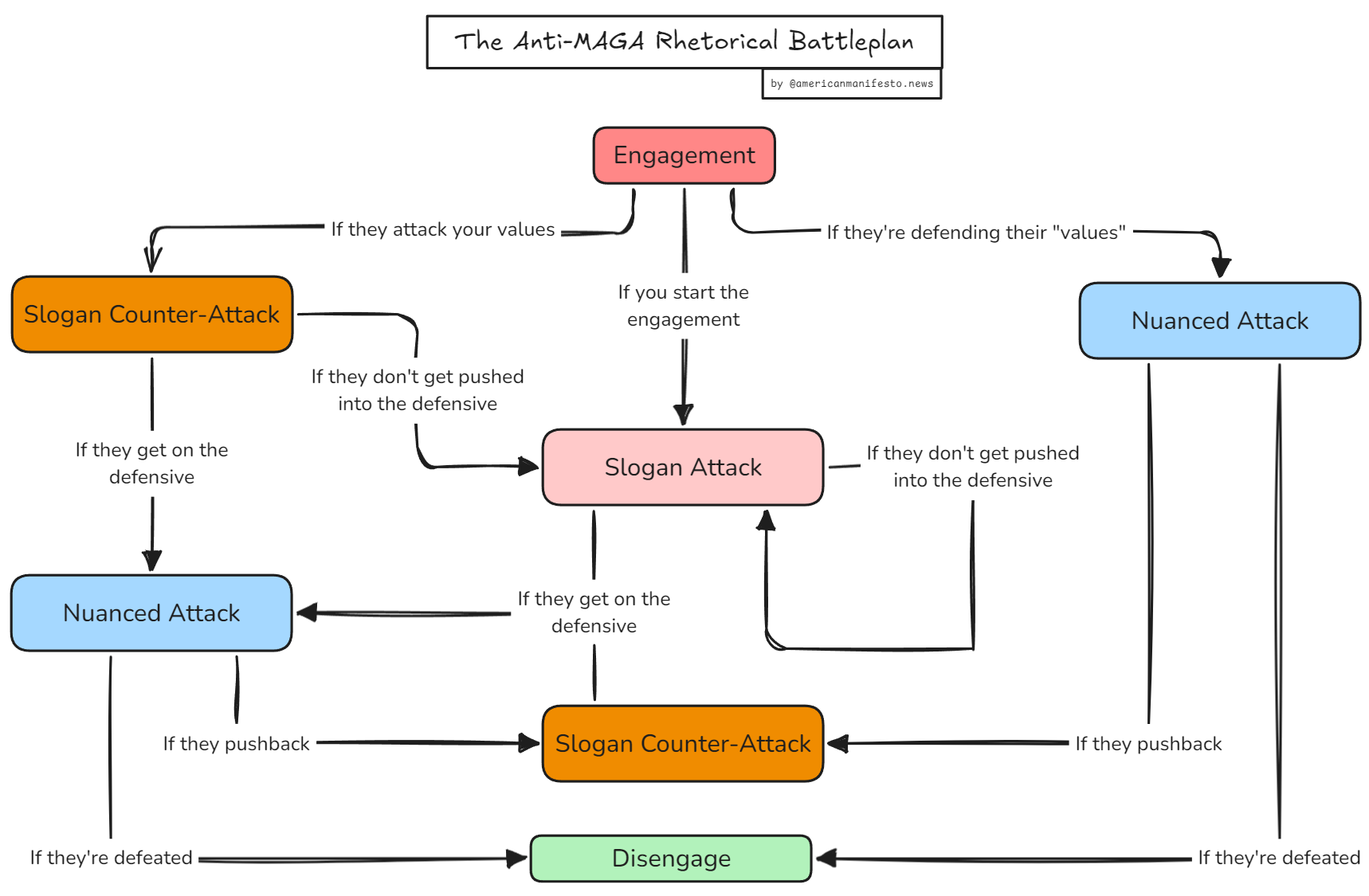
The Core Principle: Defense Doesn’t Exist
Look at the battleplan diagram. Count the nodes. There are five: Engagement, Slogan Attack, Slogan Counter-Attack, Nuanced Attack, and Disengage. Notice what’s missing — there is no “Defense” node. That’s not an oversight. It’s the thesis.
The moment you defend, you’ve accepted their framing. You’re now operating inside their narrative, playing by their rules, on their terrain. Even if you execute a flawless rebuttal, all you get is a tie — and in politics, a tie is a loss. The side that’s explaining is losing. So we don’t explain. We don’t defend. Every move in this framework is an attack — even the reactive ones.
This is the operational version of the principle laid out in “Fighting Fascism”: Never Play Defense. The Rhetorical Battleplan takes that principle and turns it into a decision tree you can execute in real time. Every branch leads to an attack. Every outcome is either “they’re on the defensive” or “disengage.” There is no path that leads to you defending your own values, because the moment that happens, you’ve already lost the exchange.
Engagement: Reading the Room
Every rhetorical encounter starts with Engagement — the moment of contact. Before you say a word, you need to read the situation. Three scenarios determine your opening move:
Scenario 1: You start the engagement. You chose to bring this up. You have the initiative. You pick the topic, you pick the framing, you set the terms. Your opening move is the Slogan Attack — you’re on offense from the first word.
Scenario 2: They attack your values. They came at you. They’re challenging something you believe in — maybe they’re mocking progressive values, maybe they’re repeating a Fox News talking point about your side. Your opening move is the Slogan Counter-Attack — you don’t defend the thing they’re attacking. You redirect to where they’re vulnerable on the same value.
Scenario 3: They’re defending their “values.” They’re not attacking you — they’re puffing up about something they claim to stand for. “We’re the party of law and order.” “We protect the children.” “We fight for the working man.” Your opening move is the Nuanced Attack — they’ve exposed a position, and you have the receipts to demolish it.
The key skill here is pattern recognition. Don’t react emotionally. Read the board. Identify which of the three scenarios you’re in, and deploy the correct opening.
Tone: Know Who You’re Talking To
The battleplan’s five moves don’t change based on your opponent. The tone does. And getting the tone wrong can turn a winning move into a backfire. There are two kinds of opponents, and they require opposite emotional registers.
Against Acolytes and True Believers
Acolytes are deep in MAGA. They’re not confused — they’re committed. They parrot the talking points with conviction. They may be influencers, media figures, or just someone who’s made MAGA a core part of their identity. You’re not going to deprogram them in a single conversation, and that’s not the goal.
With acolytes, your tone is assertive and accusatory. You’re not inviting them to reconsider — you’re cornering them. The goal is to force them into a lose-lose: either they defend the indefensible (protecting pedophiles, pardoning drug lords, gutting children’s healthcare), or they denounce it — which would be enormously costly to their position. Either outcome damages their credibility with anyone watching.
This is especially powerful when there’s an audience. Against an acolyte in a private conversation, you’re sharpening your skills. Against an acolyte in front of others, you’re performing a demolition that the audience will remember.
Against Followers
Followers are a completely different situation. These are people who got swept up — often for legitimate reasons. They were angry about real problems (lost jobs, rising costs, a system that failed them), and MAGA gave them a narrative that felt like it explained everything. They’re not your enemy. They’re people who were betrayed by a movement that exploited their pain.
With followers, your tone is empathetic and sympathetic. You’re not cornering them — you’re approaching them as someone who shares their values. You’re an ally within that value realm, not an adversary. The goal is not to force them on the defensive. The goal is to stand beside them on the shared value, show them where their own side is failing that value catastrophically, and let the question form in their own mind: “How come my side is failing on these massive things within this value while obsessing over these much smaller ones?”
You don’t need to answer that question for them. You just need to make it impossible to avoid asking it.
The Difference in Practice
The tactical moves are identical — same counter-attack, same redirect, same evidence. But the delivery changes everything:
Acolyte tone: “If you cared about protecting kids, you’d be going after the hundreds of pedophile pastors in the SBC. You’re not. Because you don’t actually care about kids — you care about control.”
Follower tone: “I know you care about protecting kids — I do too. That’s actually why I’m so troubled by what came out of the SBC. Hundreds of confirmed cases, kids actually hurt, and nobody on that side has done anything about it. That bothers me. Doesn’t it bother you?”
Same facts. Same redirect. Same value realm. But the acolyte hears an accusation they can’t escape, and the follower hears a fellow human who shares their concern and is genuinely troubled. One is a weapon. The other is an invitation to doubt.
Read your opponent before you speak. Get this wrong, and a follower who could have been reached will shut down because you came at them like they were an acolyte. Get it right, and you’ll either demolish an acolyte’s credibility or plant a seed of doubt in a follower that grows long after the conversation ends.
Slogan Attack: Choosing the Battlefield
The Slogan Attack is your default opening when you initiate the engagement. It’s short, punchy, and designed to do one thing: put them on the defensive.
You’re not making a detailed argument. You’re not presenting evidence. You’re delivering a concise, emotionally resonant strike that forces them to respond to your framing. You choose the battlefield, you choose the topic, and you set the terms.
A good slogan attack has three properties:
It’s short. One or two sentences. If you need a paragraph, it’s not a slogan.
It’s specific. It names a name, cites a fact, or points to a concrete betrayal. Not “Republicans are hypocrites” — that’s vague. “Trump pardoned a drug lord who trafficked 400 tons of cocaine for El Chapo” — that’s a slogan attack.
It demands a response. It puts something on the table they can’t ignore. They now have to explain, deflect, or go silent — all of which mean you’re winning.
The goal of the slogan attack is not to persuade in this moment. The goal is to crack their confidence and put them on the defensive. Once they’re there, you transition to the Nuanced Attack where the real persuasion happens.
If the slogan attack doesn’t push them into the defensive — if they shrug it off or pivot — don’t panic. Stay at the slogan level. Try a different angle. You have an arsenal of ammunition; use another round.
Slogan Counter-Attack: Rhetorical Judo
The Slogan Counter-Attack is the most elegant move in the framework. It’s what you deploy when they come at you — when they attack your values or raise a topic designed to put you on the defensive. The instinct is to defend. Resist it.
Instead, you do something far more devastating: you accept their value premise and redirect it to where they’re catastrophically vulnerable.
This is rhetorical judo. You use their momentum against them. They chose the value realm — you stay in it. But instead of defending your position in that realm, you pivot to their worst failure in the same realm. And then you set a gate: their problem is orders of magnitude worse than yours, and until they can address it, you’re not engaging on their terms.
Example: “Protect the Children”
They attack: “What about transgender kids? Don’t you care about protecting children from these radical treatments?”
Don’t defend. Don’t explain how transgender medical care works. Don’t cite studies. The moment you do, you’ve validated the premise that there’s something dangerous to defend against.
Counter-attack — against an acolyte: “We absolutely agree — protecting children is everything. So let’s talk about protecting children. The Southern Baptist Convention has hundreds of confirmed pedophile pastors. The denomination hid a secret list of predators for years. Where’s the GOP outrage? Where are the investigations? Zero.” This is particularly devastating if your opponent is religious — the SBC angle is a double strike that hits both their political and spiritual identity. Force them to defend it or denounce it. Either costs them.
If the Epstein angle hits harder: “The GOP is running a protection racket to shield powerful people in the Epstein circle — people the FBI says have thousands of victims. Actual children, actually abused. When your side solves that problem, we can talk about whatever else you want.”
Counter-attack — against a follower: “I know you care about protecting kids — honestly, that’s one of the things I respect about you. That’s actually why something has really been bothering me. Did you see what came out of the Southern Baptist Convention? Hundreds of confirmed cases of pastors abusing children, and the denomination covered it up for years. And the party that says it protects kids hasn’t done anything about it. I don’t understand that. Do you?” You’re not attacking them. You’re standing next to them on shared ground and pointing at something that doesn’t add up. The question isn’t an accusation — it’s an invitation to think.
The gate: Transgender medical care involves a tiny portion of the population making decisions with doctors and psychologists. The SBC scandal and Epstein files involve actual pedophiles actually abusing children at massive scale. One of these problems is incomparably worse than the other. Until they can address the real crisis, you refuse to engage on the manufactured one. With an acolyte, you state the gate explicitly as a demand. With a follower, the gate forms naturally — once they see the scale of the real problem, the manufactured one starts to feel hollow on its own.
The counter-attack works because you never rejected their value. You embraced it. You said “yes, protecting children matters — and here’s where your side is failing children catastrophically.” They’re now defending their own record instead of attacking yours. That’s the entire game.
If they don’t get pushed into the defensive — if they try to dismiss and pivot back — escalate to a Slogan Attack on a new topic. Don’t let them escape.
Nuanced Attack: Bringing the Receipts
The Nuanced Attack is where persuasion actually happens. But it only works once they’re on the defensive.
This is critical to understand: nuance bounces off someone who’s in attack mode. If they’re confident and aggressive, a detailed argument will wash over them. They’ll interrupt, dismiss, or pivot. But once they’re rattled — once a slogan attack or counter-attack has cracked their confidence — that’s when the specifics land.
The Nuanced Attack is where you deploy:
Evidence. Specific numbers, dates, names. Not “the economy was bad” — “they cut $880 billion from Medicaid while giving billionaires a $1 trillion tax cut.”
Narrative. Connect the dots into a story of betrayal. Not a list of facts — a sequence that shows how they were used.
The question they can’t answer. After laying out the evidence, ask the question that has no good answer. “If they’re the party of law and order, why did they pardon people who beat police officers with flagpoles?”
The nuanced attack has a natural endpoint. Either they’re defeated — they go quiet, they change the subject, they concede ground — or they push back. If they push back, don’t try to win at the nuanced level. Cycle back to a Slogan Counter-Attack. Reset their defensive posture with a punchy strike, then go nuanced again once they’re back on their heels.
This oscillation — slogan to crack the defense, nuance to land the blow, slogan again if they recover — is the heartbeat of the entire framework.
The Oscillation: Slogan, Nuance, Slogan
The battleplan is not a linear process. It’s a cycle. The pattern looks like this:
Slogan → They get defensive → Nuanced Attack → They push back → Slogan Counter-Attack → They get defensive again → Nuanced Attack → They’re defeated → Disengage.
Think of it as a rhythm: jab, cross, jab, cross. The slogan is the jab — fast, disorienting, designed to open the guard. The nuanced attack is the cross — the power shot that does real damage. If the cross doesn’t land clean, throw another jab to open the guard again.
The key to the oscillation is reading your opponent’s state:
They’re confident and attacking → Stay at slogan level. Crack that confidence first.
They’re rattled and defensive → Go nuanced. This is your window to land real arguments.
They’re recovering and pushing back → Return to slogans. Don’t let them regain their footing.
They’re defeated → Disengage. Don’t give them a chance to recover.
The mistake most people make is going nuanced too early — trying to have the “real conversation” before the other person is in a state to hear it. The slogans aren’t beneath you. They’re the tool that makes everything else possible.
Disengage: Walk Away With the Win
Disengage is the exit. When they’re defeated — when they’ve gone quiet, when they’ve started repeating themselves, when they’ve resorted to personal attacks because they have nothing substantive left — that’s your cue to leave.
Don’t linger. Don’t gloat. Don’t try to land one more point. Every moment you stay past the victory is a moment where you might say something that gives them a foothold to recover. You’ve made your point. The seed is planted. Walk away and let it grow.
Disengagement also applies if the exchange is going nowhere — if you’re dealing with someone who’s genuinely unreachable in that moment. Not everyone can be moved in every conversation. Recognize when you’ve hit a wall, preserve your energy, and disengage cleanly. You can always re-engage another day.
The goal was never to win an argument. The goal was to plant doubt, expose betrayal, and create an opening. Once that’s done, leave. The most powerful thing you can do after making an unanswerable point is walk away in silence.
Now you have the decision tree. But a framework without ammunition is just a diagram on a wall. You need the slogan attacks, the counter-attacks, the nuanced evidence, and the deprogramming tactics to load into every node. That’s what we built. See the links below.
If this framework matters to you, please consider becoming a paid subscriber. You keep the fight alive.
Fighting Fascism: How We Charge Ahead and Win — The strategic playbook that this battleplan operationalizes
The Trump Regime Messaging Guide — The ammunition: every slogan, counter-attack, and deprogramming tactic you need to load into the framework
The Freedom Illusion — How we got here, and the counter-ideology that gets us out
THIS !!!!!!!!!! I always meet them where THEY are ! You want to talk about Jesus and the Bible ? You got it ! Wanna talk about the constitution? I’m there ! Let’s do this
Thanks! I hope everyone remembers to hit the "like" button on this...& every other post you make.