


While others stenograph, grift, or chase the next distraction—this is the news that matters and how it’s connected.
New important information published since this article appeared is available here
Last week, the FBI and DHS stopped cooperating with local authorities investigating the killing of Renee Good.1 State officials say the FBI is actively blocking evidence.2 The question is why.
Pieces of this story have been reported elsewhere—the video of the shooting, Ross’s MAGA background, the physician turned away at the scene. But no one has connected them. No one has asked why DHS is so desperate to bury this case that the FBI reversed course on a joint investigation within days.
We did.
We synced three bystander videos frame by frame to reconstruct exactly what happened between the moment Ross fired and when first responders finally arrived—approximately seven minutes later. The timeline reveals something no single video shows: not just a physician on scene, begging to help, told "I don't care"—but every agent then walking away, leaving Renee Good alone for nearly three minutes. No CPR. No pressure on wounds. Nothing. The evidence doesn't just implicate Ross. It potentially implicates every agent at the scene.
Add to it a thirteen-year-old federal report that might shed light on the shooting—one that ties directly to Ross’s past.
The official story will be that Ross panicked and violated his training. The evidence suggests he followed a playbook—one DHS tried to bury thirteen years ago.
The Playbook They Tried to Bury
In 2013, the Police Executive Research Forum completed a review of 67 deadly force incidents at Customs and Border Protection between 2010 and 2012.3 What they found was damning: CBP agents were “intentionally putting themselves into the exit path of vehicles, thereby exposing themselves to additional risk and creating justification for the use of deadly force.”
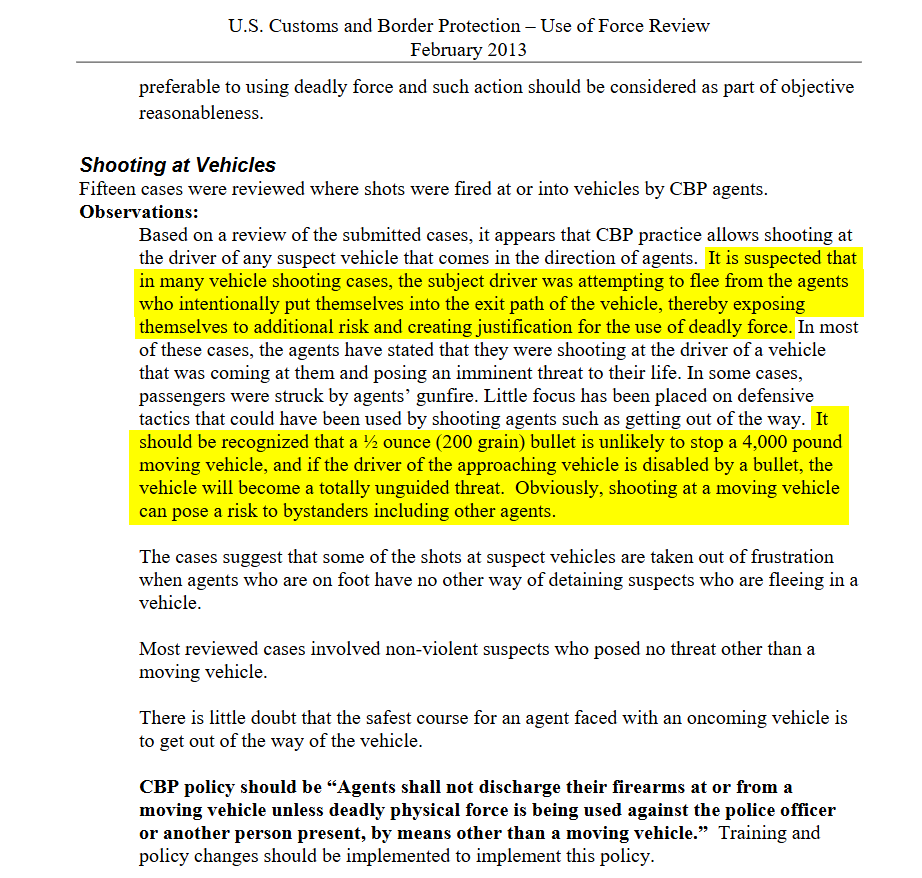
Read that again. Agents were deliberately stepping in front of cars so they could claim self-defense when they shot the drivers.
CBP tried to suppress the report. The ACLU sued. In May 2014, CBP was forced to release it. One month earlier—March 2014—CBP Chief Michael Fisher had already issued a directive explicitly banning this behavior: “Agents should not place themselves in the path of a moving vehicle.”4
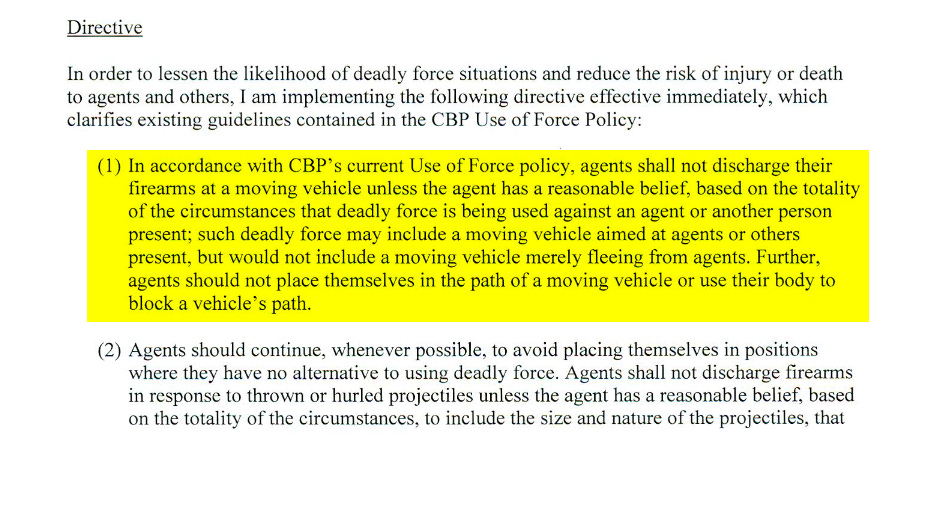
Here’s what no one has connected: Jonathan Ross was at Border Patrol during the entire 2010-2012 period when this behavior was documented. We’re not claiming Ross personally engaged in this practice at the time. But he was at the agency when it was happening. He was there when CBP tried to bury the report. He was there when the directive banned the practice. He didn’t just learn the rule against stepping in front of vehicles—he was at the agency at a time this “culture” of stepping in front of vehicles to justify deadly force was so prevalent that it led to the investigation that put the policy in the books.
The Training He Can’t Claim He Missed
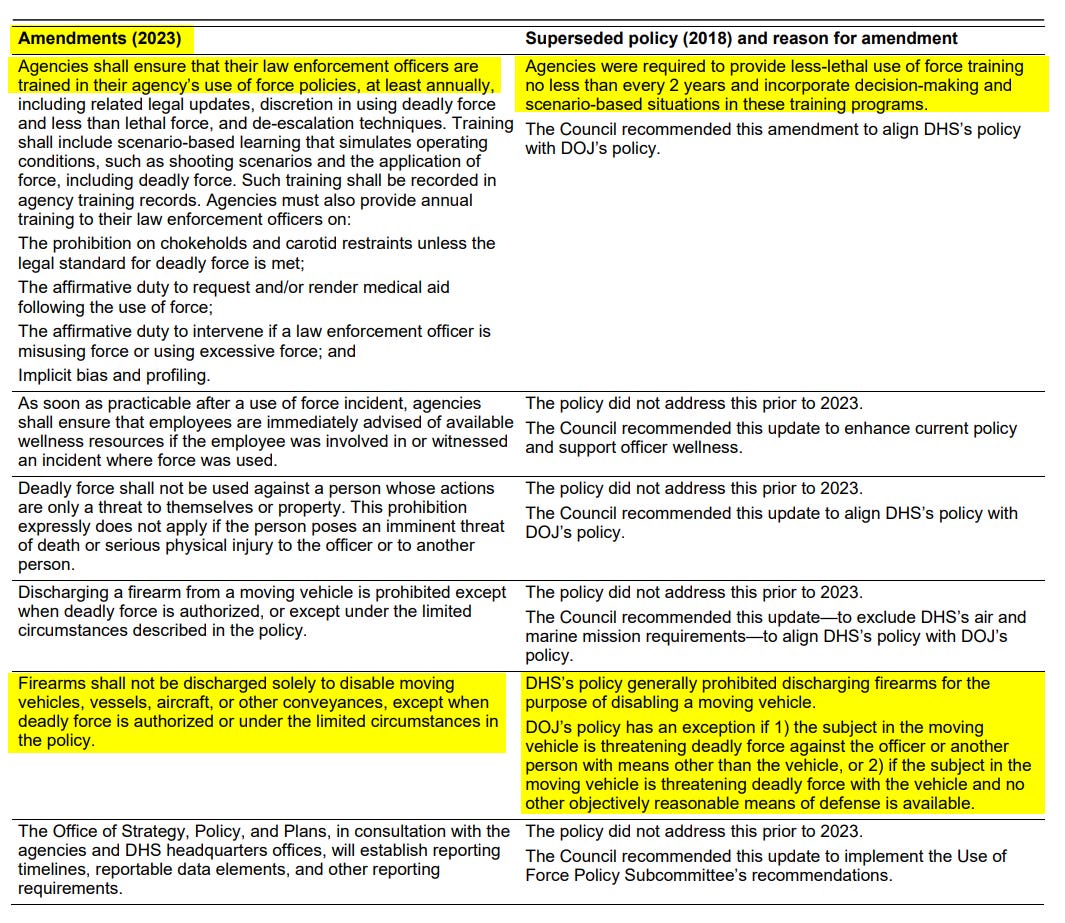
Assuming DHS followed its own protocols, Ross was trained on this prohibition at least seven times.
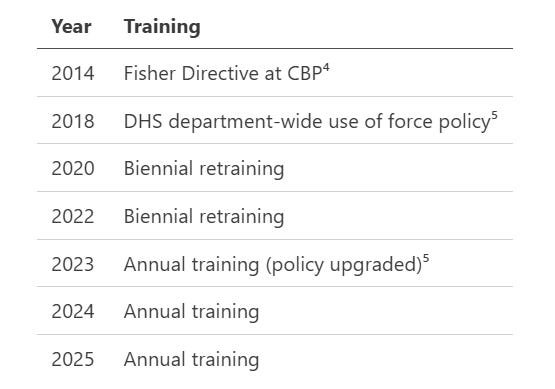
The 2018 DHS policy5, which followed directly from the 2014 CBP Fisher Directive, allowed shooting at a moving vehicle in only two scenarios:
If the driver is threatening deadly force with a weapon other than the vehicle, or
If they're using the vehicle as a weapon and no other reasonable means of defense is available.6 Stepping out of the way IS a reasonable means of defense.
Bystander video7 shows Ross had time to stop, keep recording, unholster his weapon, aim, and fire. Looking at the tree in the background behind Ross you will see he is not moving for the duration of the video below (53 frames at 30 frames/second = 1.77 seconds). Below are the exact 53 frames from the moment when Ross becomes stationary and fires the first shot.
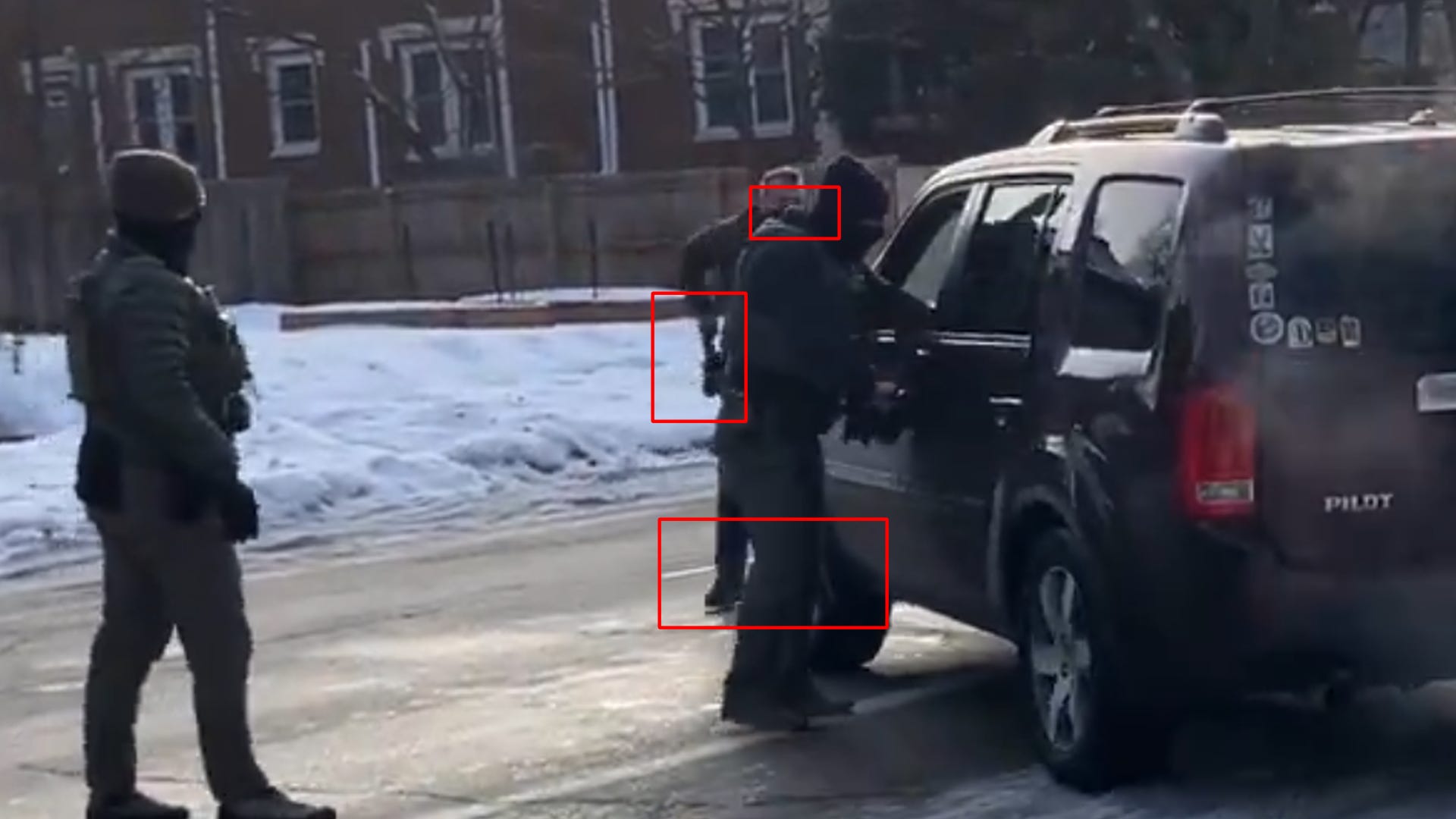
He could’ve simply continued walking instead of stopping to pull his gun, or stepped out of the way instead of aiming.
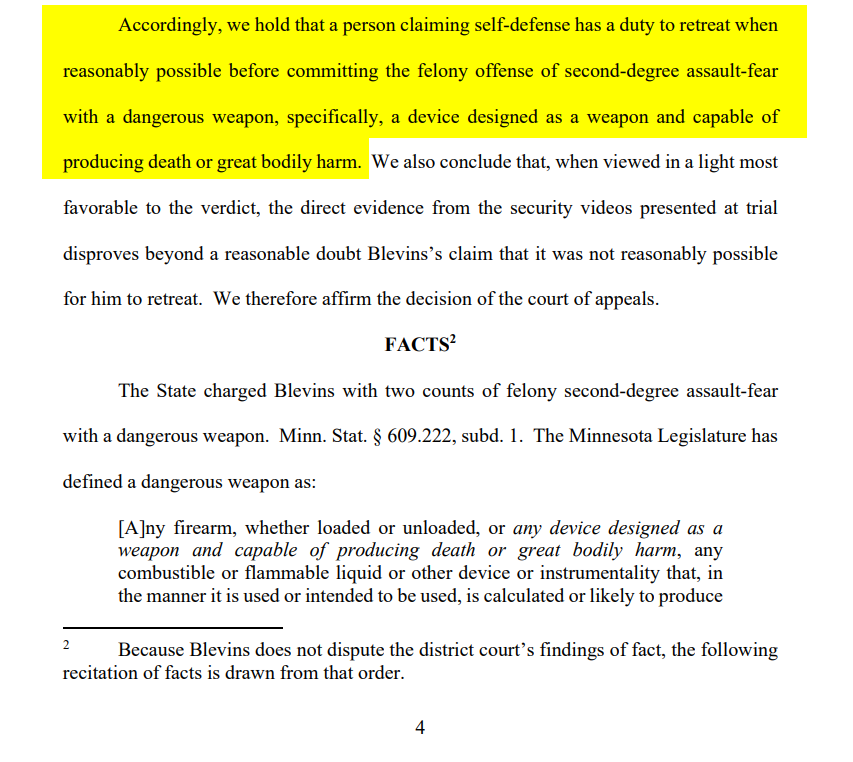
Additionally, under Minnesota law—specifically State v. Blevins8 (2024)—that means self-defense doesn’t apply. The state requires retreat “when reasonably possible” before using deadly force.
And Good? The video shows her doing a two-point turn (see full videos below)—backing up, then pulling forward. If she were trying to use the vehicle as a weapon, why back up first? Why give Ross more time to step away? She was trying to leave. He was preparing to shoot.
Ross violated his training when he stepped in front of the vehicle. He violated it again when he shot instead of stepping away. And under Minnesota’s State v. Blevins⁷—which requires retreat “when reasonably possible”—he gave up any claim to self-defense the moment he chose his gun over his feet.
They Let Her Bleed
By syncing multiple bystander videos (all 3 full videos will be at the end of the article with their sync events),91011 we can reconstruct exactly what happened between the shooting and when first responders arrived.
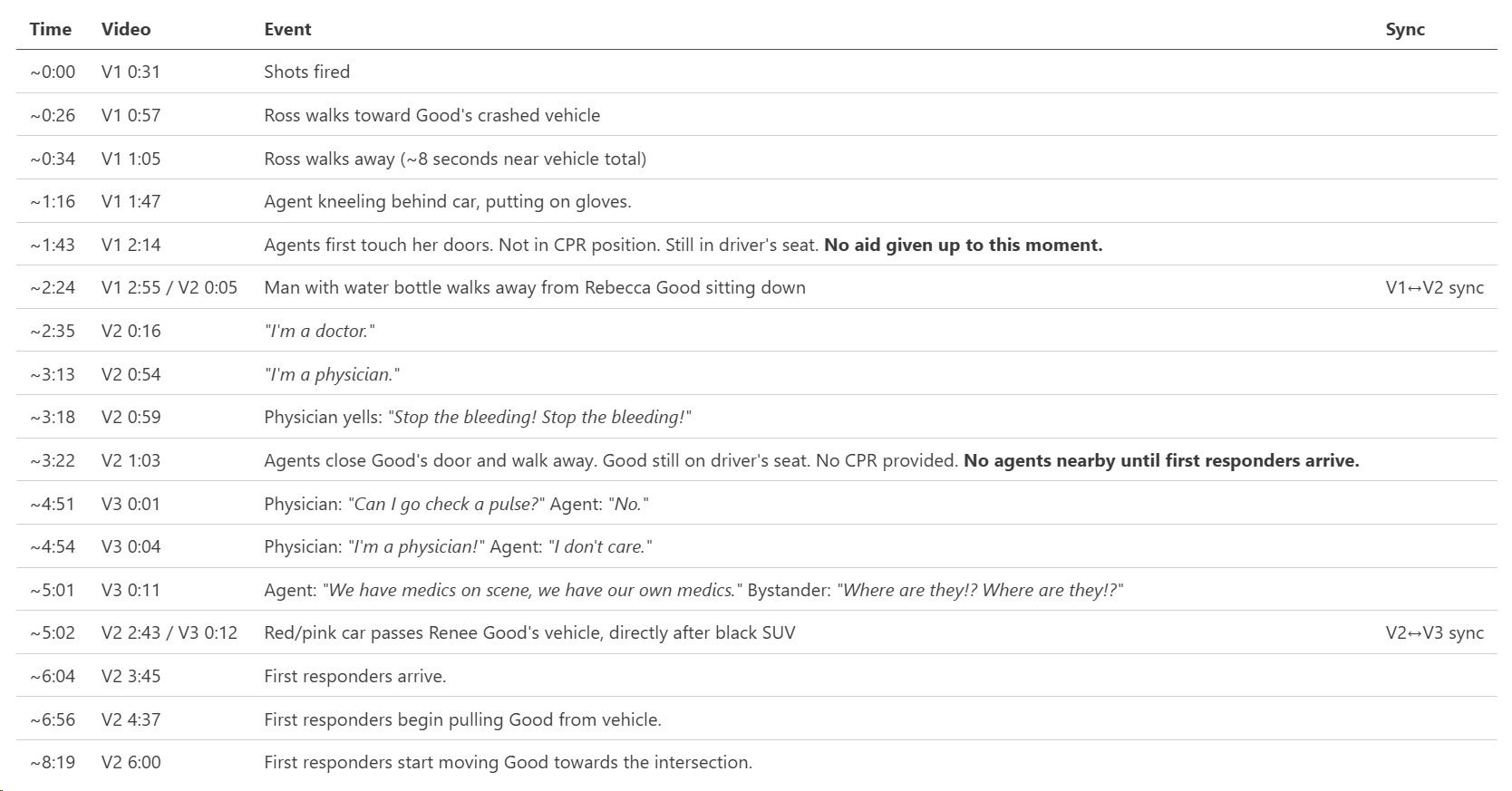
ABC News independently reconstructed a minute-by-minute timeline of the shooting.12 Their timestamps validate ours:
Physician denied: ABC says 9:42:03 a.m. (4:50 after gunfire)—we have ~4:51
First responders arrive: ABC says 9:43:14 a.m. (6:01 after gunfire)—we have ~6:04
Good carried to intersection: ABC says 9:45:30 a.m. (8:17 after gunfire)—we have ~8:19
Our timelines match within seconds.
Ross had the opportunity to begin providing aid approximately 30 seconds after the shooting. He chose to walk away and leave the scene.
No ICE agent begins to provide aid until ~1:43 after the shooting. No CPR is attempted. At most, there appears to be one agent next to the vehicle checking on her—at best, maybe applying pressure to wounds. She’s still in the driver’s seat.
At ~2:35, a doctor on scene announces himself (Can be heard on Video 2). Agents choose not to bring him to aid. At ~3:13, the physician insists again—“I’m a physician”—and immediately begins yelling instructions: “Stop the bleeding! Stop the bleeding!”
Seconds later, all agents walk away—completely ignoring the physician’s instructions. From ~3:22 until first responders arrive at ~6:04—two minutes and forty-two seconds—nobody is near Renee Good. A physician is on scene. They refuse to allow him to help.
At ~4:51, the physician tries one last time: “Can I go check a pulse?” The agent’s response: “No.” Three seconds later, the physician insists: “I’m a physician!” The reply: “I don’t care.” When the agent claims they have their own medics, a bystander screams back: “Where are they!? Where are they!?”
When first responders finally arrive, they pull Good from her vehicle and carry her to the intersection—where they attempt CPR. That matters. Why would first responders spend several minutes performing CPR and attempting to provide aid if she was beyond saving? Why did the agents not provide the same kind of aid—or allow a physician to assist? Did they have someone on scene medically qualified to pronounce death? And if so, why would they not have closed the scene and prevented first responders from attempting aid?
These questions have since been answered in our updated reporting here
Why DHS Wants This Buried
Start with Ross. DHS can’t hide behind a “training failure” defense—because Ross may be the best trained person in the entire agency on this specific policy. He’s a firearms instructor. He spent eight years at the very agency whose misconduct created these policies. He didn’t just learn the rule against stepping in front of vehicles—he was at CBP when they learned why the rule was needed.
Now add motive. Neighbors describe Ross as a “hardcore MAGA supporter.”13 Until recently, he flew Trump flags and a Gadsden flag outside his home. In 2020, after Trump’s infamous “stand back and stand by” moment, Ross got into a Facebook argument with his own sister about the Proud Boys—comments he later deleted.
Renee Good wasn’t just any bystander. She was a 43-year-old Minnesota woman who showed up that day to observe and document—a citizen exercising her constitutional rights. Her last words to Jonathan Ross: “That’s fine dude. I’m not mad at you.” To a true believer, she wasn’t a person—she was the enemy. That’s not panic. That’s motive.
And the cover-up is already underway. On Friday, ICE sent a masked Special Response Team—their own tactical unit, identifiable by SRT patches on their vests—to Ross’s empty home.¹³ Agents in balaclavas removed five crates of belongings and a computer tower.


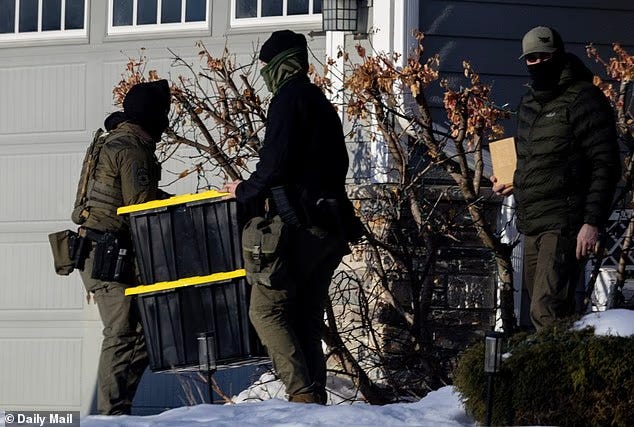
Here’s the problem: The FBI initially agreed to a joint investigation with Minnesota’s Bureau of Criminal Apprehension. Then they reversed course and claimed exclusive jurisdiction—blocking state investigators from accessing “case materials, scene evidence or investigative interviews.”² If the FBI has taken sole custody of this investigation, why was ICE—not the FBI—at Ross’s home removing evidence? ICE doesn’t investigate potential crimes—they enforce immigration law. Are there illegal aliens in Ross’ home? That wasn’t an FBI evidence team. It was ICE cleaning up after their own.
A full investigation doesn’t just expose Ross. It exposes a culture. Ross pulled the trigger—but the other agents closed her door, walked away, denied a physician, and potentially lied about having medics on scene. That’s not one rogue officer. That’s a team. What training produced agents who tell a doctor “I don’t care” while a woman bleeds out? What culture treats protesters as enemies unworthy of basic medical aid? How many agents across DHS share these attitudes—and how many know the playbook Ross used?
By the way—someone should file a FOIA request on those 67 deadly force incidents behind the PERF report. Could it be that Ross has done this before and helped inspire the policy?
There's more below, but first: DHS is blocking this investigation because they know what a full accounting would reveal. The mainstream press will move on. We won't. If you believe someone needs to keep connecting these dots—and holding this regime accountable when no one else will—consider supporting The American Manifesto. Paid subscriptions make this fight possible.
The Pattern
We’ve been mapping this administration against the fascism syndrome—ten indicators that a democracy is backsliding into fascism:
Capture of the state and elimination of accountability: The FBI blocking evidence. DHS refusing to cooperate with local investigators. Federal agencies protecting their own instead of pursuing justice.
Weaponized justice: Ross remains on administrative duty while the victim’s family waits. The investigation is obstructed while the administration attacks state officials for daring to investigate.
Erosion of due process: A woman is dead. The man who killed her violated policies he was trained on at least seven times. And the federal government’s response is to block the investigation.
“That’s fine dude. I’m not mad at you.” Those were Renee Good’s last words to Jonathan Ross. Moments later, he shot her. “Fucking bitch.”
If you want to understand how we got here—and what comes next—start here:

Your Move
This story connects dots no one else has connected—yet. Help us push it further:
Have you seen the PERF report referenced anywhere else in coverage of this shooting?
If you’re a journalist or researcher with FOIA experience, what would you request?
What other questions should investigators be asking about Ross’s time at CBP?
Have you spotted other evidence in the videos that we should examine?
No requests for comment were made to DHS or the FBI. If they have no interest in cooperating with the investigation, I have no interest in what they have to say.
Videos and Sync
⚠️ Content Warning: The video sources cited below contain graphic footage of a fatal shooting and its aftermath. These videos have not been edited or altered in any way—readers can compare them directly to the original sources linked.
Video 1:
Video 1 ↔ 2 Sync:
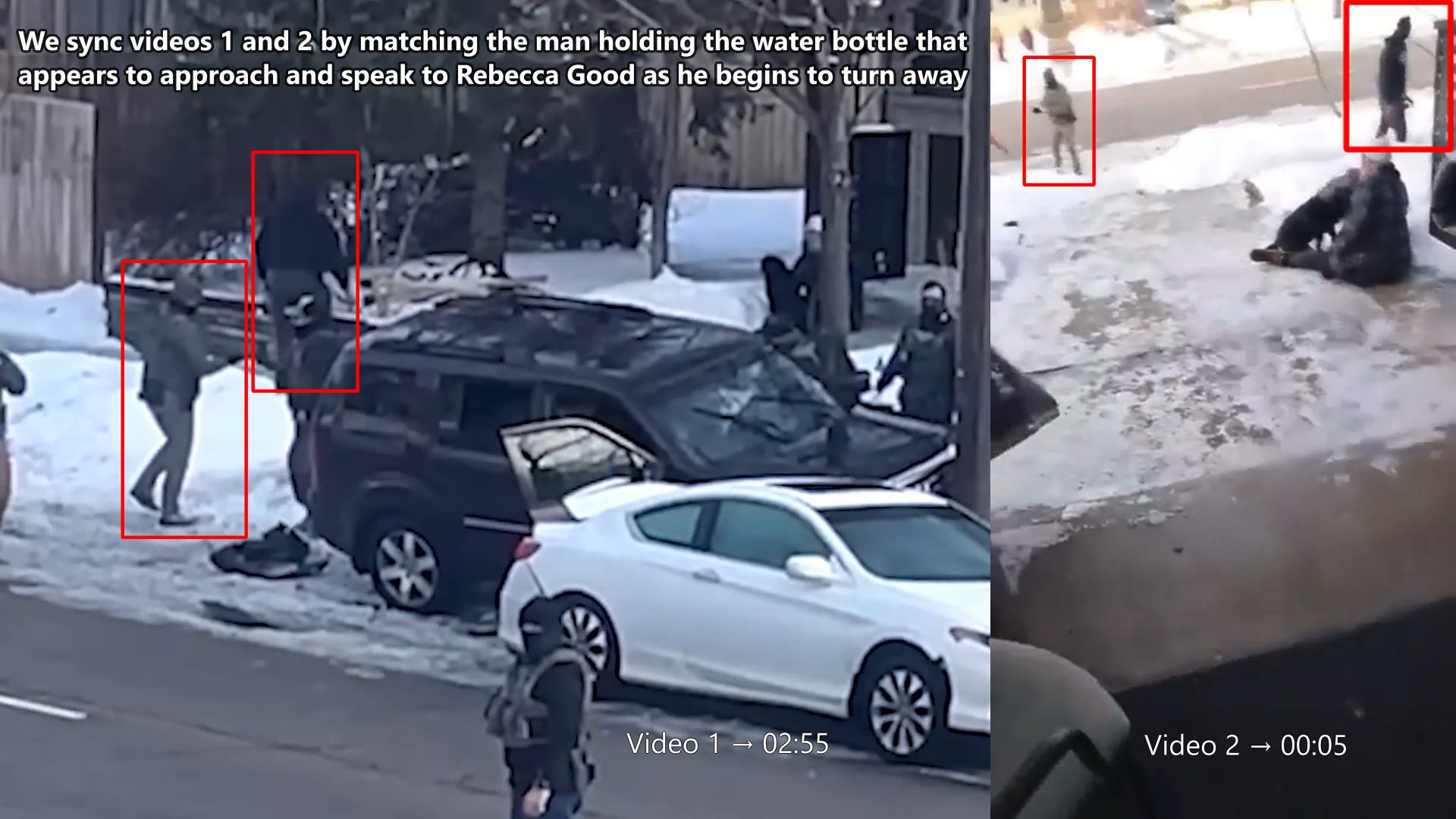
Video 2:
Video 2 ↔ 3 Sync:
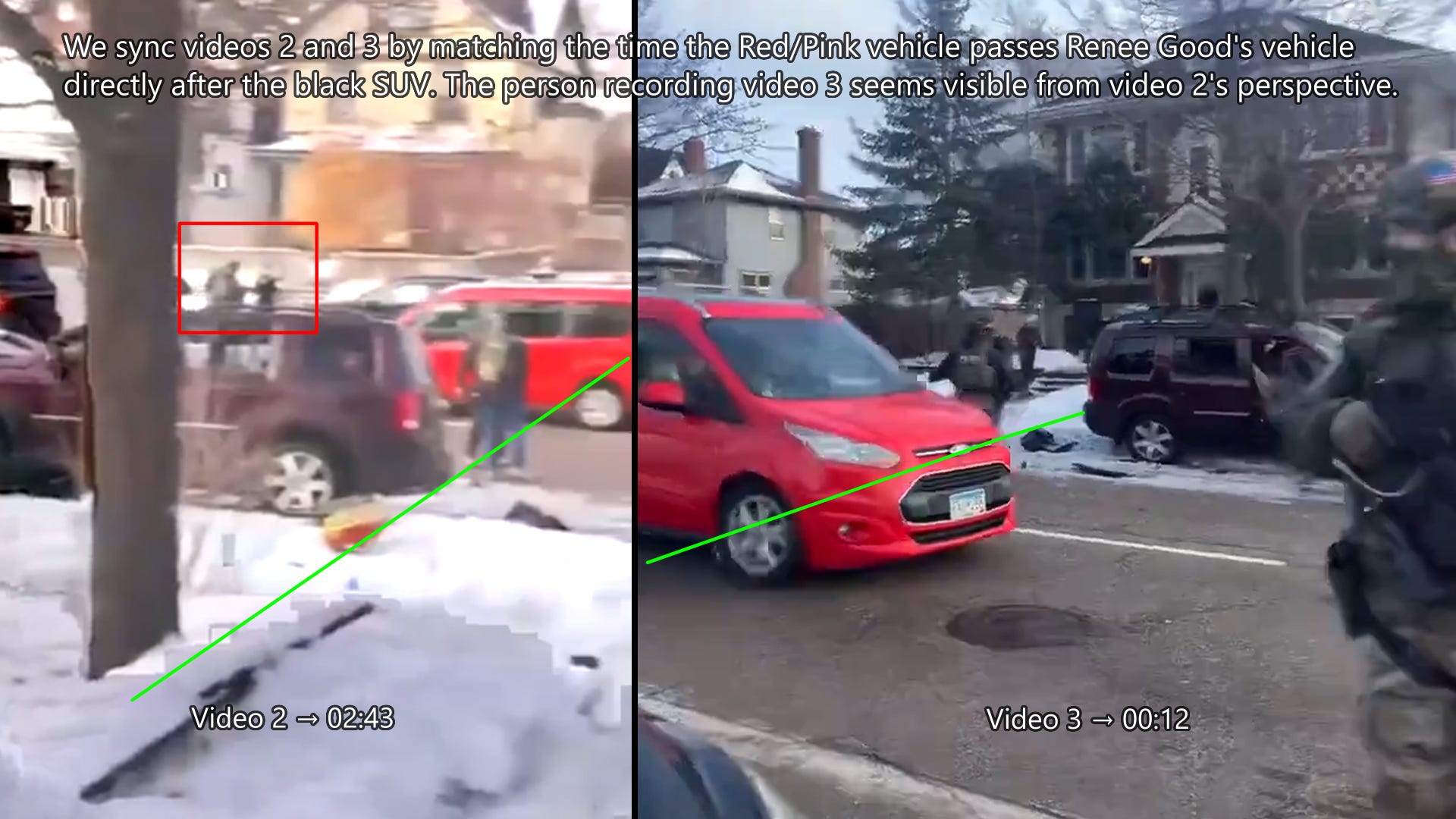
Video 3:
There’s more below, but first: DHS is blocking this investigation because they know what a full accounting would reveal. The mainstream press will move on. We won’t. If you believe someone needs to keep connecting these dots—and holding this regime accountable when no one else will—consider supporting The American Manifesto. Paid subscriptions make this fight possible.
Dan Mangan, “ICE shooting: State officials say FBI is blocking evidence in Minneapolis investigation“, CNBC, January 8, 2026.
Documents the FBI’s reversal on cooperating with Minnesota investigators. BCA Superintendent Drew Evans states the FBI initially agreed to a joint investigation, then “reversed course” at the direction of the U.S. Attorney’s Office—blocking state access to “case materials, scene evidence or investigative interviews.” Critical for understanding the chain of custody concerns when ICE’s Special Response Team later removed evidence from Ross’s home.
Police Executive Research Forum, “CBP Use of Force Review: Cases and Policies“, CBP, February 2013.
The suppressed report documenting 67 deadly force incidents at CBP from 2010-2012. Contains the key finding that agents were “intentionally putting themselves into the exit path of vehicles... creating justification for the use of deadly force.” Ross was at Border Patrol during this entire period.
We synced three bystander videos frame by frame to reconstruct exactly what happened between the moment Ross fired and when first responders finally arrived—over seven minutes later. The timeline reveals something no single video shows: not just the physician on scene, begging to help, told “I don’t care” but agents who then walked away and left Renee Good alone for nearly three minutes. No CPR. No pressure on wounds. Nothing. The evidence doesn’t just implicate Ross. It potentially implicates every agent at the scene.
And we found a thirteen-year-old federal report that might shed light on the shooting—one that ties directly to Ross’s past.
U.S. Government Accountability Office, “DHS Should Strengthen Use of Force Data Collection and Analysis“, GAO, July 24, 2023.
Documents the evolution of DHS use of force policy from 2018 to 2023, including mandatory training requirements. Establishes that Ross would have received training in 2018, 2020, 2022 (biennial), then 2023, 2024, 2025 (annual after 2023 upgrade).
Ryan Goodman, “DHS, DOJ and Customs & Border Patrol Policies: Use of Deadly Force and Moving Vehicles“, Just Security, January 11, 2026.
Comprehensive compilation of all relevant federal policies on use of force against moving vehicles. Documents that the 2018 DHS policy already prohibited shooting at vehicles when “other objectively reasonable means of defense” were available—including stepping out of the way.
Max Nesterak, “Video post“, X, January 2026.
The viral video with over 10 million views that was broadcast across major news networks. Bystander footage from the rear left of Good’s vehicle capturing the shooting itself. Shows Ross’s legs were to the side of the SUV—not in its path—as he fired.
Minnesota Supreme Court, State v. Blevins, A22-0432, July 31, 2024.
Landmark ruling establishing Minnesota’s duty to retreat. The court held: “a person claiming self-defense has a duty to retreat when reasonably possible.” The video evidence showing Ross had time to unholster, aim, and fire demonstrates he had time to retreat—meaning self-defense does not apply under Minnesota law.
“Dramatically undershared video of immediate aftermath“, Reddit, January 2026.
Bystander video capturing the immediate aftermath of the shooting, including the physician’s attempts to offer aid and the agents’ responses. Yes, this is a video posted to Reddit—I have not been able to track down the original source. However, multiple features throughout the video match other verified footage of the scene, and there is no indication it has been altered or fabricated.
New York Post, “New Eyewitness Video Captures Chaos After ICE Agent Kills Renee Good“, YouTube, January 13, 2026.
Bystander video showing the immediate aftermath of the shooting, used to establish the timeline of events and sync with other footage. Captures Ross walking toward and away from Good’s vehicle, agents putting on gloves, and the initial response before the physician’s arrival.
@Partisan_12, “Video post“, X, January 2026.
Bystander video used to confirm the physician denial sequence and cross-reference events visible in other footage. This footage matches the clip broadcast by Erin Burnett OutFront (CNN) on Instagram.
“Minneapolis ICE shooting: A minute-by-minute timeline of Renee Nicole Good’s death“, ABC News, January 2026.
Independent minute-by-minute timeline that validates our video synchronization. ABC places gunfire at 9:37:13 a.m. and Good being carried to the intersection at 9:45:30 a.m.—8 minutes 17 seconds later. Our synced video analysis places the same event at ~8:19, a difference of only 2 seconds. ABC confirms CPR was administered at the corner of Portland Avenue and 34th Street after Good was moved from the vehicle.
Ben Ashford, “Gun-toting feds in ski masks swarm the ICE agent shooter’s home to retrieve belongings as the house sits empty amid claims he has gone into hiding“, Daily Mail, January 9, 2026.
Exclusive report documenting ICE’s Special Response Team removing belongings from Ross’s home two days after the shooting. Neighbors describe Ross as a “hardcore MAGA supporter” who flew Trump and Gadsden flags. The article details Ross’s 2020 Facebook argument with his sister about the Proud Boys, and captures agents in balaclavas intimidating journalists while removing five crates, a computer tower, and personal items—raising serious chain of custody concerns about ICE handling evidence in their own officer’s case.
Thanks for the in-depth reporting which makes everything fall into place. Remember, we got this Congress because no one was paying attention. Never again.
Have you shared all sources with the MN AG?